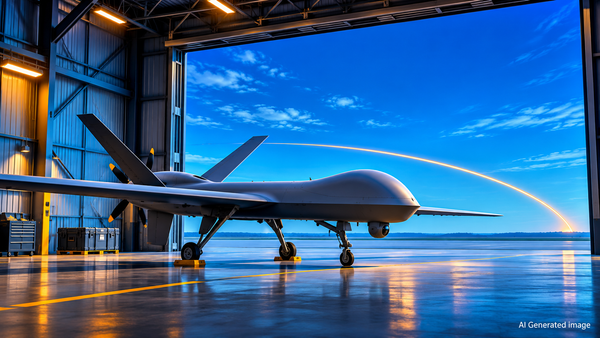
A 1,000-Kilometre Reply: Britain Doubles Down on Long-Range Drones
Two days after a senior Pentagon official questioned the value of Ukraine's strikes deep inside Russia, London put £260 million behind more than 1,000 long-range strike drones, some able to fly beyond 1,000 km. Nothing has been delivered yet. The message, however, is already out.

Baltic Security Monitor | Material Update
Security Watch, 19 November 2026, 14:00 EET · MATERIAL UPDATE · MODERATE
Two days after a senior Pentagon official questioned the value of Ukraine's strikes deep inside Russia, London put £260 million behind more than 1,000 long-range strike drones, some able to fly beyond 1,000 km. Nothing has been delivered yet. The message, however, is already out.
Key figures
- Package: £260m
- Long-range strike drones: 1,000+, some with a range beyond 1,000 km
- Also included: maritime, logistics and surveillance drones
- Spent in the UK: more than 80%
- Avengers AI Labs: 12 UK firms selected from 92 applicants
- Delivery schedule: not announced
- Cycle uncertainty: 🟡 4 · 🔴 0
Britain has answered American scepticism about deep strikes with a budget line rather than a statement. The package expands precisely the capability Washington criticised on 17 November: hitting military targets far behind the front. For NATO's northeastern flank, the bigger story is political. European allies are increasingly shaping their own Ukraine policy without waiting for US alignment. Until a delivery schedule and platform list appear, though, the operational effect cannot be assessed.
What was announced
The UK government published the package on 18 November. Prime Minister Andy Burnham was due to present it in Berlin on 19 November, where he co-chairs a Coalition of the Willing meeting convened together with Friedrich Merz and Emmanuel Macron.
The core is more than 1,000 long-range strike drones. Some can travel beyond 1,000 km, roughly the distance from London to Berlin. According to the government, they carry heavy warheads and are intended for military production sites and other military targets well behind the front line.
Britain will also build and deliver maritime, logistics and surveillance drones. The logistics systems are meant to resupply front-line units, including with blood and refrigerated medical supplies.
More than 80% of the money will be spent in the UK, including with small and medium-sized firms in Wales, Northern Ireland and Scotland. The release gives no delivery dates.
What is actually new
This is a separate commitment from the UK air-defence package announced on 17 November at the Ukraine Defence Contact Group (covered by BSM on 18 November).
The open question is overlap with April. Back then London promised at least 120,000 drones during 2026, including "thousands" of long-range strike systems. The government has not said whether the new 1,000-plus drones sit inside that figure or on top of it. Until it does, treating them as wholly additional would be premature.
What is new in November is a budget tied specifically to the long-range segment, a stated range beyond 1,000 km and the emphasis on heavier warheads.
Context: the transatlantic row over deep strikes
On 17 November, US Under Secretary of Defense Elbridge Colby told reporters at NATO headquarters that Ukraine's deep strikes had neither brought the war closer to an end nor slowed Russia's advance, and that some had probably hardened Russian public opinion.
Europe pushed back hard. German Defence Minister Boris Pistorius called the US warning "quite a stupid thing". UK Defence Secretary Wes Streeting said he had no doubt the long-range campaign had degraded Putin's war machine.
British drones were already at the centre of this argument. In August, after The Times reported that UK-made drones had been used against targets inside Russia, the Russian embassy in London threatened "consequences". Burnham replied that Britain backed Ukraine "100%".
BSM analysis
The timing looks deliberate. London and Berlin have openly broken with Washington over the deep-strike strategy, and London has now put money behind that position. For Moscow, the implication is that leaning on Kyiv through the US no longer guarantees fewer long-range strikes, because European capitals are funding them. For Washington, it is a sign that the European wing of the coalition is willing to act on its own even on escalation-sensitive questions.
Avengers AI Labs: battlefield data as an industrial asset
Alongside the drones, 12 UK firms have been granted access to Ukraine's Avengers AI Labs. The government says 92 companies applied. Access follows the AI partnership Burnham and Zelensky agreed in Kyiv in August.
According to Ukraine's Defence Ministry, the platform holds more than 5 million annotated battlefield frames. Over 30 Ukrainian companies already train models on it, and three resulting systems are in use at the front. Foreign participants cannot download the dataset; they train and test inside the platform's secure environment.
BSM analysis
This may prove the most durable part of the package. Drones get expended; access to combat data shapes a generation of British AI for target recognition and autonomy. The Baltic states, Poland and Finland should watch the model closely: Ukrainian battlefield experience is becoming the asset that decides whose defence technology stays competitive in Europe.
Why it matters for the northeastern flank
First, industry. Britain is building a domestic production base for drones proven in Ukraine, which strengthens the European defence autonomy the Baltic region is counting on.
Second, reach. A range beyond 1,000 km covers most of European Russia, including the oil and port infrastructure already on the BSM tracker (Ust-Luga, refineries). Ukraine has hit such sites before. The change is potential volume and warhead weight, not reach as such.
Third, rhetoric. Moscow has already threatened London over British drones. A new batch raises the likelihood of information campaigns targeting the British presence in the region, including the UK-led contingent in Estonia. No practical Russian steps have been observed so far.
Still unconfirmed 🟡
- delivery schedule and size of the first batch;
- specific models and manufacturers;
- whether the 1,000-plus drones fall within April's 120,000 commitment;
- operational effect of the new systems.
WATCH: other threads this cycle
Berlin, security guarantees. The Coalition of the Willing meeting focuses on guarantees for Ukraine after a possible ceasefire. As of 14:00, no new signed document has been verified. Next check: the final communiqué and any force or funding commitments.
Tatarstan. Reuters, citing local authorities, confirmed an attempted drone attack on an oil facility in the Almetyevsk district. No significant disruption to operations has been confirmed. Operator data is pending.
(The remaining 12 WATCH lines show no new verified delta; see Security Watch, 19 November, 14:00.)
Bottom line
The £260m package does not shift the battlefield overnight: the drones are not yet in Ukraine and the models are unnamed. It does, however, capture a shift inside the coalition. When Washington questions deep strikes, London answers with range and Berlin with blunt words. The next indicator is the Berlin communiqué, which will show whether European autonomy on Ukraine becomes a written commitment or stays a sum of national decisions.
In this argument, range is also a form of speech.
Baltic Security Monitor (osint-baltic.com) — an analytical publication covering security on NATO's northeastern flank.
All OSINT assessments are produced by an automated monitoring system based on open sources and independently verified.