What Sikorski Said vs. What the Headlines Heard

Baltic Security Monitor | Fact-check Analysis 25 September 2026
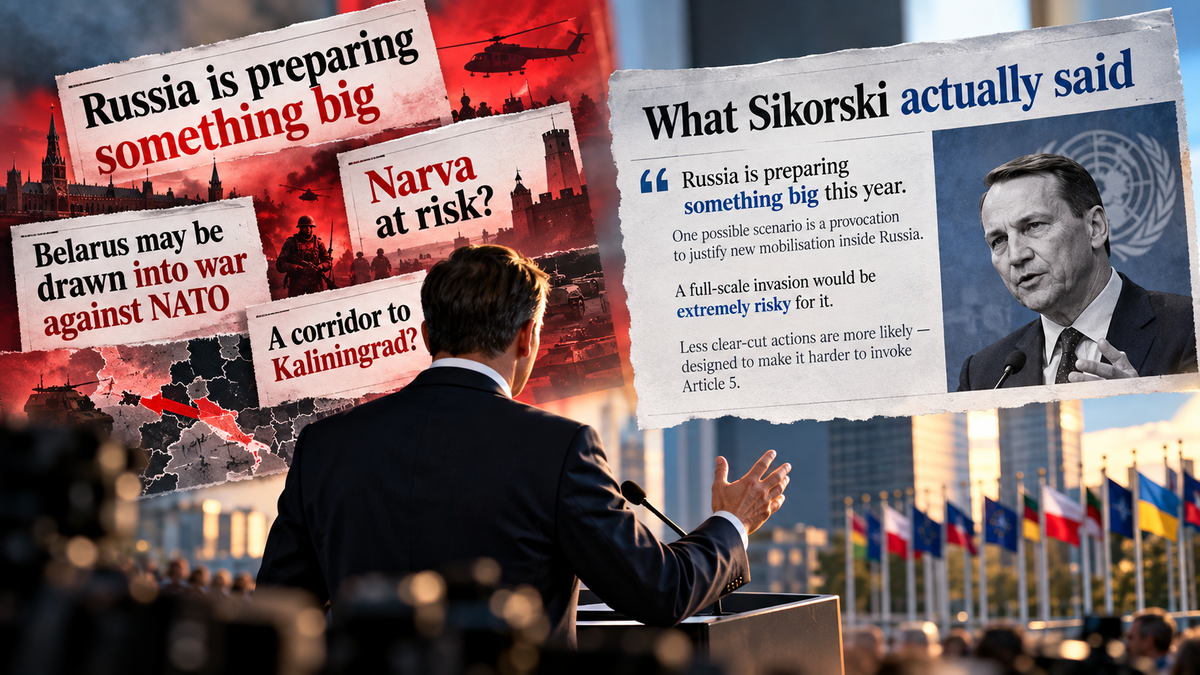
Over the past 24 hours, one line has spread across newsfeeds: "Russia is preparing something big." The source is Polish Foreign Minister Radosław Sikorski. Regional Russian-language outlets, Delfi among them, put the phrase in their headlines. As it was reposted, the story grew louder with each step: "something grand," "Belarus drawn into war against NATO," Narva, a corridor to Kaliningrad.
Then you read what Sikorski actually said. His central point turns out to run almost opposite to the one the headlines built around it.
What was said in New York
Sikorski spoke on 24 September in New York, including at the Council on Foreign Relations. His key line: Warsaw is receiving information from many sources, which it will not disclose, that Russia is preparing something big this year.
He then explained what he meant. One possible scenario is a provocation the Kremlin could use as a pretext for new mobilisation inside Russia. In other words, the warning is primarily about domestic Russian mobilisation and a possible false-flag operation, not tank armies rolling toward NATO.
The most important sentence barely made the headlines. Sikorski said a Russian decision to launch a full-scale invasion would be extremely risky. He therefore considers less clear-cut actions more likely — ones designed to make it harder to invoke Article 5.
Worth noting: the quote "something big" itself is accurate. The distortion comes from removing its context. The headline invites readers to hear "big = war with NATO," a reading the speaker explicitly set aside.
How Belarusian fears became "Belarus at war with NATO"
A telling mutation. The context was Sikorski's first meeting in seven years with Belarusian Foreign Minister Maksim Ryzhenkov. Sikorski relayed that people in Belarus fear being dragged into the war.
One Ukrainian portal turned this into a headline saying Sikorski "did not rule out Belarus being drawn into war against NATO countries." Minsk's anxiety was repackaged as a forecast by Poland's foreign minister. "They are afraid of this" and "I do not rule this out" are not the same claim.
Narva and the corridor: where Sikorski supplied the fuel
To be fair, some of the alarming vocabulary came from Sikorski himself. He noted that most of Narva's population is Russian and that Moscow would like a land corridor from Belarus to Kaliningrad through Lithuania.
But he closed that thought with: "We don't know what they will do, but we must be ready to respond." That is a description of Russian aims and allied vulnerabilities, not an intelligence warning of a specific operation. In the reposts, the two genres merged into one.
The view from the front line
The most striking contrast comes from the countries a "large-scale invasion" would hit first.
Estonia's Foreign Intelligence Service assessed in February that Russia has no intention of militarily attacking Estonia or any other NATO member in the coming year. The reason it gave: steps taken by Tallinn and Europe force the Kremlin to weigh very carefully what, if anything, it can risk.
This spring, according to OSW, Baltic intelligence services and leaders judged that Russia's current mobilisation was not aimed at NATO's eastern flank. Media speculation about aggression increasingly irritated officials, particularly in Estonia and Latvia, because it breeds fear out of proportion to their risk assessment.
What the facts support: the states with the closest view of Russian forces on their borders do not publicly see preparations for a full-scale invasion.
Where the threat is real
None of this means the concern is baseless. It is simply about something else.
The hybrid campaign against Poland is established fact, not hypothesis. Polish authorities formally attributed the 2024 fire at Warsaw's Marywilska shopping centre to Russian intelligence services. In the case of the fire at the WB Electronics plant, which supplies drone components to Poland and Ukraine, prosecutors are investigating possible foreign intelligence involvement, including on terrorism charges.
The "small grab" scenario is also taken seriously by analysts. On 22 September, ISW outlined a hypothetical in which Russia seizes a sliver of Estonia with a small force to test whether allies would act under Article 5.
Provocations, sabotage and grey-zone operations are what Sikorski was actually warning about. That is a serious threat, but of a different scale and nature from a "mass invasion."
Why Warsaw says this out loud
Going public is deliberate. Back in July, Sikorski explained that disclosing intelligence on Moscow's plans is meant to help prevent them. It is the same logic of pre-emptive disclosure the West used before February 2022. Such statements are a deterrence tool, not a guarantee that something will happen.
Bottom line
The chain looks like this:
- The minister says: "Russia is preparing something big — likely a provocation to justify mobilisation; a full-scale invasion would be too risky for it."
- The headline keeps: "Russia is preparing something big."
- The repost adds: "grand," "Belarus at war with NATO," "Narva."
At every step a caveat drops out and fear gets added.
The real picture is more sober. The risk of hybrid attacks and provocations on NATO's eastern flank is rising and well documented. Open sources and Baltic intelligence services record no signs of preparation for a mass invasion.
An alarmist headline does as much damage as complacency. The first erodes trust in genuine warnings; the second erodes the will to act on them.
Baltic Security Monitor (osint-baltic.com) — an analytical publication covering security on NATO's northeastern flank. This piece compares media coverage of official statements with primary reporting and assessments from the Estonian Foreign Intelligence Service, OSW, ISW, Euronews and TVP.