Licensing a Shortage: Washington Opens the Door to Russian Diesel Until April 2027

Baltic Security Monitor | Material Update Snapshot: 10 October 2026, 08:00 (Europe/Tallinn) · Event: 9 October 2026 · Late capture
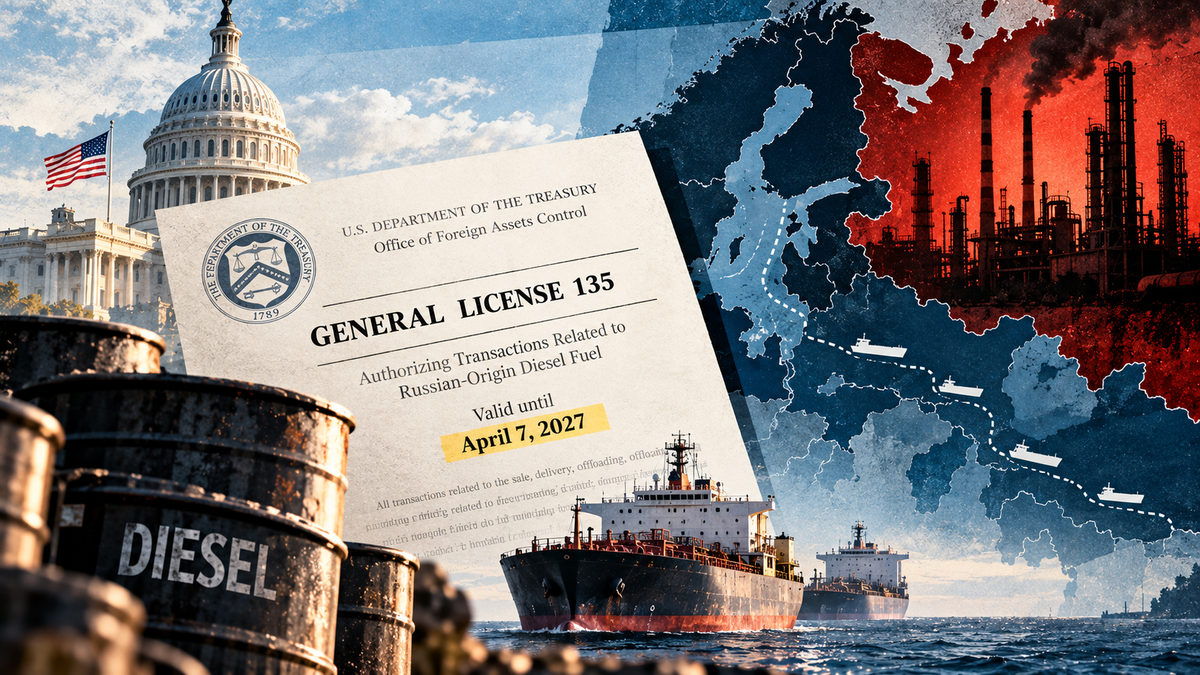
The United States has legally cleared trade in Russian diesel for the next six months — at a moment when Russia itself bans most diesel exports because Ukrainian drones keep hitting its refineries. The licence is in force. The millions of tonnes Trump promised are not.
BSM Assessment
| Indicator | Value |
|---|---|
| Status | MATERIAL UPDATE — HIGH |
| Category | Sanctions / Russian energy revenue / transatlantic coordination |
| Legal instrument | OFAC General License 135 — ✅ text verified |
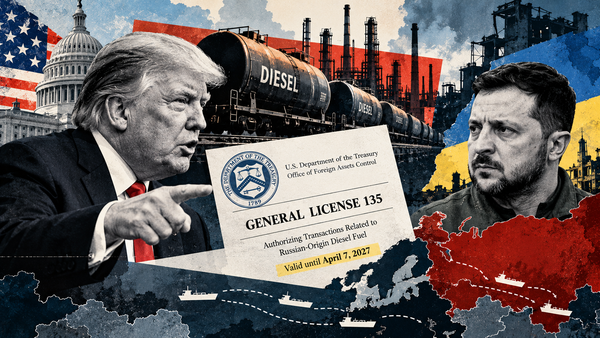
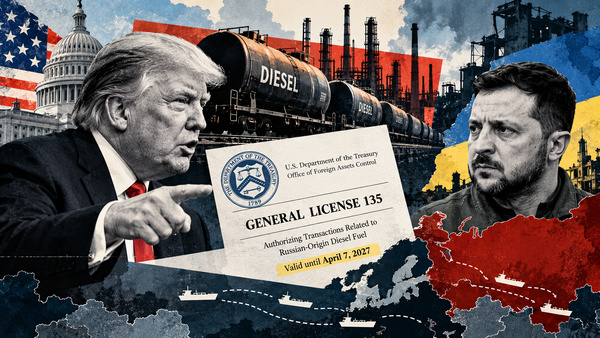
| Validity | until 12:01 a.m. EDT, 7 April 2027 |
| Announced volumes | 🟡 Trump statement, unverified |
| Actual deliveries | 🟡 not established |
| EU / UK response | 🟡 no official response recorded |
| Military consequences for the region | 🟡 not established |
What matters is not the licence itself but its duration. Every earlier OFAC carve-out for Russian oil this year — GL 133, 134 and 134A–C — was short and tied to cargoes already loaded by a fixed date. GL 135 has no such anchor and runs for six months. This is no longer housekeeping for stranded tankers; it is a political decision about a market. For the Baltic states the core issue is sanctions cohesion: Washington is loosening what Brussels and London are still tightening.
What the licence actually permits
BSM checked the primary text on OFAC's site. Dated 9 October and signed by OFAC Director Bradley T. Smith, GL 135 authorises all transactions related to the sale, delivery, offloading and importation of Russian-origin diesel — including importation into the United States — that would otherwise be prohibited under two regimes: the Russian Harmful Foreign Activities Sanctions Regulations (31 CFR 587) and the Ukraine-/Russia-Related Sanctions Regulations (31 CFR 589).
There is one carve-out: no debits to accounts held at U.S. financial institutions by Russia's Central Bank, National Wealth Fund or Ministry of Finance.
BSM analysis: the text contains no vessel-loading cutoff — the key limiter in every previous oil licence of 2026. Some outlets, NPR among them, describe GL 135 as covering only diesel already loaded as of Friday; the legal text does not say that, and BSM follows the document. NPR is right on the bigger point, though: this is the first easing on Russian diesel since the full-scale invasion that runs beyond the standard 30-day window.
The diesel paradox
After his call with Putin, Trump announced more than 300,000 tonnes "immediately", 500,000 tonnes in November, 1 million tonnes after that — and perhaps 3 million more, depending on the state of Russian refineries. These are pledges, not contracts.
The catch is that the fuel may not exist in exportable quantities:
- Russia has banned most diesel exports since July to protect its domestic market.
- The IEA, as cited by NPR, estimates Russian diesel output is down roughly 30%.
- Trump himself wrote on 21 September that Russia had "lost control" of its diesel industry because of the refinery strikes.
BSM analysis: the licence bets that Moscow can — or will choose to — divert fuel from a short domestic market to export. The first 300,000-tonne cargo is a test of Russian refining and logistics, not of U.S. policy. If shipments stall, GL 135 stays a political signal with no product behind it.
Scale (BSM estimate): the 1.8 million tonnes actually scheduled (excluding the conditional 3 million) equal roughly 13 million barrels. Reuters reported in late September that Washington was pressing the EU to release 120 million barrels of diesel from emergency stocks over six months. The Russian volume is an order of magnitude smaller.
Context: a diesel crisis and an election
This did not come out of nowhere. It closes a month of pressure:
- 13 September — Trump publicly told Zelenskyy to stop hitting Russian diesel facilities, as U.S. average diesel prices broke $6 a gallon for the first time.
- Late September — the administration weighed a ban on U.S. diesel exports. The European Commission called it a bad idea: American diesel made up about half of EU diesel imports in August, and EU pump prices hit a record €2.23 per litre.
- The Kremlin had earlier tied any "energy truce" to sanctions relief.
- 3 November — U.S. midterm elections.
BSM analysis: experts cited by the Kyiv Independent, and KSE Institute research reported by the FT, point to the Iran war and the disruption around the Strait of Hormuz as the main driver of diesel prices — not Ukrainian strikes. The licence therefore treats a secondary cause of the crisis, while handing Moscow something it explicitly asked for.
Why it matters for the Baltic states
- A split sanctions front. GL 135 does not change EU or UK sanctions. But it lands a day after a new British package targeting Russian oil companies and the shadow fleet (per the digest), and alongside the EU's proposed expansion of its listings. Three allies are now moving in different directions.
- Tanker traffic in the Gulf of Finland. Russian product exports flow heavily through Primorsk and Ust-Luga. Any revival of diesel exports means more tankers through waters that Estonia and Finland watch most closely.
- A precedent for Moscow. The Kremlin gains proof that sanctions can be traded for energy concessions — weakening the hand of Tallinn, Riga and Vilnius in EU debates over the next packages.
Ukraine's response
According to the digest (citing Reuters), Zelenskyy condemned the deal as an "investment in war", as Ukrainian officials were meeting U.S. counterparts in Miami. 🟡 BSM could not independently access the primary report at publication time; the position is given as reported in the digest.
WATCH log
| Thread | Cycle status | BSM verification | Next check |
|---|---|---|---|
| 🟡 Montenegro — Rybar founder and four Russians expelled | New development | ⚠️ Not independently confirmed (AP source not found) | Official investigative findings |
| 🟡 RAF Molesworth — two Latvian nationals | Released on bail | Digest status | Charges, attribution |
| 🟡 Black Sea — attack on MV Able | No drone debris recovered | Digest status | Forensics, satellite imagery |
| 🟡 Germany — Hanning / BND case | Investigation ongoing | Digest status | Prosecutorial findings |
| 🟡 Lithuania — permanent U.S. base | No decision | Digest status | U.S. basing decision |
| 🟡 Lithuania — constitutional amendment | 6 Oct vote remains latest milestone | Digest status | Next vote |
| 🟡 NATO — Theory of Victory | Presentation expected 12 Oct | Digest status | Official NATO documents |
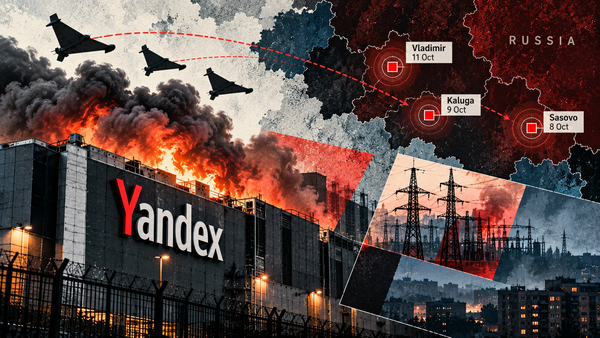
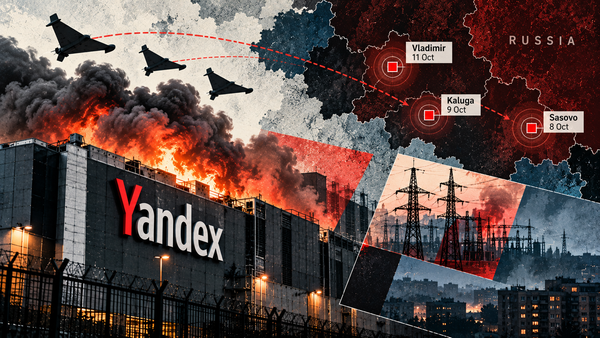
Checked, no new delta: overnight drone attack on Kyiv (9–10 Oct); Russian satellite manoeuvres (ICEYE — see 9 Oct 20:00 update); Yandex data-centre strikes (see 9 Oct 14:00 cycle); Steadfast Noon preparations.
Pipeline integrity note
- The digest's link to the OFAC announcement (
recent-actions/20261009_33) returned 404 at check time. The licence text itself is live and verified, so the fact stands — the published link has been switched to the primary PDF. - Several digest links carried a
utm_source=chatgpt.comtracking parameter; stripped before publication. - The 08:00 GitHub commit to
baltic-security-monitor-editorialwas blocked at the connector level; nothing was committed. - The Montenegro item was presented as confirmed in the digest, but BSM found no independent source — downgraded to unverified.
Conclusion
GL 135 is the most concrete document of this cycle and the least concrete in its effects. Legally, the door is open until April. Whether a single tonne passes through it depends on refineries Ukraine has spent the year knocking out — and on a Kremlin that may prefer trading concessions to trading fuel.
Next indicators: first loadings at Russian ports, identified buyers, OFAC FAQ guidance, and responses from Brussels and London.
Sanctions that can be bought with diesel stop being sanctions. They become a price.
Baltic Security Monitor (osint-baltic.com) — an analytical publication on security across NATO's northeastern flank. Materiality assessments are produced by an automated open-source monitoring system and verified by the editorial team.
Sources: OFAC GL 135 — text · NPR, 9 Oct · ANI / Tribune, 10 Oct · Mondaq — GL 133/134 · AP, 13 Sep · Kyiv Independent, 21 Sep · Kyiv Post · Reuters via investingLive — 120m-barrel demand · EC response to export-ban idea