Ukrainian Strikes Are Rewriting Russia's Own Rules of Management: The Kremlin Grants Itself the Right to Seize Poorly Protected Critical Infrastructure

Baltic Security Monitor | Analytical Review Material OSINT Update — 25 August 2026, 20:00 Europe/Tallinn
Materiality assessment
| Parameter | Value |
|---|---|
| Status | MATERIAL UPDATE |
| Category | Ukraine war / Critical Infrastructure / Logistics |
| Materiality | medium-high |
| 🟡 markers (unconfirmed/forecast) | 5 |
| 🔴 markers (confirmed fact) | 0 |
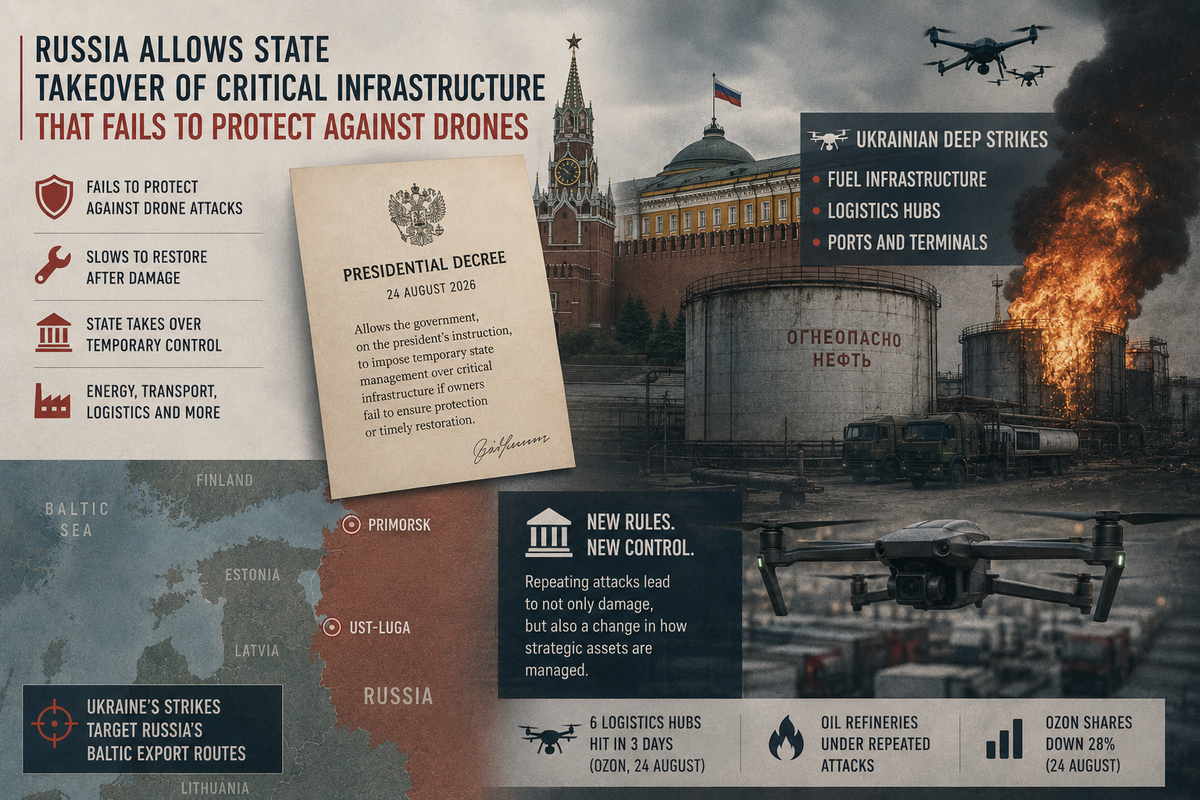
The decree Vladimir Putin signed on 24 August is not another reconstruction announcement — it changes the rules of the game itself: the Kremlin has, for the first time, formalised the state's right to strip private owners of management over critical infrastructure they failed to protect from Ukrainian drones or failed to restore quickly enough. The materiality here isn't the decree as a document; it's that Ukraine's deep-strike campaign has, for the first time, officially produced not just physical damage but a change to how Moscow governs strategic wartime assets.
What happened
Russian President Vladimir Putin signed a decree on 24 August allowing the Russian government, acting on presidential instruction, to place critical infrastructure under temporary state administration when its owners are judged to have failed to protect it adequately from attacks — including drone strikes — or to restore operations quickly enough after damage. The measure covers fuel and energy, industry, communications, utilities, transport and logistics infrastructure, among other facilities deemed important to national security and economic stability. <cite>Reuters, 24 August 2026</cite>
The decree is dated 24 August, so it is technically a late-identified development from the 24-hour look-back rather than something that happened after the previous 14:00 cycle. Reuters reports that temporary administration can extend to physical and financial assets and to formal ownership rights. First Deputy Prime Minister Denis Manturov said the mechanism should not be read as general nationalisation but as "the state's involvement in managing an enterprise to solve specific security problems," applied case by case rather than broadly. Kremlin spokesman Dmitry Peskov added that "business owners are not paying enough attention to security measures, to anti-drone security." <cite>CP24/AP, 25 August 2026</cite>
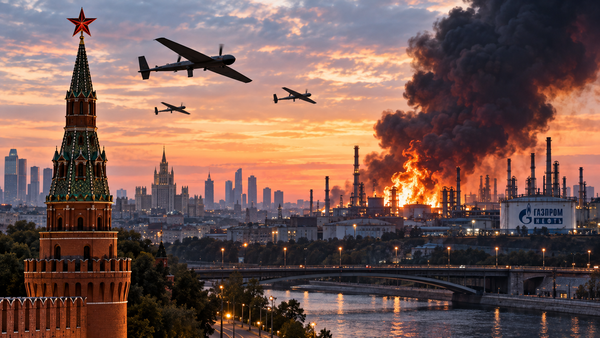
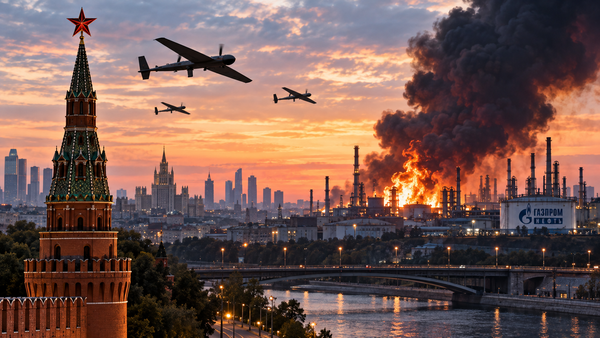
The decree lands against the backdrop of a widening Ukrainian deep-strike campaign against Russian economic and logistics infrastructure. On 24 August, Ozon said four of its logistics hubs had been attacked by drones, bringing the number of its facilities struck in three days to six. <cite>Reuters, 24 August 2026</cite> Fuller reporting shows the overnight strikes into 24 August hit Ozon hubs in Krasnodar region, Dagestan, Samara region, Adygea and Stavropol; the Krasnodar strike killed at least three teenagers and hospitalised six more children after drone debris struck a private children's centre. Ozon's shares fell 28% on the Moscow Exchange; its major shareholder AFK Sistema dropped 13%. <cite>The Moscow Times, 25 August 2026</cite> Wildberries, Russia's largest retailer, has faced over a month of repeated strikes on its own warehouses — Kyiv accuses the company of supplying military equipment, including drone components, as the stated rationale for targeting it. In parallel, strikes on refineries and fuel infrastructure continue: the Afipsky refinery has been hit eight times in a year, Novoshakhtinsk four times. <cite>CP24/AP</cite>
What changed
Russia had already pressed companies to improve protection against Ukrainian drones and had announced reconstruction support for damaged commercial infrastructure. The material delta is the creation of a formal legal mechanism allowing the Kremlin to replace private management with temporary state administration when security or reconstruction is judged inadequate.
BSM analysis: Ukraine's deep-strike campaign is no longer producing only physical damage and temporary production losses — it has now contributed to a change in how Moscow governs strategically important civilian and industrial infrastructure during wartime. That's a qualitative shift: Ukrainian strikes now have a measurable effect on Russia's internal architecture of authority, not just on fuel stockpiles or logistics capacity.
Why it matters for Ukraine and the Baltic region
For Ukraine, the decree is evidence that sustained long-range strikes are imposing systemic costs beyond any individual destroyed warehouse or damaged refinery. Moscow is reorganising responsibility for protection, reconstruction and control because existing arrangements are considered insufficient against repeated drone attacks.
The sectors explicitly covered — energy, fuel, industry, transport and logistics — are central to Russia's military sustainment and export economy. Greater state control could, in theory, improve coordination of repairs and counter-UAS protection, but the need for such powers in the first place also signals growing strain on Russia's infrastructure-resilience model.
For the Baltic region, the connection is particularly relevant to Russia's north-western logistics and energy assets. Baltic export infrastructure such as Ust-Luga and Primorsk falls within the broader categories the decree covers. If Moscow applies the new powers there, Ukrainian pressure on Russian infrastructure could translate into greater state and security-service involvement around strategically important facilities adjacent to Estonia, Finland and the Baltic Sea. 🟡
BSM analysis: This isn't a speculative scenario invented for effect — Ust-Luga, Russia's principal Baltic oil-export terminal, has already been struck by drones repeatedly through 2026, including a 14 August attack that started a fire, and a March run of strikes that Euromaidan Press assessed as frequent enough to suggest Kyiv was trying to knock Russia's Baltic oil-export ports "beyond repair." <cite>The Moscow Times, 14 August 2026; Euromaidan Press</cite> In other words, the facility cited here as a plausible test case for the new decree is already inside the active strike zone — the open question isn't whether Ust-Luga is vulnerable, but whether the next hit triggers a formal transfer of the facility to state administration.
Likely implications
- Russia is likely to impose stricter protection and reconstruction requirements on operators of refineries, fuel terminals, ports, warehouses and logistics hubs, including greater investment in local counter-UAS measures. 🟡
- The first actual use of temporary administration will show whether the decree functions mainly as leverage to force companies to spend more on protection, or becomes a broader mechanism for consolidating strategic assets under wartime state control. 🟡
- Application to major Baltic ports or energy terminals could increase the security and military footprint around Russian infrastructure in the Gulf of Finland and the eastern Baltic Sea. 🟡
- The decree may also encourage Ukraine to prioritise targets where repeated disruption imposes organisational and governance costs on top of immediate physical damage. 🟡
BSM analysis: The context around the decree supports the logic of that last point. Analysts cited by AP frame the Kremlin's move as a way to force repeatedly struck refinery owners — Afipsky hit eight times, Novoshakhtinsk four — to fund their own protection and repairs: in effect, an ultimatum to invest in defence or lose control. If that logic holds in practice, it gives Kyiv an additional argument for prioritising repeated strikes on the same categories of target over one-off hits.
Bottom line
The 24 August decree is a material update not because it is itself a new attack or a new incident, but because it documents a transition: Ukraine's deep strikes now measurably affect the internal model of how Russia governs critical infrastructure, not just its physical condition. The Baltic connection through Ust-Luga and Primorsk remains a forecast, not a confirmed fact — but it rests on the already-documented vulnerability of these ports throughout 2026. The next indicator for BSM to watch is the first confirmed application of the decree — and specifically whether it touches a facility inside the Baltic geographic perimeter.
Baltic Security Monitor (osint-baltic.com) — an analytical publication covering security on NATO's northeastern flank. Materiality assessments and 🟡/🔴 status markers are reproduced from the source BSM analytical cycle; underlying facts were independently cross-checked and supplemented from open sources.