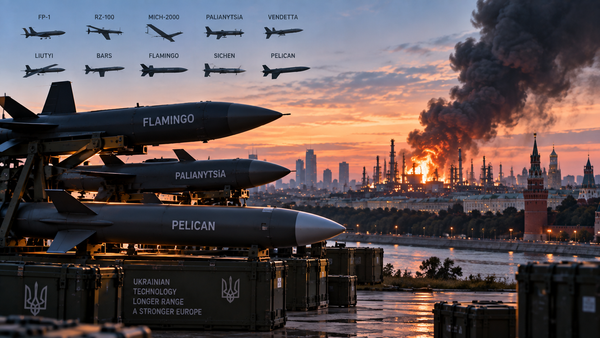
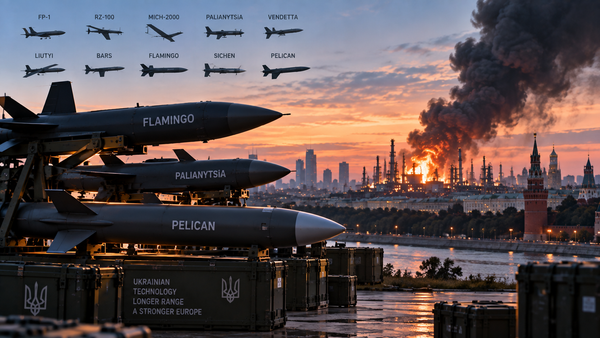
Ukraine Sets a Target of 1,000 Long-Range Drones a Day: The Strike Campaign Against Russia Moves to a New Scale

Baltic Security Monitor | Material Update Published: 29 August 2026, 08:00
The order came the same evening Zelensky, in a separate Telegram post, addressed CIA Director Ratcliffe's Moscow visit from the day before — a story BSM covered yesterday. The president confirmed the US had briefed Ukraine on the Moscow meetings and that Kyiv supports Washington's push for greater pressure on Russia. The 1,000-drones-a-day target isn't a standalone statement of resolve — it's a concrete production-and-operational order issued the same day Washington and Moscow were exchanging signals about the war.
What happened
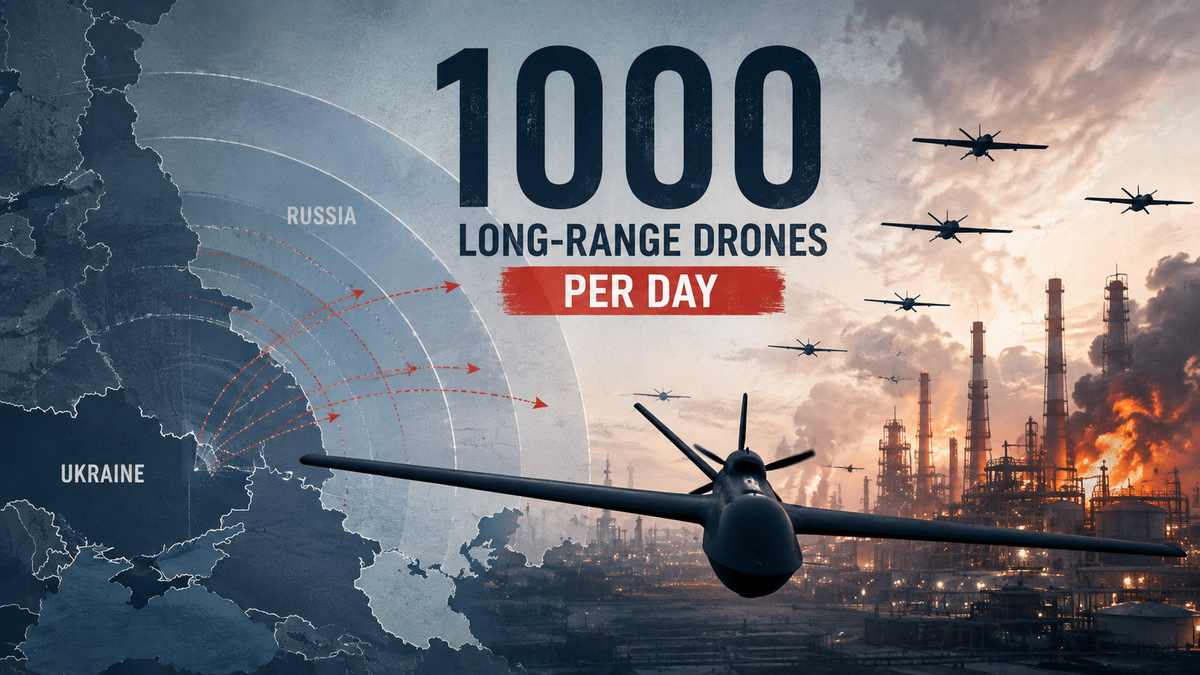
President Volodymyr Zelensky said on 28 August, following a meeting of the Staff of the Supreme Commander-in-Chief, that Ukraine has set a concrete objective: 1,000 long-range drone strikes on Russia per day, up from a current average of more than 300. The Office of the President published the statement at 19:18 Kyiv time, and Reuters independently reported the order later that evening. "The task is: 1,000 drones a day for long-range attacks against Russia. We are currently carrying out an average of over 300 such long-range attacks — that figure must increase," Zelensky said in his evening address.
The instruction combines an operational objective with an industrial requirement. Zelensky said Ukraine must maximise the use of domestically produced weapons, increase long-range strikes, and accelerate protection against Russia's jet-powered Shahed variants — the same target class Ukraine recently fielded the Alexa Spatium interceptor against, a story BSM covered on 22 August. The president also stressed the need to significantly ramp up production of interceptor missiles specifically designed to counter Russian drones.
The order comes as Ukraine's existing strikes are already having measurable effects on Russian energy infrastructure. Reuters reported on 28 August that Russian gasoline production had fallen to about 70% of domestic demand after drone attacks forced shutdowns at major refineries — over the past week, drones struck and halted operations at several major plants, including facilities in Perm and Nizhny Novgorod, requiring increased imports and the return of regional fuel restrictions. Putin has acknowledged the economic damage from the strikes but has publicly downplayed it as not critical.
The same day the order was issued, Russia kept striking Ukraine: at least one killed and two wounded in the Kyiv region Friday morning, one killed and seven wounded in a drone strike on Sumy region, one killed and 11 wounded, including a child, from air and artillery attacks on Kherson, and two killed in shelling in Kharkiv region. That's the backdrop — not an abstraction but the day itself, with hostile strikes killing people across six regions — against which the order to triple Ukraine's own long-range strike tempo was issued.
BSM analysis: The difference between "strikes on Russia will continue" and "a concrete target of 1,000 drones a day, ordered by the Staff of the Supreme Commander-in-Chief" is the difference between political rhetoric and a formal production-and-operational directive. Ukraine has not disclosed a deadline for reaching that level, the mix of drone types involved, or whether 1,000 represents sustainable daily capacity rather than a desired peak rate. 🟡 This should be read as a declared objective, not an achieved capability — there is currently no independent evidence Ukraine can sustain that launch rate.
Why it matters for Ukraine and the Baltic region
For Ukraine, sustaining anything close to 1,000 long-range launches per day would materially increase pressure on Russian refineries, fuel depots, military-industrial facilities, air bases, ports and logistics networks. The effect wouldn't depend solely on successful strikes — Russia would also have to devote more air-defence, electronic-warfare and security resources to protecting a much larger number of potential targets. Zelensky also reported results from strikes on Russia's oil and port infrastructure, saying Ukraine had already paralysed the port of Novorossiysk, important to Russia's Black Sea Fleet, and vowing Kyiv "will certainly find ways to block their other ports as well."
The Baltic dimension here is operational. Finland, Estonia, Latvia and Lithuania have already dealt with unidentified or misdirected drones, temporary airspace restrictions and interceptions as Ukraine has increased attacks against Russian targets around the Baltic Sea. Reuters documented that spillover earlier in August, including concern that Ukrainian drones targeting Russian Baltic ports had entered neighbouring NATO airspace.
BSM analysis: A threefold expansion of Ukraine's long-range strike volume would logically increase the probability of navigation failures, electronic-warfare deviations and unidentified tracks affecting NATO's north-eastern airspace — even without any deliberate Ukrainian entry into allied territory. 🟡 That directly reinforces the case for persistent low-altitude surveillance, cross-border flight-track sharing and rapid forensic attribution — precisely the capabilities Sweden and Finland began operationally reinforcing this week, a story BSM covered yesterday.
Likely implications
Ukraine's defence industry would need to substantially expand production of long-range airframes, engines, navigation systems, communications equipment and warheads for a 1,000-per-day rate to become sustainable rather than episodic. 🟡
Russia is likely to strengthen and redistribute air defence and electronic warfare around refineries, ports, air bases and military-industrial facilities, potentially forcing harder decisions about where scarce defensive systems are deployed. 🟡
The economic effects could become increasingly nonlinear if higher strike volumes repeatedly interrupt the same refineries and logistics nodes — Russia is already covering part of its gasoline deficit through imports after production disruptions. 🟡
For Finland and the Baltic states, a substantially larger drone campaign would strengthen the case for persistent low-altitude surveillance, cross-border flight-track sharing and rapid forensic attribution — the same capabilities Sweden and Finland began operationally reinforcing this week. 🟡
The 1,000-per-day figure should not yet be described as achieved Ukrainian capacity. It is a declared operational and production objective; no independent evidence currently demonstrates Ukraine can sustain that launch rate. 🟡
Bottom line
The order for 1,000 drones a day came the same evening Zelensky confirmed coordination with Washington over Ratcliffe's Moscow talks, and the same day Russian strikes killed people across six Ukrainian regions. That's not a coincidence of timing — it's the logic of the decision itself: Ukraine is answering an intensifying Russian terror campaign not by waiting for a diplomatic outcome, but with a formal order to triple its own strike tempo deep into enemy territory.
Baltic Security Monitor (osint-baltic.com) — an analytical outlet covering security on NATO's northeastern flank. This report draws on an automated monitoring digest cross-checked against independent open sources.