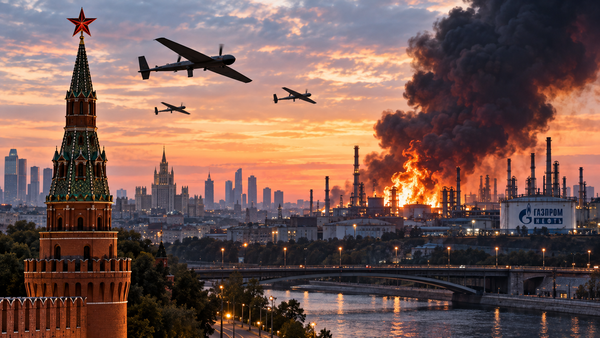
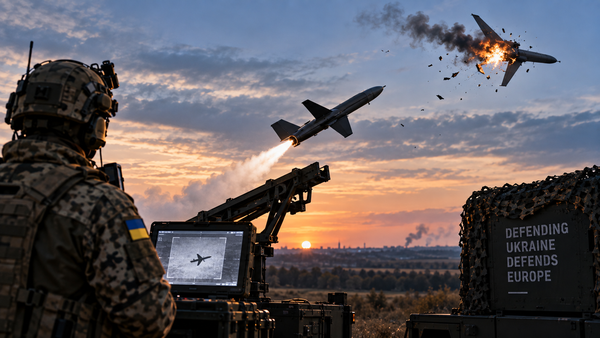
Ukraine Reaches Yamal for the First Time: Strike Drones Cross 3,000 km, Russia Confirms Fire in Novy Urengoy

Baltic Security Monitor | Analytical Briefing
Event: 9 September 2026 · Published: 10 September 2026
This is not another strike on frontline-adjacent refining capacity — it is proof that Ukraine's drone reach now extends into Russia's Arctic gas heartland, a region Moscow had long treated as effectively untouchable. The fire in Novy Urengoy is independently confirmed by the regional governor and by Western wire services, so the operative question is no longer whether the drones arrived, but how much damage they did — and how many more such nodes Russia will now have to defend. For the Baltic states the relevance is indirect but structural: it signals that Russian air-defense resources are being stretched across an ever-larger map.
What happened
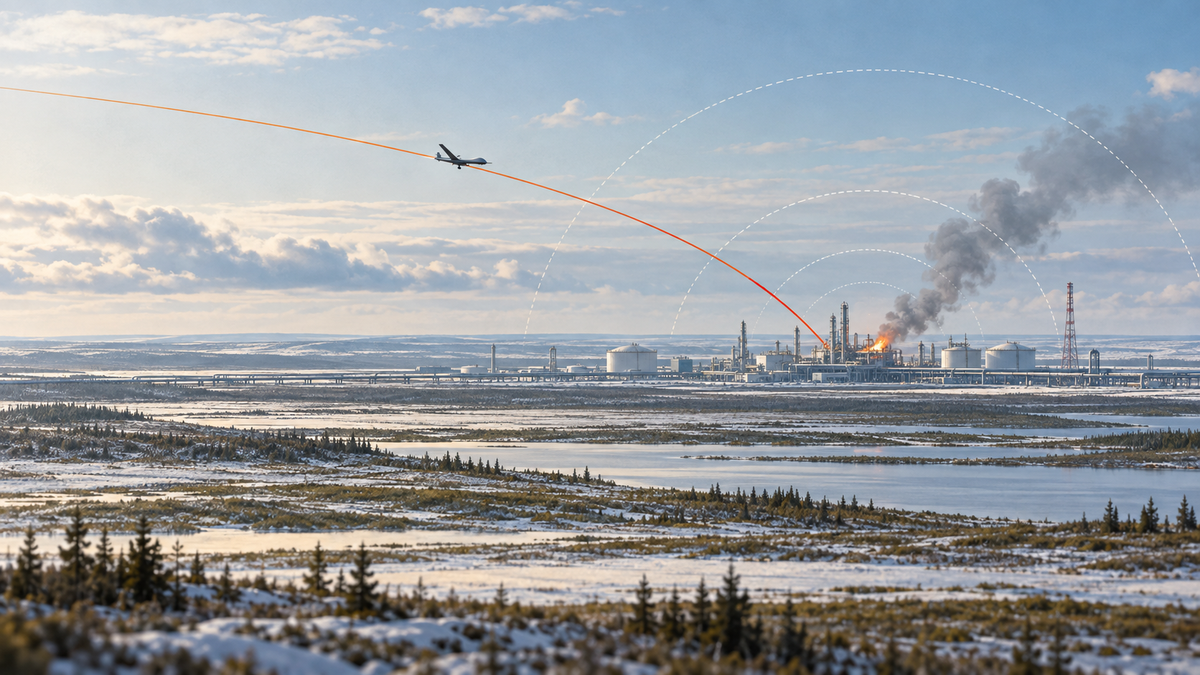
Late on 9 September, Ukraine's Special Operations Forces announced strikes on two gas-condensate plants in the Yamalo-Nenets Autonomous Okrug — the Novy Urengoy Gas Condensate Treatment Plant and the Purovsky Condensate Processing Plant. According to the SOF, the drones covered more than 3,000 km, making this Ukraine's deepest strike inside Russia since the full-scale invasion began. Ukraine's General Staff separately confirmed hitting the Novy Urengoy facility, which has a design capacity of roughly 19.5 million tonnes per year; the Purovsky plant reportedly processed 13.4 million tonnes of condensate in 2025.
Independent confirmation came from the Russian side. Yamalo-Nenets Governor Dmitry Artyukhov reported a fire at an industrial site in Novy Urengoy caused by falling drone debris, stating there were no casualties while damage assessment continued. Reuters and AFP separately characterized the strike as the first drone attack to reach Russia's northern gas hinterland; Gazprom did not respond to Reuters' request for comment. Artem Zhoga, the Kremlin's plenipotentiary envoy to the Urals Federal District, likewise confirmed this was the first time Ukrainian drones had reached the Arctic portion of the district.
BSM analysis: Ukraine's previous farthest confirmed strikes reached roughly 2,500 km, exemplified by the Omsk refinery. A jump to 3,000–3,300 km is not incremental — it pulls an entire industrial region, long assumed to sit outside any realistic threat envelope, into contested airspace, forcing Moscow to reconsider air-defense allocations it had not previously needed to make.
What's still unconfirmed
🟡 Ukraine claims both plants were hit; independent confirmation of damage specifically at the Purovsky facility has not yet surfaced — only the Novy Urengoy fire is publicly corroborated.
🟡 The scale and duration of any production shutdown remain unknown. Russian officials' framing — a fire caused by falling debris from an intercepted drone — sits in tension with Ukraine's claim of a direct hit, a narrative gap worth tracking as further reporting emerges.
Notably, the strike landed the same day U.S. President Donald Trump said he had spoken by phone with Vladimir Putin and suggested both sides might be ready to negotiate, while pointing to personal animosity between Putin and Volodymyr Zelensky as the main obstacle. Ukrainian defense manufacturer Fire Point publicly signaled possible involvement, citing a range of more than 3,300 km.
Regional context
Yamalo-Nenets is Russia's primary gas-producing region, with proven reserves estimated in the trillions of cubic meters. The plants hit process gas condensate rather than raw gas output, so a direct hit to overall gas production has not been established — but the strike's strategic and logistical weight extends well beyond the fire itself.
For the Baltic states, the relevance is indirect but systemic. Ukraine's military intelligence chief, Oleh Ivashchenko, warned days earlier that the Kremlin would keep intensifying pressure on NATO's eastern flank — citing repeated Russian airspace violations over Romania, Poland and the Baltic states — to probe the alliance's below-Article-5 response threshold. At the same time, speaking at the Eastern Economic Forum, Putin emphasized layered air-defense buildup (Pantsir, Tor-M2, Buk-M3, S-300V4, S-400) specifically to protect strategic sites, including oil and gas facilities. The wider the geography Ukrainian drones can reach, the sharper the competition becomes for those same air-defense assets between covering the Urals and Siberia and maintaining coverage closer to Finland and the Baltic Sea.
Against this backdrop, the Baltic states continue outpacing NATO's spending baseline: Lithuania at roughly 5.33% of GDP in 2026 — the alliance's highest — Estonia at around 5.1%, and Latvia at around 4.9%. This is not a direct response to the Yamal strike, but it frames the broader picture: the Baltic region is raising its own resilience ceiling at precisely the moment Russian air-defense resources show signs of geographic overstretch.
Bottom line
The Novy Urengoy and Purovsky strikes are primarily a story about demonstrated range, not (yet) proven economic damage — the real production impact remains to be established. But the fact that Arctic western Siberia can no longer be treated as guaranteed rear territory reshapes Moscow's air-defense calculus for years to come — with indirect implications for the defense calculus on NATO's northeastern flank as well.
Baltic Security Monitor (osint-baltic.com) — an analytical outlet covering security on NATO's northeastern flank.
Compiled from open sources and BSM's automated OSINT monitoring system.