Three Plants, Six Weeks: Ukraine's Steel Industry Loses Its Margin for Error

Baltic Security Monitor | Analysis Based on the emergency update of 26 September 2026, 14:00 Europe/Tallinn; ArcelorMittal's original statement — 25 September
ArcelorMittal's decision not to restart its Kryvyi Rih plant after a fourth missile strike in five weeks is not an isolated incident. It caps a six-week stretch in which three of Ukraine's six remaining major steel producers — Zaporizhstal, Kametsstal, and now ArcelorMittal Kryvyi Rih — were knocked out of production in quick succession. The direct impact on the Baltic region is limited, but the episode illustrates a structural erosion of Ukraine's industrial base that European partners will have to factor into both wartime support and postwar reconstruction planning.
What happened
On 25 September, ArcelorMittal told the Ukrainian government it could no longer safely and sustainably restart Ukraine's largest steel plant, ArcelorMittal Kryvyi Rih, after four missile strikes in five weeks — the latest on 21 September. The company says the strikes have killed five workers and injured 17, with one injured employee still in critical condition. Reuters independently confirmed the decision.
Rather than resume production, the company will preserve the site's infrastructure while discussing its future with Kyiv, keeping a theoretical option to restart if conditions allow. It expects a roughly $1 billion non-cash impairment, mostly against property, plant and equipment.
This is the fourth strike on the plant this year. An August 16–17 attack damaged power and blast-furnace facilities, killing two people and injuring over a dozen workers; a 14 September strike followed; the 21 September strike was the fourth in the series. Each successive strike narrowed the path back to production — the August damage was still framed as a "partial halt," but after the September strikes the company's language shifted to an inability to restart safely at all.
BSM analysis
The material change here is not the strike itself but the shift in the company's own language — from "assessing damage, planning to restart" to "cannot guarantee a safe and sustainable restart." That is a qualitative break. Despite years of loss-making operations in Ukraine (ArcelorMittal says it has put over $700 million into sustaining the operation since 2022) and repeated public statements about "fighting for survival," the company had never formally declared any of its Ukrainian assets unfit to restart — until now.
Regional context: not a one-off
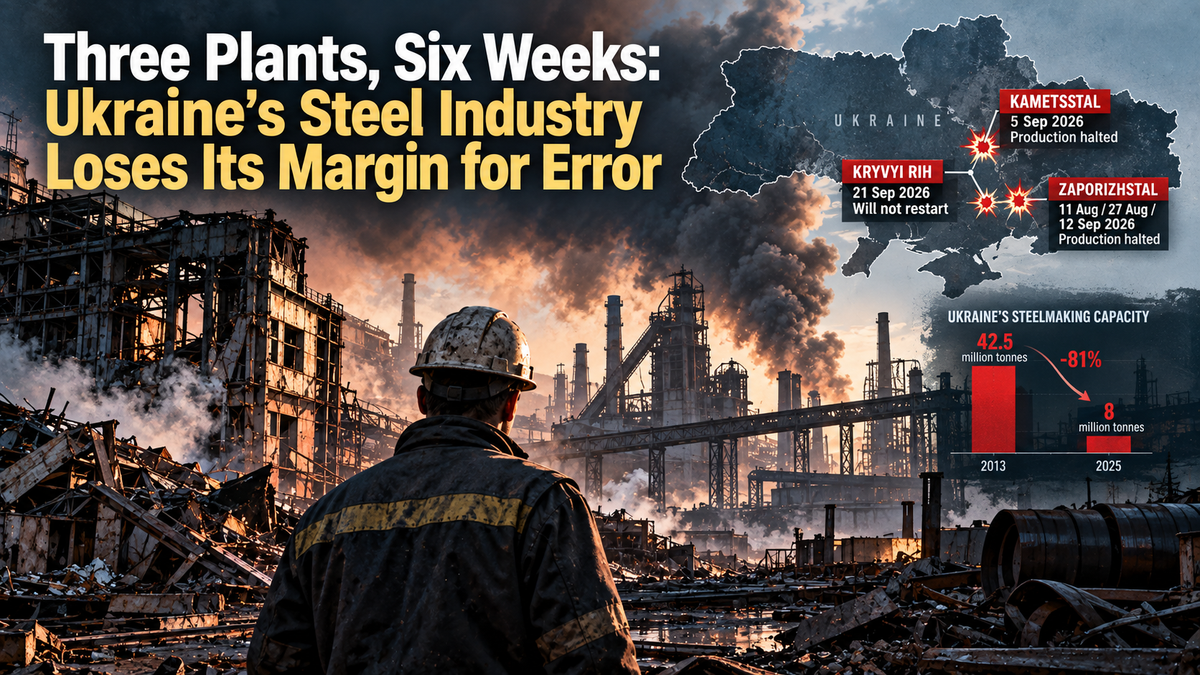
Kryvyi Rih is not the only major plant to go offline this autumn. Zaporizhstal fully halted operations after ballistic strikes on 11 and 27 August and 12 September, which damaged power, transport, blast-furnace and coking facilities. On 5 September, a strike on Kametsstal in Kamianske killed five workers and forced a complete production stop.
In roughly six weeks, Ukraine effectively lost the output of three of the six plants that currently make up its steel industry — an industry that was already running with essentially no slack. Ukraine's nominal steelmaking capacity has fallen 81% since 2013, from 42.5 million tonnes to about 8 million tonnes, and the number of operating plants has dropped from 14 to 6. Capacity utilization among the survivors reached 92.5% in 2025 — leaving almost no buffer to absorb the loss of any single major producer.
What it means for the Baltic region and support for Ukraine
The direct effect on European steel supply is likely limited — Kryvyi Rih was already running well below its pre-war capacity. The more significant signal is the cumulative erosion of what remains of Ukraine's heavy-industrial base under repeated strikes, which raises the economic cost of sustaining wartime production, exports, and eventually reconstruction — a cost that ultimately falls, in part, on the European partners, including the Baltic and Nordic states, funding Ukraine's support.
ArcelorMittal has not announced a permanent closure and formally keeps the door open to restarting. But barring a material improvement in security conditions around Kryvyi Rih, the plant is likely to stay in preservation mode rather than production — the same state Zaporizhstal and Kametsstal have been in since this autumn's strikes.
Baltic Security Monitor (osint-baltic.com) — an analytical publication on security along NATO's northeastern flank.
Sources
- ArcelorMittal — official statement, 25 September 2026
- Reuters — confirmation of ArcelorMittal's decision on its Ukrainian plant
- GMK Center — on the Zaporizhstal and Kametsstal shutdowns, August–September 2026
- Ukrmetallurgprom / GMK Center — Ukraine steelmaking capacity trends, 2013–2025