The Server and the Substation: How Strikes on Yandex Data Centres and Kyiv's Grid Blur the Line Between Digital and Physical Infrastructure

Baltic Security Monitor | Analytical Brief Snapshot: 9 October 2026, 14:00 (Europe/Tallinn) · Material OSINT Update (three material updates, two of them late captures from 8 October)
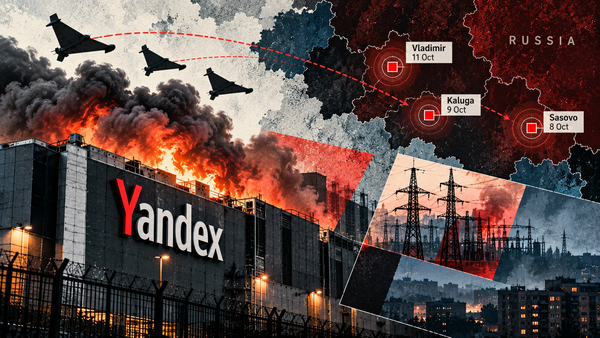
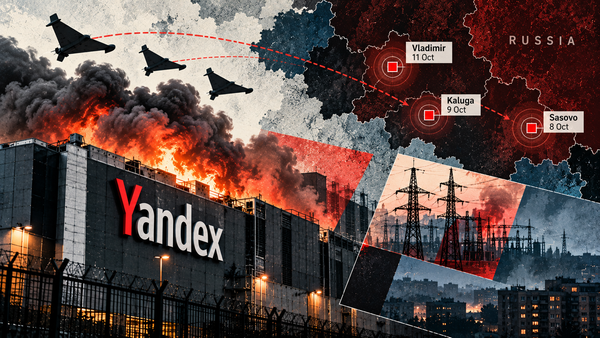
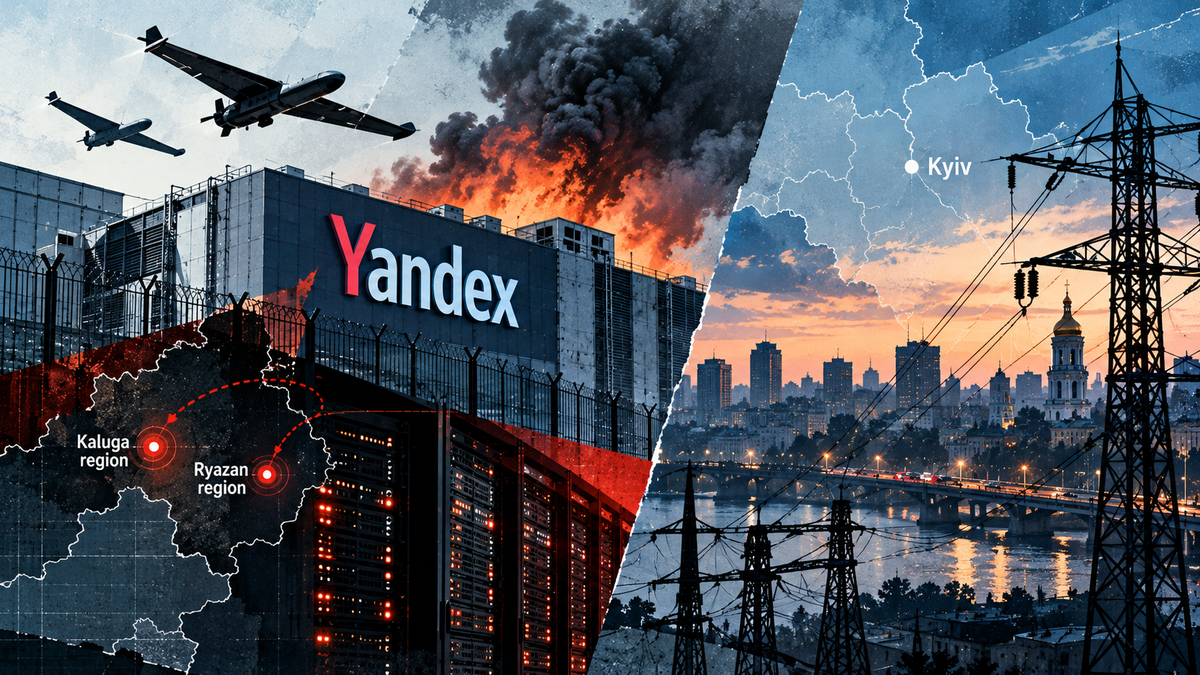
In two days Yandex has acknowledged damage to a second data centre: after Sasovo in Ryazan region, "several modules" are down in Kaluga region. Meanwhile Kyiv spent an evening without power, metro and running water after a strike on an energy facility. Both sides are hitting the nodes that a city or a company cannot function without. In both cases the question is not whether the target was hit but how long the disruption will last.
Assessment
| Indicator | Value |
|---|---|
| BSM assessment | MATERIAL UPDATE ×3 |
| Categories | Ukraine war / digital infrastructure; energy and urban resilience; sanctions |
| Materiality | High (Kaluga, Kyiv) · Medium–High (UK sanctions) |
| Uncertainty flags | 🟡 9 in the table below · 🔴 0 |
| Delta type | One damaged facility → two in separate regions; strikes on the grid → documented cascade of failures in the capital; new UK legal restrictions |
1. Second attack in two days: Yandex confirms damage to its Kaluga data centre
Yandex said a drone strike damaged its data centre in Kaluga region: "several modules of the data centre have been completely disabled." The company warned that some services may be disrupted, said the full extent of the damage is still being assessed, and said it is "very difficult at this point" to give a timeline for restoring equipment (Meduza; Kyiv Independent, citing Vedomosti). Yandex shares fell about 4% on the Moscow Exchange (Meduza). No injuries were reported at the facility.
This follows the Sasovo strike of 8 October (see BSM, 9 October, 08:00). What is new is not repetition but geography: a different region, a different site, confirmed loss of modules.
BSM analysis: Sasovo could be read as a one-off, a data centre that happened to sit on the grounds of another plant. Kaluga weakens that reading. Two facilities of one operator in two days, in different regions, looks like a deliberate campaign, but nobody has confirmed that. Yandex does not name the attacker, and Kyiv has not claimed responsibility. The only official attribution in our sources is from Kaluga governor Vladislav Shapsha, who said Ukrainian drones struck the regional capital and several districts, injuring nine people. He did not say which facilities were hit, so we do not treat his statement as established proof about the data centre.
The practical question is whether Yandex can still shift workloads between sites. Neither the lost capacity nor the duration of the disruption is established today.
2. Kyiv: a strike on an energy facility halted the metro and disrupted water (late capture, 8 October)
On 8 October, according to Kyiv Independent, Energy Minister Denys Shmyhal reported an attack on "one of the energy facilities important for the city of Kyiv" (not named). By about 20:00 most districts were without power; reporters documented outages in Podil, Pechersk, Solomianskyi and on the left bank. Voltage drops stopped metro trains and escalators, and the metro was closed for lack of electricity. Water was scarce: the city warned of interruptions on the right bank, in the Holosiivskyi, Sviatoshynskyi, Solomianskyi and Shevchenkivskyi districts. DTEK announced emergency shutdowns in parts of Kyiv Oblast.
According to Mezha, by 11:15 on Friday, 9 October, the capital was back on scheduled stabilisation outages, on instruction from Ukrenergo.
BSM analysis: The key word is cascade. One damaged node produced a halt in transport, a drop in water pressure, and businesses running on generators, all at once. That shows how interdependent urban systems are. It is not proof of lasting destruction: within a day the city was back on schedules. A same-date detail: on 8 October Vitali Klitschko told AFP that residents with somewhere to go may consider leaving temporarily, while ruling out a call for full evacuation. Our sources do not link that advice to the evening blackout, so we do not link them either.
3. Britain: 38 new sanctions designations against oil, the shadow fleet and suppliers (late capture, 8 October)
According to the official GOV.UK announcement of 8 October, London added 38 designations: the oil companies Zarubezhneft and INK Capital, 12 shadow-fleet tankers, three crypto exchanges and two payment platforms (partly linked to Kyrgyzstan, in the government's wording). The UK says its sanctions now cover over 90% of Russia's oil production capacity and more than 600 shadow-fleet vessels.
BSM analysis: The 90% and the 600 describe the coverage of the lists, not a fall in Russian output or exports. For the Baltic states the shadow-fleet element is directly relevant: opaque tanker operations in the Baltic Sea are a shipping-safety, environmental and sanctions-enforcement problem. The lists alone do not show whether exports have fallen. This is separate from the EU's 1,646 listings, which BSM covered on 8 October and which are not yet formally adopted.
Confirmed versus outstanding
| Claim | Status |
|---|---|
| Drones damaged a Yandex data centre in Kaluga region; "several modules completely disabled" | ✅ Yandex (via Vedomosti), Meduza, Kyiv Independent |
| The attackers were Ukrainian drones | 🟡 Only the governor's statement about a strike on the region; Yandex names no attacker, Kyiv has not claimed it |
| Scale of service disruption and restoration time | 🟡 Yandex itself does not know |
| Condition of equipment and the two supercomputers at Sasovo | 🟡 Unknown |
| Kyiv, 8 October: mass power outages, metro halted, water problems | ✅ Kyiv Independent |
| Which facility was hit | 🟡 Not named |
| 9 October: return to scheduled stabilisation outages | ✅ Mezha (citing DTEK) |
| Number of consumers affected, permanent damage | 🟡 Not established |
| 38 designations, Zarubezhneft, INK Capital, 12 tankers, 3 crypto exchanges, 2 payment platforms | ✅ GOV.UK |
| 17 individuals and entities in military supply chains | 🟡 Digest only; not on the GOV.UK page I read; Reuters not verified by me directly |
| Real effect of sanctions on oil exports and production | 🟡 Not established |
WATCH
🟡 Montenegro, founder of the Rybar network. According to Reuters (as republished by Global Banking & Finance Review), Mikhail Zvinchuk, founder of the Rybar Telegram channel, was detained in Risan on Friday along with his wife and three other Russians. Prime Minister Milojko Spajić confirmed the detention on X and tied it to earlier warnings of destabilisation attempts and hybrid warfare. The Montenegrin paper Pobjeda, citing sources, reports the detainees face allegations of spreading "Russian influence"; I do not know of a formal charge. The digest, citing Vijesti, reports seized drones and electronic equipment; I could not verify this (source blocked), and the Reuters text does not mention it. The US and UK have previously linked Rybar to Russian information operations. Involvement of Russian military intelligence is not established. For the Baltic states the relevance is indirect. Do not conflate this with the case of two people detained at Tivat on 23 September: our sources do not connect them. Next check: formal charges, official attribution, findings on any seized equipment.
🟡 Germany, the Hanning case. Two Spiegel reports now exist. On 7 October it named Azerbaijan: Hanning allegedly prepared a written analysis for a representative of Azerbaijan's intelligence service; whether it reached the recipient is under investigation. On 9 October (Reuters, citing Spiegel) it reported his long-standing contacts with a retired Chinese major general, a German-affairs expert, and several trips to China. Prosecutors have not named any country, the material, or whether the China contacts are part of the case. Hanning's lawyer denies he harmed German interests. This updates the 9 October 08:00 note that the recipient had not been named publicly: media now name candidates, the investigation does not. The two reports do not contradict each other, but they do not prove a single operation either. Nothing in our sources points to a Russian link.
🟡 RAF Molesworth. The two Latvian nationals remain under investigation. No new evidence of a link to Russian intelligence. Next check: charges, forensics, attribution.
🟡 Black Sea. Attribution of the attacks on commercial ships off Romania and Bulgaria is not established.
🟡 Lithuania, permanent US base. No confirmed agreement.
Lithuania, constitutional amendment. The latest verified step is the 6 October vote; per the digest the next vote is expected in January 2027 (not verified by me). No nuclear deployment is authorised.
NATO, Theory of Victory. No implementation decision verified; next checkpoint 12 October.
Other items checked
The strike on a cruise-missile component facility in Tver region (Redkino): reports exist, but no independent confirmation of damage to production; below the materiality threshold. The opening of the UK-backed Kyiv Business Centre is confirmed by Ukraine's Defence Ministry, but there are no new contracts or transferred capabilities. New strikes on frigates at Novorossiysk are not confirmed; the reporting concerns previously known hits. The Lithuanian Kaliningrad-border deployment and Switchblade 600 were covered on 8 October; no new delta.
Conclusion
The day's three stories form one picture: the war is increasingly fought over the systems daily life depends on, namely servers, substations and tankers. The takeaway for the Baltic states is practical, not alarming: redundancy, independent power and tested recovery plans are no longer "IT hygiene" but part of security. These events create no separate new threat to Baltic data centres.
Next checks: actual damage and restoration time at Yandex (Sasovo and Kaluga); further strikes on computing infrastructure and whether Kyiv claims responsibility; which Kyiv facility was hit and whether emergency outages return; the effect of the UK listings on the shadow fleet; charges in the Rybar, Molesworth and Hanning cases.
Baltic Security Monitor (osint-baltic.com) — an analytical publication on security on NATO's northeastern flank. All OSINT assessments are produced by an automated monitoring system using open sources.