The Pause Expires, the Zone Opens

Baltic Security Monitor | Analytical review Material update snapshot: 8 September 2026, 08:00 Europe/Tallinn (processed 08:01:15–08:03:25)
Cycle indicators
| Indicator | Value |
|---|---|
| Cycle type | MATERIAL UPDATE (not a full daily snapshot) |
| Category | Ukraine war / Diplomacy / Air defence |
| Materiality | medium-high |
| 🟡 WATCH signals | 3 |
| 🔴 WARNING signals | 0 |
| Composite / Force Posture / Logistics / Info-Cyber / Border-Air-Maritime | not computed in this cycle |
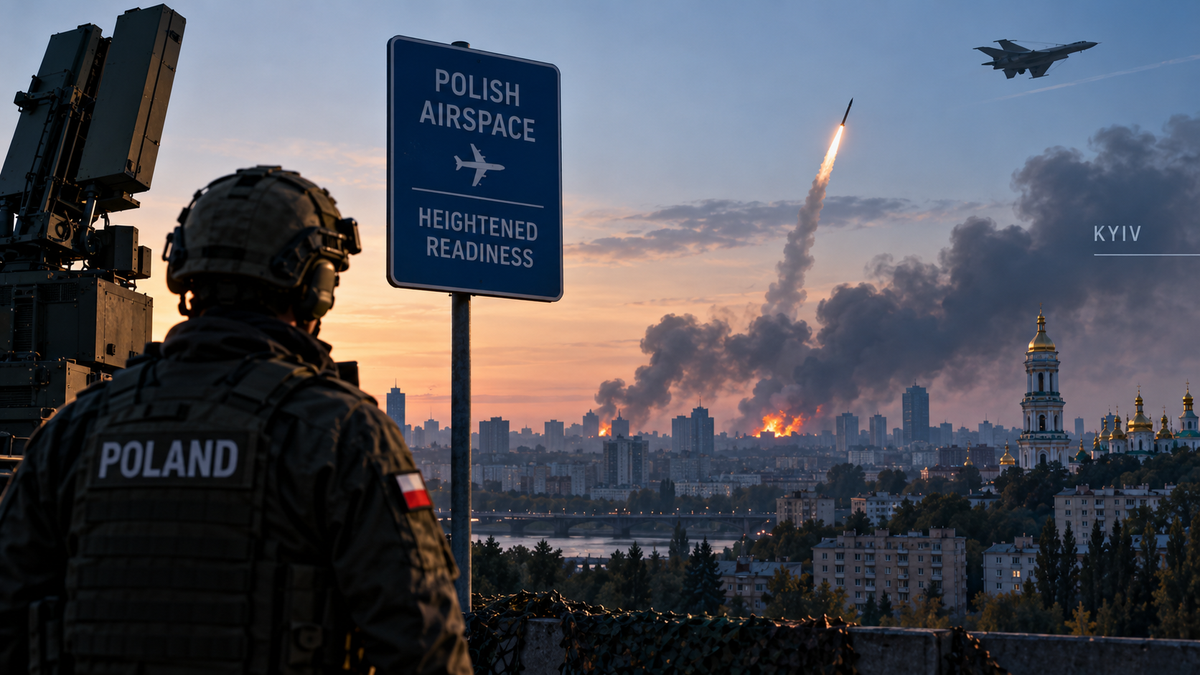
The three-day halt on strikes against Kyiv ended precisely where it was always going to end: at the edge of the American negotiators' travel schedule. Nothing was violated — an arrangement simply ran out that never claimed ceasefire status in the first place. The more consequential point lies elsewhere. The 8 September strike again mechanically generated an air response on NATO's eastern flank, two days before Poland converts that reflex into a standing administrative regime over its own airspace. The pause expires; the zone opens.
What happened
🟡 1. Ballistic strike on Kyiv after the envoys left
Russia resumed strikes on Kyiv in the early hours of 8 September, shortly after US negotiators Jared Kushner and Steve Witkoff departed. Mayor Vitali Klitschko reported casualties, people trapped in a residential building and fires across several districts. The Kyiv military administration separately reported a five-storey apartment building and a three-storey residential block damaged by falling debris.
Verification correction. The early Reuters cut on which the update was built recorded six injured and described the attack as ballistic. By mid-morning the picture had moved: Kyiv Post reports two killed and seven injured, while CNN, citing Ukrainian officials, describes a combined package of ballistic and cruise missiles plus drones. Ukraine's Air Force had warned specifically of a ballistic threat and tracked high-speed targets inbound to the capital.
BSM analysis: the divergence is not a digest error. It is the normal behaviour of wire reporting in the first two hours after impact. For BSM it confirms a standing rule: casualty counts and weapon composition at T+2h are always provisional, and "ballistic strike" in early copy far more often means "the first wave was ballistic" than "nothing else was used." The editorial consequence is concrete — do not build structural argument on the composition of a strike package for six to eight hours.
🟡 2. A pause that was never a confidence-building mechanism
The digest reads the situation as a pause that ended without maturing into wider de-escalation. Verification allows a sharper formulation.
Dmitry Peskov described the arrangement openly on 5 September: Putin ordered no strikes on Kyiv for three days beginning at midnight Saturday, and tied the order explicitly to preparations for the envoys' visit. Putin himself stressed that the two sides had not agreed to any broader ceasefire, and Peskov noted there was no talk of new ideas on the table. Volodymyr Zelensky, for his part, said Ukraine was ready to hold off striking Moscow through Monday and expected reciprocity over Kyiv. The Kremlin meeting ran more than three hours and ended with no announced breakthrough; after the Kyiv meeting on 6 September Zelensky acknowledged the war would most likely run into winter.
BSM analysis: the arrangement did not stop being a potential confidence-building mechanism — it never was one. It was a bilateral logistical deconfliction pegged to a delegation's route from Moscow through Rzeszów to Kyiv, with a pre-announced expiry and a pre-announced refusal to expand. The coding rule for future cycles follows directly: a pause whose duration equals the duration of a visit should not be scored as a de-escalation signal, because it is a travel-security measure. The first meaningful indicator will be a pause whose end date matches nobody's itinerary.
🟡 3. Polish aviation launched
Poland's Armed Forces Operational Command reported that military aviation had begun operating in Polish airspace, with ground-based air defence and radar reconnaissance brought to readiness. The command described the measures as preventive and directed at the security of regions bordering Ukraine.
BSM analysis: this is routine — and the routineness is the finding. The procedure became standard after repeated incidents of munitions falling on Polish soil, and Polish fighters have already carried out at least nine interceptions of Russian aircraft over the Baltic Sea during 2026. But routine has a price. Every mass strike on Ukraine consumes allied flight hours, airframe life and readiness margin with no engagement at the end of it. Russia obtains that attrition for free, as a by-product of a campaign aimed at someone else.
The signal outside the digest: zone EP R134
The most consequential fact of 8 September never reached the digest, because it happened before it.
From 10 September to 9 December 2026, eastern Poland falls under the temporary restricted airspace zone EP R134, running from ground level to flight level FL95 — roughly three kilometres. The Operational Command's stated purpose is to give the country's eastern air-defence system adequate freedom of action and the ability to respond effectively to potential threats while minimising disruption to civil aviation. Passenger traffic is effectively unaffected, operating far above the ceiling. Exceptions cover military aircraft and pre-coordinated take-offs and landings at Depułtycze Królewskie airport near Chełm; at night the airspace inside the zone reverts to unclassified status.
The decision's context is a July incident: Polish investigators confirmed that a Russian Kh-101 cruise missile, manufactured in the second quarter of 2026 at a plant in Moscow Oblast, came down in Lublin Voivodeship on 30 July. Polling afterwards showed nearly 38% of Poles dissatisfied with the authorities' response.
BSM analysis: this is the structural shift of the cycle. Until now the Polish answer to Russian strike packages was episodic and reactive — scramble the duty pair, raise air defence, stand down a few hours later. A three-month zone converts that logic into a standing posture: airspace is reserved for air defence in advance, whether or not a strike comes tonight. The dates matter. The Kyiv pause expires on 8 September; the zone opens on 10 September. Those two days are not a calendar coincidence but a measurable gap between a diplomatic cycle and a defence-planning cycle that are no longer synchronised.
There is a second reading, domestic. Thirty-eight percent dissatisfaction over the Kh-101 means the political cost of "nothing happened, it landed in a field" has risen in Warsaw. A permanent zone answers the electorate as much as the radar picture.
The mirror side
Overnight into 8 September, Ukrainian drones damaged civilian infrastructure and injured people in Saratov, some 730 km southeast of Moscow, in an area hosting a large Rosneft refinery alongside other industrial and military facilities. This breaches nothing: Zelensky's undertaking covered Moscow, and ran through Monday.
BSM analysis: both sides exited the pause with technically clean hands, which is exactly what makes the episode useful as precedent. Capital-city geography leaves both parties full operational latitude everywhere outside two cities. Any future proposal cut to the same pattern will produce the same outcome.
Regional context
- Namejs 26 — Latvia's comprehensive national defence exercise, 2 September to 8 October, with roughly 12,000 Latvian troops and Zemessardze volunteers joined by Canadian, US, Estonian and Lithuanian units under NATO Multinational Division North. The Polish scramble of 8 September therefore lands against the backdrop of the year's largest Latvian mobilisation exercise.
- The Polish-Belarusian border buffer zone has been extended by a further 90 days, to 29 November 2026.
- On 5–7 September Poland launched a military helicopter over an unidentified object approaching from Belarus; verification of radar records established the return came from a large flock of birds. Civil traffic in the sector was restricted and Rzeszów airport briefly suspended operations pending the check.
- The Baltic states' agenda. In May 2026 the presidents of Estonia, Latvia and Lithuania jointly called on NATO to move Baltic Air Policing from a policing to a full air defence mission and to reinforce the eastern flank with counter-drone capabilities. Poland's EP R134 is, in practice, a national implementation of the same logic, executed around a slower alliance decision.
Conclusion
8 September yields three clean findings and no alarming ones.
First, the pause performed precisely the function it was built for. It delivered the negotiators and then ended. It was not broken; it was used up.
Second, the diplomatic and defence tracks on the eastern flank no longer share a tempo. Washington measures progress in visits; Warsaw measures it in quarters, and has reserved its airspace through 9 December.
Third, and most important regionally: NATO's response to Russian strikes on Ukraine is ceasing to be an event and becoming a regime. An event has a start and an end, and it enters a digest. A regime enters nothing. It simply runs, spending resources every day.
A pause lasts as long as a delegation's flight. A zone lasts three months. The distance between those two numbers is the actual state of affairs.
Baltic Security Monitor (osint-baltic.com) — an analytical publication on security along NATO's northeastern flank. All OSINT coefficients are produced by an automated indexing system drawing on open sources. Every item above was verified independently of the digest.