The EU Commits to Joint Freyja Missile-Defence Development With Ukraine and a New SAFE-Funded Industrial Programme

Baltic Security Monitor | Analytical Briefing Event: 16 September 2026 · Published: 17 September 2026
It's worth separating two things here: political commitment and operational capability. Ursula von der Leyen didn't announce a finished air-defense system, a production contract or an in-service date — she announced that joint EU-Ukraine development of Freyja is now an explicit EU policy objective, and that remaining SAFE funding will go toward joint projects with Ukrainian companies. That's a step from aid procurement toward industrial integration — but the Strasbourg speech itself isn't a contract yet.
What happened
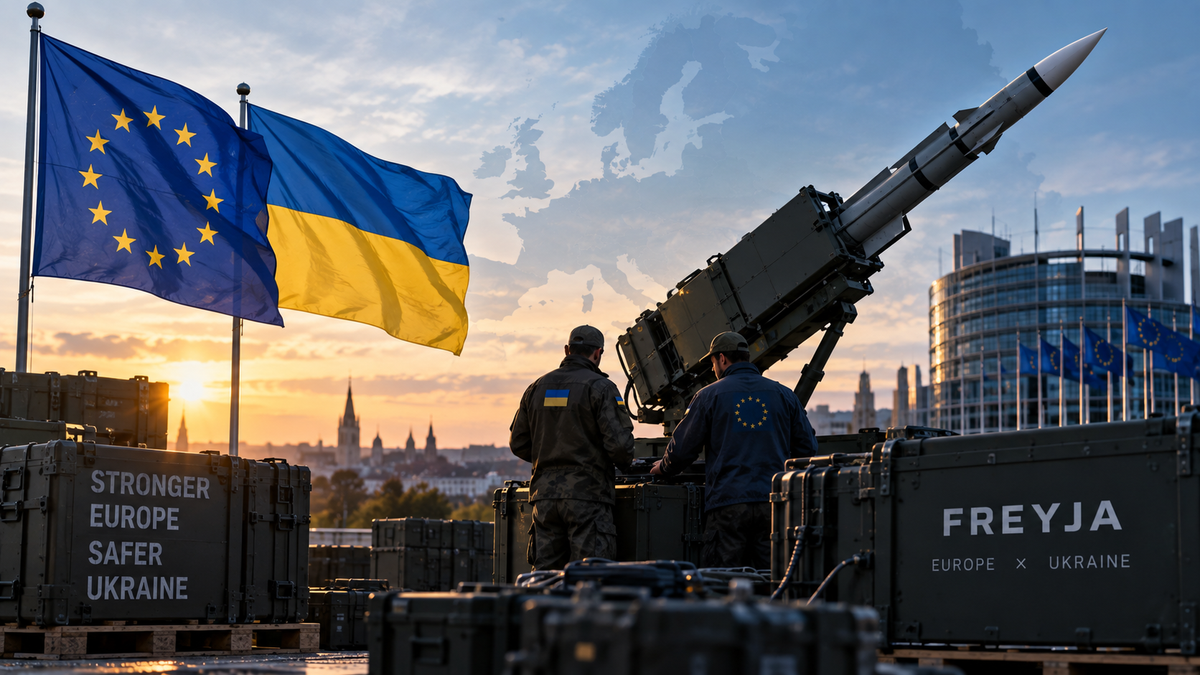
In her annual State of the Union address on 16 September, European Commission President Ursula von der Leyen said the EU wants to develop an affordable, modular missile-defence system together with Ukraine, with the Freyja project at its core. The cooperation, she said, would combine Ukrainian combat experience and innovative capacity with Europe's technological leadership and substantial production capacity. Von der Leyen also announced that remaining funds under the EU's €150 billion SAFE defence-loan instrument would go toward a new programme for joint projects with Ukrainian companies; Euronews estimates roughly €10–15 billion remains unallocated after several member states reduced their initial borrowing requests.
Freyja was already under development: on 8–9 September, President Zelenskyy met with defence-company executives in Norway specifically to discuss the anti-ballistic programme, and a ten-country ballistic-missile-defence coalition had already formed earlier in the summer. What's new is that the European Commission has now formally adopted joint Freyja development as an explicit EU policy objective, rather than merely supporting it as a side initiative.
BSM analysis: In the same speech, von der Leyen noted that the EU had, for the first time last week, approved the purchase of U.S.-made Patriot interceptor missiles and stressed the urgency of delivering them — directly echoing the PAC-3 derogation BSM covered separately just days earlier. Freyja's logic extends that same line directly: reduce dependence on a single supplier (the U.S.) by developing a European-Ukrainian alternative. Von der Leyen also announced a new European Instrument for Strategic Enablers to strengthen capabilities like air and missile defence, strategic transport, space and cybersecurity — explicitly designed to be fully aligned with NATO.
What's still uncertain
🟡 The precise allocation of funds, eligibility rules, governance mechanism and timetable for the new programme haven't been published yet. The €10–15 billion figure is an estimate of unused SAFE borrowing capacity; von der Leyen didn't say all of it would ultimately go to joint projects with Ukraine.
🟡 No operational Freyja capability has been publicly demonstrated. If the project produces a viable lower-cost interceptor architecture, it could eventually complement Patriot and other high-end systems both in Ukraine and across NATO's eastern flank — but that remains a prospect, not yet a fact.
Regional context
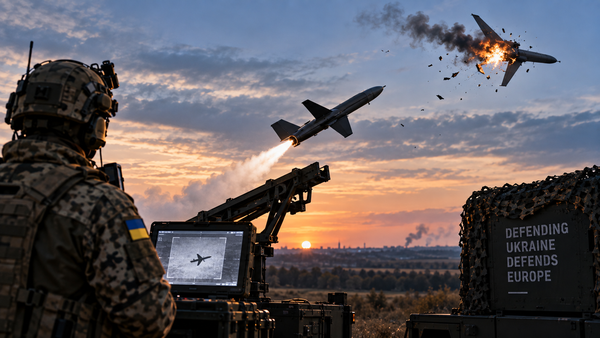
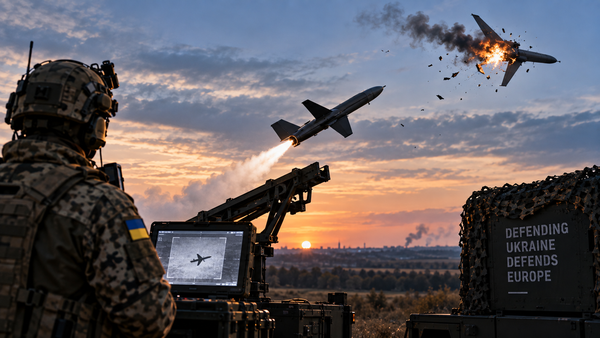
For Estonia, Latvia, Lithuania, Poland, Finland and the rest of NATO's northeastern flank, the problem Freyja is trying to solve is directly transferable. The mixed missile-and-drone campaigns seen over Ukraine demonstrate how difficult it is to protect infrastructure and military formations when every interception depends on scarce, expensive top-tier ammunition. If Freyja succeeds, an affordable European-Ukrainian architecture could eventually contribute to layered air and missile defence of Europe's eastern flank, while simultaneously boosting Ukraine's defence-industrial capacity.
Notably, in the same speech, von der Leyen proposed a new EU emergency-consultation mechanism for hybrid incidents (sabotage, cyberattacks, drone incursions), modeled on NATO's Article 4, along with a European Security Council involving partners such as Canada, Norway, Ukraine and the UK — explicitly calling it a "counter-hybrid playbook." That resonates directly with the recent cluster of drone and maritime incidents BSM has been covering — the Lithuanian drone, the Danish frigate, the Polish border corridor — exactly the kind of episodes such a mechanism is designed to address.
Bottom line
The details worth watching next are a defined SAFE allocation, named industrial participants, signed development or production contracts, Freyja flight/intercept testing, and an actual procurement decision. For now, this is an institutional step rather than an operational one — and the transition from speech to signed contracts will determine whether Freyja becomes a real complement to Patriot or stays a political declaration.
Baltic Security Monitor (osint-baltic.com) — an analytical outlet covering security on NATO's northeastern flank. Compiled from open sources and BSM's automated OSINT monitoring system.