Sweden Signs Contract for Four French Frigates: NATO's Baltic Fleet Gets an Air-Defence Buildout Through the 2030s

Baltic Security Monitor | Analytical Brief As of 1 September 2026, 14:00 EEST
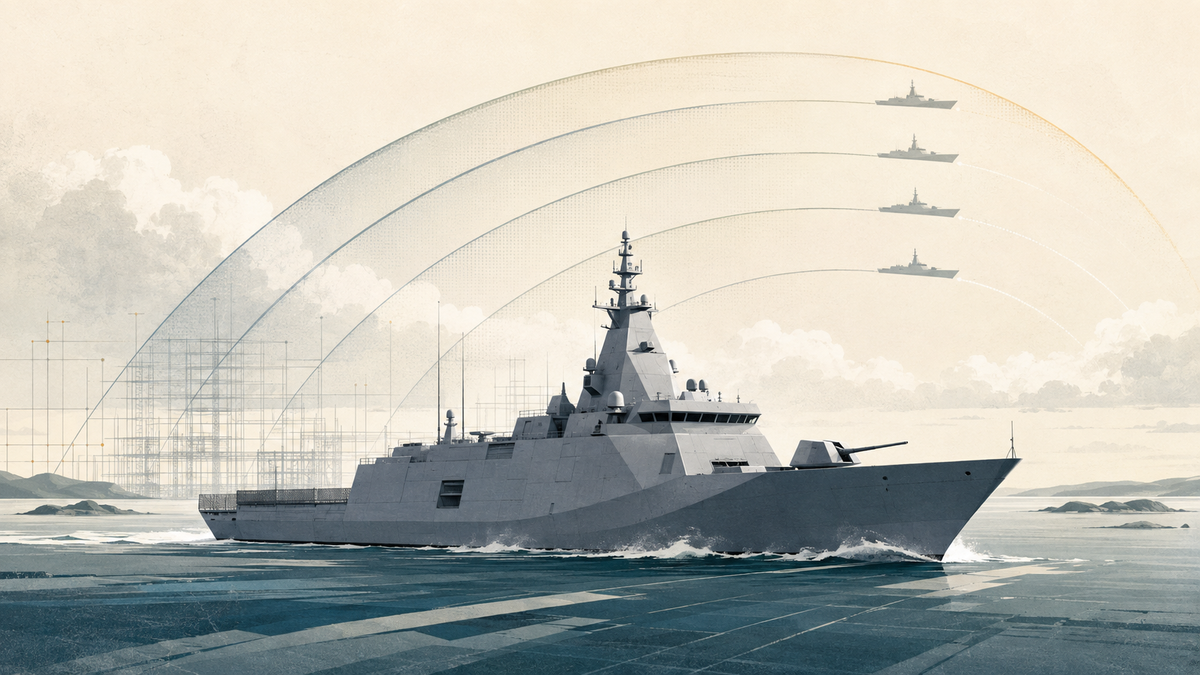
On 31 August, Sweden's Defence Materiel Administration (FMV) and France's Naval Group signed the procurement contract for four air-defence frigates for the Royal Swedish Navy. The ceremony took place in Stockholm, aboard the lead ship of France's own FDI class, in the presence of French President Emmanuel Macron and Swedish Prime Minister Ulf Kristersson; the contract was signed by FMV Director-General Mikael Granholm and Naval Group Chairman and CEO Pierre Éric Pommellet. The ships will enter Swedish service as the Luleå class — a Swedish configuration of France's Frégate de Défense et d'Intervention (FDI) design — fitted with advanced anti-air and anti-submarine systems. Contract signature means construction and Swedish crew training can now begin: the first vessel is scheduled for delivery in 2030, with the remaining three following roughly one per year.
The agreement formalizes a decision Stockholm first announced on 19 May 2026, when it selected Naval Group over two other contenders — Babcock's Arrowhead 120 and Navantia's ALFA 4000. AP puts the package's value at roughly €4.3 billion ($5 billion), covering weapons, additional equipment, and training. Swedish Defence Minister Pål Jonson said the four ships will triple the country's current air-defence capability. Kristersson said they are meant to protect military and civilian maritime links and help keep vital sea routes open. The same day, Sweden and France also signed a separate framework agreement on operational cooperation, defence capabilities, and industrial development.
The notable part isn't the choice of supplier — that was already known since May. What matters is that the contract moves the program from a political decision into execution: there is now a legally binding delivery timeline starting in 2030, and ship construction can begin immediately. That meets BSM's delta test as a concrete, signed implementation step rather than another statement of future intent.
BSM analysis: from coastal corvette to a major Baltic combatant
The Luleå program has gone through a long transformation. It began in 2021 as a Saab contract for preliminary design of an air-defence corvette based on an enlarged, improved Visby class — dubbed "Visby Generation Two." After Russia's full-scale invasion of Ukraine in 2022 and Sweden's accession to NATO, the program grew in scope: Babcock joined in 2023 as the planned vessel expanded into a full surface combatant rather than a coastal corvette. Stockholm ultimately shifted to evaluating existing foreign designs and selected the French FDI, already under construction at Naval Group's Lorient shipyard for the French Navy and also ordered by Greece — chosen primarily for speed of delivery, design maturity, and the ability to share costs with other operators.
The Swedish configuration will pair the French hull with Swedish systems: Saab's RBS 15 anti-ship missile, a lightweight torpedo, the Giraffe 1X radar, and the Trackfire remote weapon station, along with 57mm and 40mm naval guns from BAE Systems Bofors. According to Naval News, the ships will also carry Aster 30 and CAMM missile systems. Rear Admiral Johan Norlén, Chief of the Royal Swedish Navy, wrote in Svenska Dagbladet that Sweden's NATO accession dramatically expanded the navy's operational scope beyond territorial defense — now including maintaining operational control over the Baltic Sea and its approaches to guarantee critical sea lines of communication for Sweden and its regional allies, including Finland and the Baltic states.
Why it matters for Ukraine and the Baltic region
The Baltic Sea remains central to NATO reinforcement routes, commercial shipping, and the defense of Sweden, Finland, and the Baltic states. Sweden is adding substantially larger surface combatants with area air-defence and anti-submarine capabilities specifically intended to protect maritime transport, preserve sea access, and increase interoperability with allied forces.
The war in Ukraine is explicitly part of the rationale: Kristersson cited lessons from Ukraine on defending against ballistic missiles, and Sweden's broader post-2022 military expansion is aimed at strengthening NATO's northern and Baltic posture. The procurement also ties a major Nordic naval recapitalization program to France's defence-industrial base and comes alongside a new bilateral operational and industrial framework — deepening intra-European defence integration beyond this single contract.
Bottom line
This capability buildup is long-term, not immediate: the first ship won't arrive before 2030, and the full complement of four frigates won't be complete until the mid-2030s. The next indicator for BSM to watch is not the signing itself — that has already happened — but the pace of construction at Lorient, the specifics of the Swedish-French industrial framework agreement, and whether the Luleå program becomes a reference point for other Baltic states also expanding their surface fleets amid a protracted war on their doorstep.
Baltic Security Monitor (osint-baltic.com) — an analytical publication covering security on NATO's north-eastern flank. All OSINT indices are calculated by an automated indexing system based on open sources.