Sweden Moves to Expropriate a Russian-Owned Plot Near Muskö Naval Base: The Drone Threat Is Rewriting How Military Sites Get Protected

Baltic Security Monitor | Analytical Review Material OSINT Update — 26 August 2026, 08:00 Europe/Tallinn
Materiality assessment
| Parameter | Value |
|---|---|
| Status | MATERIAL UPDATE |
| Category | Military posture / Critical infrastructure / Counter-UAS |
| Materiality | medium-high |
| 🟡 markers (unconfirmed/forecast) | 4 |
| 🔴 markers (confirmed fact) | 0 |
This is not another warning about the risks of Russian-owned property near NATO facilities — it is the first concrete step toward forcibly removing one, explicitly citing the drone threat. Sweden's Fortifications Agency filed a formal expropriation application on 25 August for land near the Muskö naval base, and the Chief of Defence Staff directly linked the need for the move to the growing threat from unmanned aerial and maritime systems. The materiality here isn't that a "problem" property exists — it's the shift from concern and administrative review to a concrete legal procedure.
Verifying the 🟡-flagged points
1. "The owner's Kremlin connection is not established in the official notice — unlike the confirmed fact of Russian citizenship." Confirmed. The official press release from the Fortifications Agency and the Swedish Armed Forces describes the owner only as a Russian citizen assessed as a security threat, with no mention of specific Kremlin ties. The "Kremlin connections" framing comes exclusively from Swedish media and independent Euronews reporting, not from the official expropriation document. The 🟡 flag in the source is accurate: it marks a distinction between two different tiers of sourcing, not a downplaying of the case's seriousness.
2. "If the government approves the expropriation, Sweden will incorporate the site into layered base protection." A forward-looking claim by definition — the government's decision has not been made, and no timeline has been officially given. Correctly flagged as a hypothesis 🟡.
3. "The case may prompt a review of property near defence facilities elsewhere in Sweden and the region." This turned out to be more than a plausible forecast — it's an already-existing process. Sweden separately launched a review of its Expropriation Act, led by Court of Appeal Judge Henrik Matz, with recommendations due by 31 March 2027, specifically aimed at expanding powers to seize "problem" property. That means the direction of travel is already set independent of how the Muskö case resolves; this point is more accurately framed not as an open forecast but as part of an already-documented, dated process.
4. "The case could establish a practical precedent for using property law as a national-security instrument." A forward-looking claim that cannot be verified in advance. That said, the context (a law review already oriented toward exactly this kind of case) makes the scenario less speculative than a forecast starting from zero — the degree of uncertainty here is lower than a standard forward-looking claim.
Verification conclusion: three of the four 🟡 markers hold up without qualification. The fourth (point 3) needs refinement: the Muskö case is not a hypothetical trigger for a future legislative review — it is the first practical test case of a process already launched and dated. This is not an error in the source update, but a detail that further research can sharpen.
What happened
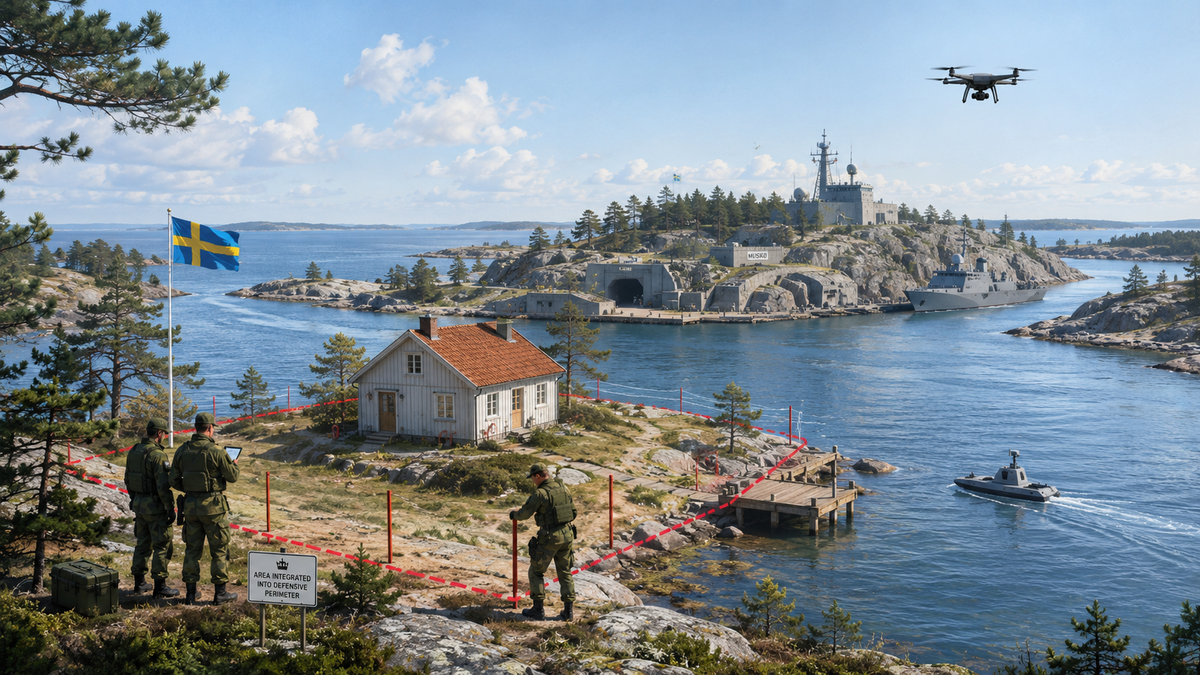
Sweden's Fortifications Agency (Fortifikationsverket) submitted a formal expropriation application to the government on 25 August for a property at one of the approaches to the Muskö naval base in the Stockholm archipelago. The application was filed at the request of the Swedish Armed Forces, which say the site has unique value for strengthening the base's defence, particularly against drones (Fortifikationsverket, 25 August 2026).
The Armed Forces say the property's owner holds Russian citizenship and is assessed as constituting a security threat. Chief of Defence Staff Lt. Gen. Carl-Johan Edström said the present ownership creates an unacceptable security risk, tying the requirement directly to the growing threat from aerial and maritime unmanned systems. The government must now decide whether to authorise the expropriation (Fortifikationsverket). The Armed Forces' own press release describes the site as the missing piece: the only approach point to the base not currently under military control, and one needed to establish effective perimeter protection (mynewsdesk.com/forsvarsmakten, 25 August 2026).
Independent AFP/Euronews reporting confirms the military's request and its counter-drone rationale. Swedish media identify the owner as a Russian businessman with Kremlin connections, but that specific political tie is not established in the official expropriation notice and should be treated separately from the confirmed fact of Russian citizenship (Euronews, 25 August 2026).
The decision was announced on 25 August and falls within this cycle's 24-hour look-back rather than counting as a separate overnight event.
What changed
The property had previously been regarded as a security concern, but Sweden has now moved from concern and administrative review to a formal legal procedure intended to place the site under state control.
BSM analysis: The material delta is the Armed Forces' explicit conclusion that the current owner constitutes a security threat, and that control of this particular site is required to establish effective defence of Muskö, especially against drones. This is concrete implementation, not another general warning about Russian-linked property or the unmanned-systems threat in the abstract.
Why it matters for Ukraine and the Baltic region
Muskö is a strategically important Swedish naval facility inside the Stockholm archipelago and the wider Baltic operating environment. The case shows Sweden hardening military infrastructure not only through sensors, weapons and personnel, but through control of the physical terrain surrounding key bases.
The Swedish military explicitly says Russia's development of drone warfare has changed Sweden's threat environment. For Baltic and Nordic NATO states, that reinforces a broader shift toward treating nearby property, observation points, possible launch sites and approaches to military facilities as part of counter-UAS and counter-sabotage planning. The Ukraine connection is indirect but operationally important: Russian drone warfare and the wider pattern of hybrid-security incidents across Europe are increasingly reshaping how NATO states protect naval bases, ports, airfields and logistics hubs.
BSM analysis: The Muskö case did not emerge in a vacuum — it sits inside an already-documented, broader Swedish process. Sweden separately launched a review of its Expropriation Act, led by Court of Appeal Judge Henrik Matz, due to deliver recommendations by 31 March 2027, aimed at expanding authorities' powers to seize property that poses a security risk — including cases where ownership could facilitate "sabotage or espionage against Sweden," in Defence Minister Pål Jonson's words. Former Defence Minister Peter Hultqvist has estimated that Russian citizens own roughly 247 properties across northern Sweden and the Stockholm region, some located near military facilities or strategically important companies (United24 Media). A separate documented case involves property linked to the Russian Orthodox Church near Västerås Airport, which has drawn concern from Sweden's Security Service. The Muskö plot itself has been under its current ownership since 2017, when it was purchased by businessman Stanislav Aleshchenko (United24 Media).
The wider European context is even starker: per Western intelligence assessments cited by The Telegraph, Russians are systematically buying residential and commercial property near NATO installations, ports and strategic infrastructure in at least a dozen European countries — from Finland (17 properties acquired by the company Airiston Helmi near strategic sea routes) to the Baltic states, Norway, Sweden and the UK; intelligence officials describe this as a network of "Trojan horses" for espionage, sabotage and preparation for possible attacks, including storage of drones or explosives. Finland and the Baltic states have responded by effectively banning Russian and Belarusian citizens from buying real estate; loopholes remain in the UK and elsewhere (Militarnyi, citing The Telegraph).
Likely implications
- If the government approves the expropriation, Sweden will be able to incorporate the site into Muskö's layered base-protection and counter-drone architecture. 🟡 (contingent on a government decision not yet made)
- The case is most likely to become not the trigger, but the first practical test case, of an already-launched review of property law around defence facilities and critical infrastructure elsewhere in Sweden and potentially across the wider Nordic-Baltic region — a review that formally began independent of the Muskö case, with recommendations due by 31 March 2027.
- It could also establish a practical precedent for using ordinary property and expropriation law as a national-security instrument when the armed forces can demonstrate a specific operational requirement. 🟡
BSM analysis: Sweden's review of the Expropriation Act under Judge Matz is an existing process with a concrete deadline, not a potential future reaction to the Muskö case. That means Muskö is most likely to become not the trigger for such a review, but the first practical test case within a process already underway.
Bottom line
The Muskö expropriation application is material not because it conclusively proves the specific owner's tie to the Kremlin — per official records, that link remains a journalistic characterisation rather than a legal finding — but because Sweden has, for the first time, converted concern about Russian-owned property near military sites into a concrete legal action with an explicit counter-drone rationale. Combined with the roughly 247 properties already owned by Russian citizens in strategically sensitive parts of Sweden, and the broader European pattern of "Trojan horse" property near NATO bases, this points to a new phase: moving from mapping the risk to removing it.
Baltic Security Monitor (osint-baltic.com) — an analytical publication covering security on NATO's northeastern flank. Materiality assessments and 🟡/🔴 status markers are reproduced from the source BSM analytical cycle; every 🟡-flagged point was independently checked against outside sources.