Sweden Joins the Defence of Finland's Border Against Drones: Ukraine's Drone War Is Reshaping Air Defence on NATO's Northern Flank

Baltic Security Monitor | Analytical Review Material OSINT Update — 28 August 2026, 14:00 Europe/Tallinn
Materiality assessment
| Parameter | Value |
|---|---|
| Status | MATERIAL UPDATE |
| Category | Military posture / Border-Air / Counter-UAS |
| Materiality | medium-high |
| 🟡 markers (unconfirmed/forecast) | 4 |
| 🔴 markers (confirmed fact) | 0 |
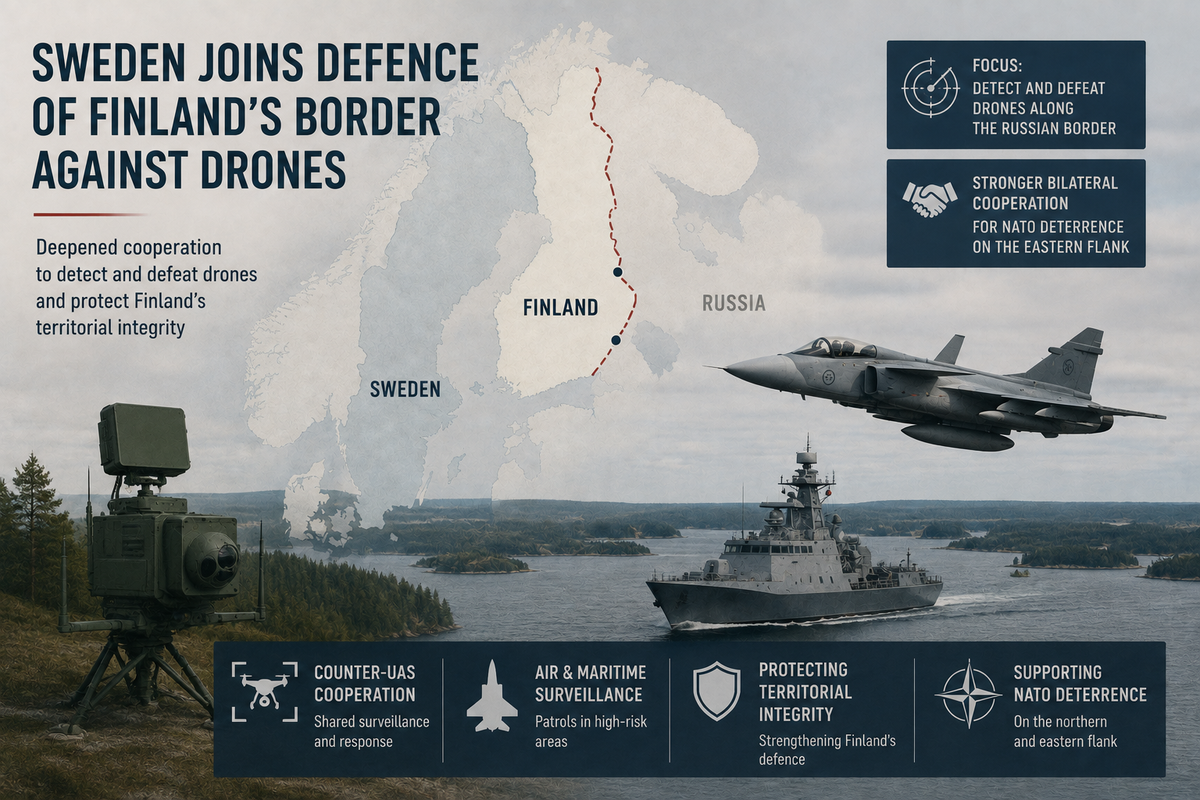
Sweden and Finland announced on 28 August that they are deepening bilateral defence cooperation to strengthen territorial surveillance and the protection of Finland's territorial integrity, with detecting and countering drones named explicitly as the goal. The materiality isn't another statement about the drone threat — it's that already-close air and maritime cooperation between the two countries is now formally extending to territorial surveillance and land-border defence, including along NATO's longest land border with Russia.
Verifying the 🟡-flagged points
1. "The official announcements do not specify the forces, aircraft or systems involved; separate Swedish media reporting names JAS 39 Gripen fighters and other units near Finland's Russian border, but this is not confirmed by either government announcement." Confirmed, and independent research adds detail. Swedish broadcaster SVT reported that Sweden will deploy Gripen fighter jets and naval vessels to Finland at Helsinki's request, focused on air and maritime patrols in higher-risk areas, with counter-drone army units potentially added in autumn if needed. Finland's Ministry of Defence confirmed strengthened cooperation on monitoring territorial integrity but did not name Gripen jets or specific units in its official statement — nor did Finnish President Alexander Stubb, who called it "a new step in Finnish-Swedish defence cooperation" without confirming the SVT report's technical detail. The 🟡 flag in the source accurately captures the gap between the confirmed fact of cooperation and the media-sourced detail of its content.
2. "The precise Swedish force contribution remains undisclosed." Confirmed, via the same source (SVT/Helsinki Times): official statements from both defence ministries do not specify forces. This is an accurate flag, not an understatement of the step's significance.
3. "Sweden is likely to contribute surveillance, aviation, or other military assets to reinforce Finnish monitoring along the Russian border." A forward-looking claim by genre, but one that was already close to happening at the time of this check: per SVT, the deployment of fighters and ships is described as starting "in the near term," focused on higher-risk areas. That doesn't change the flag's formal status — there is still no official government confirmation of force composition — but it substantially narrows the uncertainty compared with an open-ended forecast.
4. "The arrangement could become a template for more routine cross-border counter-UAS support between Nordic and Baltic NATO members." Correctly flagged as a forecast — this can only be judged by future instances of the model being applied. Nothing in the sources checked confirms or rules out this scenario in advance.
Verification conclusion: all four 🟡 markers hold up. The most useful refinement is on point 1: independent Swedish reporting (SVT) doesn't merely hint at possible Gripen involvement — it describes a concrete, near-imminent deployment plan for fighters and ships that simply hasn't received official confirmation on the hardware specifics. The distinction between "entirely unknown" and "known from media, not confirmed by government" is precisely the line 🟡 is meant to mark.
What happened
Sweden and Finland announced on 28 August that they will deepen bilateral defence cooperation to strengthen territorial surveillance and the protection of Finland's territorial integrity. Both governments say the cooperation will specifically improve Finland's ability to detect and counter drones and will support NATO deterrence and defence on the eastern flank (Regeringskansliet, 28 August 2026).
Both defence ministries explicitly linked the measure to recent drone incursions resulting from Russia's war against Ukraine. Swedish Defence Minister Pål Jonson and Finnish Defence Minister Antti Häkkänen described it as an extension of already-close bilateral air and maritime cooperation into territorial surveillance and territorial defence (Regeringskansliet). Finnish President Alexander Stubb called it "a new step in Finnish-Swedish defence cooperation." Minister Häkkänen added that "aviation and maritime cooperation is already an integral part of our bilateral and Nordic cooperation" (Anadolu Agency, 28 August 2026).
The official announcements do not specify the exact forces, aircraft or systems involved. Separate Swedish-media-derived reporting says JAS 39 Gripen fighters and other Swedish military units could participate around Finland's Russian border, but that force composition has not been confirmed in either government announcement (AeroTime). Per Swedish broadcaster SVT, the operation is set to begin in the near term and will focus on air and maritime patrols in areas considered at risk; counter-drone army units could be added later in autumn if needed (Helsinki Times, citing SVT).
The decision was published at 11:00 local time on 28 August, after the previous 08:00 BSM monitoring window.
What changed
Finland and Sweden already had extensive bilateral air and maritime defence cooperation, while Finland had separately strengthened counter-UAS measures following repeated drone incursions connected with Ukrainian attacks on targets in north-western Russia.
BSM analysis: The material delta is that the two allies have now formally extended cooperation into joint territorial surveillance and protection of Finland's territorial integrity, with detection and defeat of drones named as a specific operational objective. This is an implementation step in allied defence, not another general statement about the drone threat.
Why it matters for Ukraine and the Baltic region
Finland has NATO's longest land border with Russia and has repeatedly had to manage the spillover risk created by Ukrainian long-range drone strikes against targets near the Gulf of Finland and north-western Russia. The new arrangement moves part of that burden from a purely Finnish national response toward cross-border allied defence cooperation.
The backdrop to this shift is documented well beyond the source update itself: through 2026, Finland has repeatedly dealt with aerial incidents — drone crossings and suspected Russian airspace violations that temporarily shut down airports (Anadolu Agency).
For the Baltic region, this is another indication that the drone war in Ukraine is reshaping NATO's peacetime territorial-defence architecture. Detection, identification and interception of low-altitude unmanned systems are increasingly being treated as shared regional tasks rather than solely national air-policing problems.
The development also coincides with a wider regional move: German Interior Minister Alexander Dobrindt said on 28 August that Baltic Sea countries are planning a joint drone-defence task force intended to improve rapid information exchange against hybrid and unmanned threats (Reuters, 28 August 2026).
BSM analysis: These two same-day developments — the Swedish-Finnish bilateral arrangement and Germany's statement on a Baltic-wide task force — are best read as two layers of the same trend: bilateral deepening between close neighbours (Sweden-Finland) alongside the parallel formation of a broader multilateral structure (the Baltic Sea as a whole). Neither replaces the need for the other: the bilateral model offers speed and trust between two militaries with a long history of cooperation, while the multilateral one provides coverage for countries without that same depth of mutual trust.
Likely implications
- Sweden is likely to contribute surveillance, aviation or other military assets capable of reinforcing Finnish monitoring and response along the Russian border, but the exact force package is not yet officially disclosed. 🟡
- The arrangement could become a template for more routine cross-border counter-UAS support between Nordic and Baltic NATO members, particularly during large Ukrainian strike waves against north-western Russia. 🟡
- If Swedish Gripen fighters or other armed units begin regular operational deployments specifically for Finnish territorial protection, that would constitute a further material delta requiring separate confirmation.
BSM analysis: Per SVT, the first point is already close to being realised — the deployment of aircraft and ships is described as starting "in the near term," not as a distant possibility. That doesn't change the formal 🟡 status (there is still no official confirmation of force composition), but it narrows the timeframe in which BSM should expect a first confirmed instance.
Bottom line
The Sweden-Finland arrangement is material not because it discloses a specific military order of battle — official sources still haven't done that — but because it formalises a shift from a purely Finnish national response to the drone threat toward a shared bilateral architecture of surveillance and territorial protection. Combined with Germany's parallel same-day statement on a Baltic-wide drone-defence task force, this confirms a broader trend: Ukraine's drone war is increasingly turning peacetime territorial defence on NATO's northern and Baltic flank into a shared undertaking rather than a purely national one.
Baltic Security Monitor (osint-baltic.com) — an analytical publication covering security on NATO's northeastern flank. Materiality assessments and 🟡/🔴 status markers are reproduced from the source BSM analytical cycle; every 🟡-flagged point was independently checked against outside sources.