Sweden Authorizes HIMARS Purchase, Builds a Joint Rocket-Artillery Framework With Finland: NATO's Northern Flank Gets a New Long-Range Fires Contour

Baltic Security Monitor | Analytical Brief As of 7 September 2026, 20:00 EEST
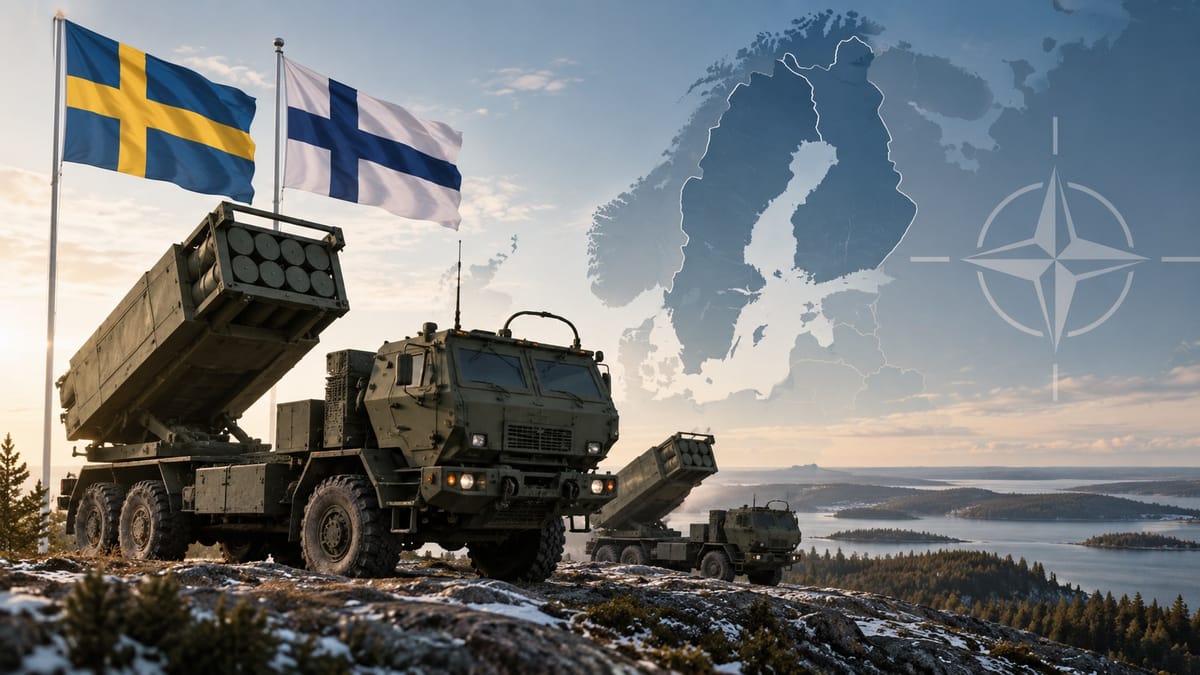
On 7 September, the Swedish government authorized the armed forces to procure the US-made HIMARS rocket-artillery system, built by Lockheed Martin — a capability Sweden currently lacks. The deal is valued at roughly SEK 7 billion (about $729 million), with first deliveries scheduled for 2027. According to Swedish Defence Minister Pål Jonson, the package covers around ten launchers plus ammunition. The purchase will be financed through the armed forces' regular investment plan as an "opportune purchase" under the Total Defence Bill 2025–2030.
The same day, Jonson and Finnish Defence Minister Antti Häkkänen signed a joint declaration on rocket-artillery cooperation, covering training, capability development, maintenance, security of supply, and production cooperation. Finland already operates the tracked M270 MLRS, which uses the same munitions and components as HIMARS — giving the two countries a shared basis for joint training, support, and capability development. "The introduction of rocket artillery clearly demonstrates that Sweden is taking responsibility for security in Europe," Jonson said. "The Joint Declaration with Finland aims to boost capacity-building, maintenance and security of supply for the systems... Together, we are developing important capabilities for NATO's collective defence."
Separately, Saab and Lockheed Martin signed an industrial declaration covering potential integration of Saab's Ground-Launched Small Diameter Bomb (GLSDB) and cooperation on ammunition production for HIMARS and other systems, including Patriot. According to Defence Matters, Saab and Lockheed Martin also signed a separate letter of intent to manufacture the PrSM precision-strike missile in Sweden — another ammunition type compatible with HIMARS. The driver behind these production arrangements is a global shortage of HIMARS ammunition; Stockholm explicitly presents the cooperation as a way to strengthen ammunition security of supply. No completed integration program, production contract, or actual Swedish GLSDB order has been announced — this is a declaration of intent, not a signed contract.
The notable part isn't the purchase itself — this decision had been anticipated. What's new is that Stockholm has moved from planning to formal procurement authorization with a concrete delivery timeline starting in 2027, while simultaneously creating a dedicated institutional framework with Finland for jointly developing and sustaining compatible long-range rocket-artillery systems — rather than simply conducting general bilateral military cooperation.
BSM analysis: closing a capability gap, not a one-off purchase
Sweden previously relied on conventional artillery such as Archer and had no modern rocket-artillery system comparable to HIMARS or M270 in its arsenal. HIMARS will let Swedish forces engage command posts, air defense, logistics, and artillery at significantly greater ranges than current systems allow — complementing conventional capabilities like Archer and grenade launchers while maintaining compatibility with allied systems.
Importantly, this decision continues an already-established line of Swedish-Finnish military integration: it follows the 28 August agreement on territorial surveillance and protection of Finnish territorial integrity, including counter-drone activity, and a Nordic security-of-supply declaration signed on 2 September. Shared ammunition families, training, maintenance, and production arrangements make it increasingly reasonable to treat Swedish and Finnish rocket artillery as a single regional capability rather than two isolated national systems.
Why it matters for Ukraine and the Baltic region
For NATO's northern and north-eastern flank, HIMARS fills an important Swedish long-range fires gap and aligns Sweden more closely with Finland's existing M270 fleet. Shared ammunition families, training, maintenance, and production arrangements make it easier to treat Swedish and Finnish rocket artillery as a regional capability — especially relevant to the defense of northern Finland, Sweden, and the wider Baltic approaches, where dispersed forces, long distances, and reinforcement routes make long-range precision fires operationally valuable.
The industrial component also matters for Ukraine. European support for Kyiv has repeatedly run into limitations in stocks and production rates for precision-guided munitions. Saab-Lockheed cooperation could eventually add another Nordic manufacturing node for NATO-compatible ammunition. The immediate effect on Ukraine, however, remains indirect: these HIMARS systems are being procured for Sweden's own use, not announced as a transfer to Ukraine.
Bottom line
The next indicator to watch is whether the Saab-Lockheed industrial declaration develops into actual production contracts — production types, quantities, and schedules remain unconfirmed. Potential GLSDB integration could broaden Sweden's future precision-strike options, but for now this remains a declaration of intent, not a completed acquisition or fielded capability. Before Swedish deliveries begin in 2027, Sweden and Finland are likely to develop joint training, maintenance, and operational concepts around the HIMARS/M270 family.
Baltic Security Monitor (osint-baltic.com) — an analytical publication covering security on NATO's north-eastern flank. All OSINT indices are calculated by an automated indexing system based on open sources.