Seoul Confirms North Korea Is Preparing a New Contingent for Russia — But Not 50,000, and Not Imminent

Baltic Security Monitor | Material Update Published: 24 August 2026, 08:00
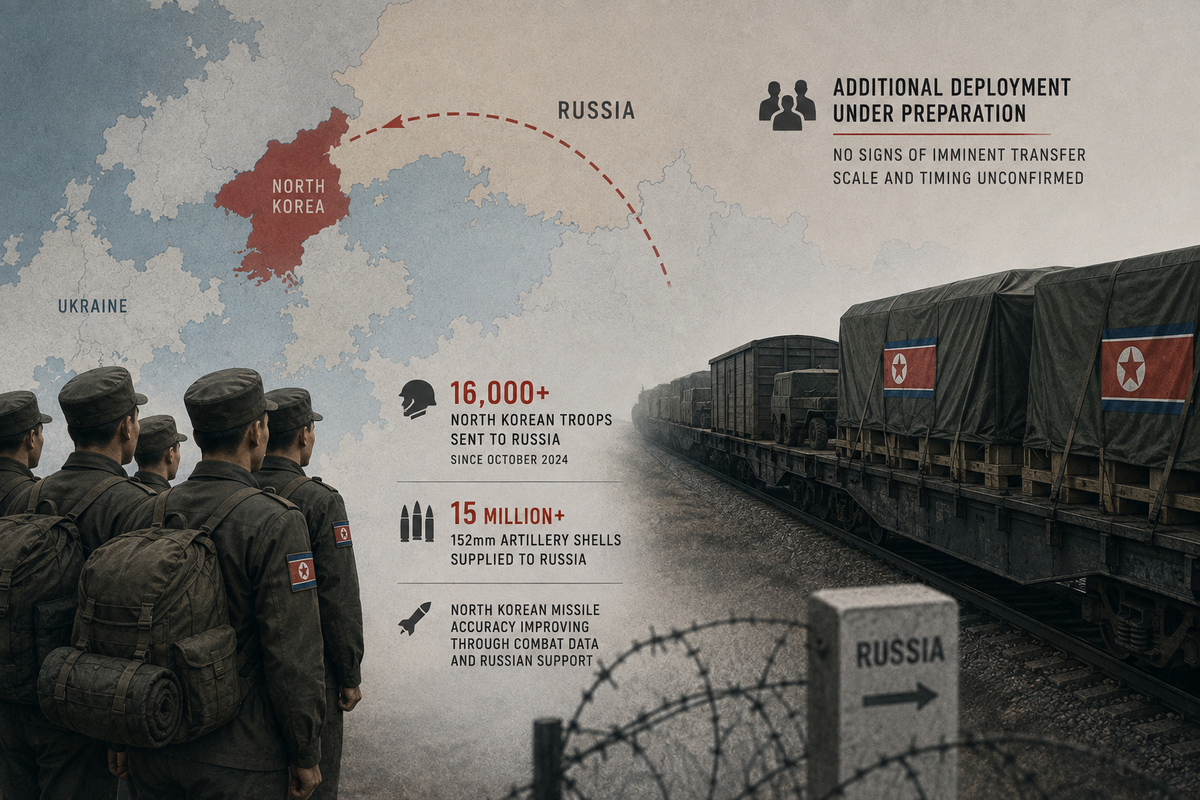
South Korea has, for the first time, officially confirmed something that until now rested on Ukrainian intelligence and Zelensky's own statements: North Korea continues preparing for an additional troop deployment to Russia. But the confirmation covers the fact of preparation — not the scale, and not the timeline. Seoul is explicit: no signs of imminent deployment have been detected, and South Korean intelligence does not validate the 30,000–50,000 figure. This is exactly the kind of story where precision matters more than drama.
What happened
South Korea's Defense Intelligence Agency (DIA), in information submitted to lawmaker Yoo Yong-won and published by Yonhap on 23 August, publicly assessed for the first time that North Korea continues preparations for an additional troop deployment to Russia. According to a military official, Pyongyang appears to be conducting internal preparations for a possible deployment, but no working-level movement pointing to actual preparations has been detected so far. Reuters independently confirmed the assessment, citing South Korea's Defence Ministry.
This provides partial independent corroboration of a story BSM had previously kept in WATCH. President Volodymyr Zelensky initially said roughly 30,000 additional North Korean troops could deploy, later raising the figure to as many as 50,000. Kim Yo Jong, sister of Kim Jong Un, explicitly called that claim "completely groundless" on 19 August. Seoul now confirms that preparations for a possible additional deployment exist, while stopping well short of validating either Kyiv's number or a near-term timeline.
South Korean intelligence also assesses that North Korea has sent more than 16,000 personnel to Russia since October 2024 (a significant share reportedly killed or wounded) and supplied more than 15 million rounds of 152mm-equivalent artillery ammunition. The DIA further believes North Korean missiles used against Ukraine may have improved in accuracy through battlefield data, Russian technical advice and component support.
BSM analysis: Worth flagging the disclosure channel — this wasn't a direct South Korean government press conference but information provided to an opposition lawmaker from the People Power Party and released through a parliamentary channel. That doesn't diminish the reliability of the DIA's assessment, but it is a different form of officialdom than a direct government statement. The trajectory of the figures themselves is also telling: as recently as spring 2026, the official estimate stood at roughly 11,000 troops and 200 long-range artillery pieces; it has now risen past 16,000. That's incremental growth in confirmed North Korean involvement, not a sudden jump — consistent with a slow, sustained partnership rather than a one-off operation.
Why it matters for Ukraine and the Baltic region
North Korean manpower has long since moved beyond symbolic military cooperation with Russia. More than 16,000 personnel deployed since October 2024, alongside North Korean artillery ammunition and ballistic missiles, have become part of the war-sustainment architecture keeping Russia's war of attrition running.
Confirmation that Pyongyang is keeping another deployment option in preparation means Russia potentially retains an additional external source of manpower while sustaining high battlefield losses. At the same time, the absence of any imminent-movement signal means this should not be read as evidence that tens of thousands of troops are about to arrive.
There is also a longer-term European-security consequence beyond Ukraine itself. South Korean intelligence assesses that North Korean missiles are improving through combat experience and Russian technical assistance. The relationship runs in both directions: Pyongyang helps sustain Russia's war against Ukraine while acquiring combat experience and technology that strengthen its own military capability — including a missile programme that bears directly on deterrence calculations in Northeast Asia, and indirectly, through technology transfer, on European security as well.
BSM analysis: For the Baltic states, this news functions less as a direct alarm than as an adjustment to the long-term calculus. The thesis BSM has repeatedly tested this week — that most Russian resources remain tied down in Ukraine, giving the Baltics a structural rather than immediate reprieve — still holds. But if Pyongyang can genuinely replenish Russian manpower quickly on Moscow's request, that extends the horizon over which Russia can simultaneously fight a war of attrition in Ukraine and accumulate technological and manpower reserves. It's exactly these slow, non-crisis shifts — not individual dramatic headlines — that determine how long the "structural" pause described in recent Western intelligence assessments actually lasts.
Likely implications
North Korea will likely retain the organisational capacity to dispatch another contingent quickly if Moscow formally requests one, though there is currently no evidence execution has begun. 🟡
The next decisive indicators would be personnel concentration at North Korean transport hubs, increased rail or air movement toward Russia, preparation of Russian receiving facilities, or South Korean/US intelligence identifying specific units assigned for deployment. 🟡
The Ukrainian estimate of 30,000–50,000 additional troops should remain unresolved rather than treated as confirmed. South Korea's assessment corroborates preparation, not scale. 🟡
Continued Russian technical assistance to North Korea's missile programmes may increase the military value Pyongyang extracts in exchange for supporting Russia, strengthening incentives for the partnership to persist beyond the current phase of the Ukraine war. 🟡
Bottom line
This is a rare case where intelligence confirmation narrows rather than widens the alarm: Seoul confirms preparation while explicitly declining to confirm either Kyiv's figure or its urgency. For BSM, that's a signal to move this item back from "closed as stale" into WATCH — with a clear caveat that it describes a capability worth tracking, not a confirmed event worth announcing.
Baltic Security Monitor (osint-baltic.com) — an analytical outlet covering security on NATO's northeastern flank. This report draws on an automated monitoring digest cross-checked against independent open sources.