Russia Strikes 800 Metres From Poland: Attack Near Yahodyn Briefly Halts a Key Crossing on NATO's Border

Baltic Security Monitor | Analytical Briefing
Event: 13 September 2026 · Published: 13 September 2026
This isn't just another strike on border infrastructure — it's the move from warning to fact. Tusk said earlier this same week that Russia could target Ukraine's crossings with European states; a few days later, it happened 800 metres from Polish territory. The distance matters more than the specific target here: it compresses reaction time, raises the risk that debris or a navigation error crosses into NATO territory, and forces Polish authorities to keep air-warning procedures on standby around civilian border infrastructure.
What happened
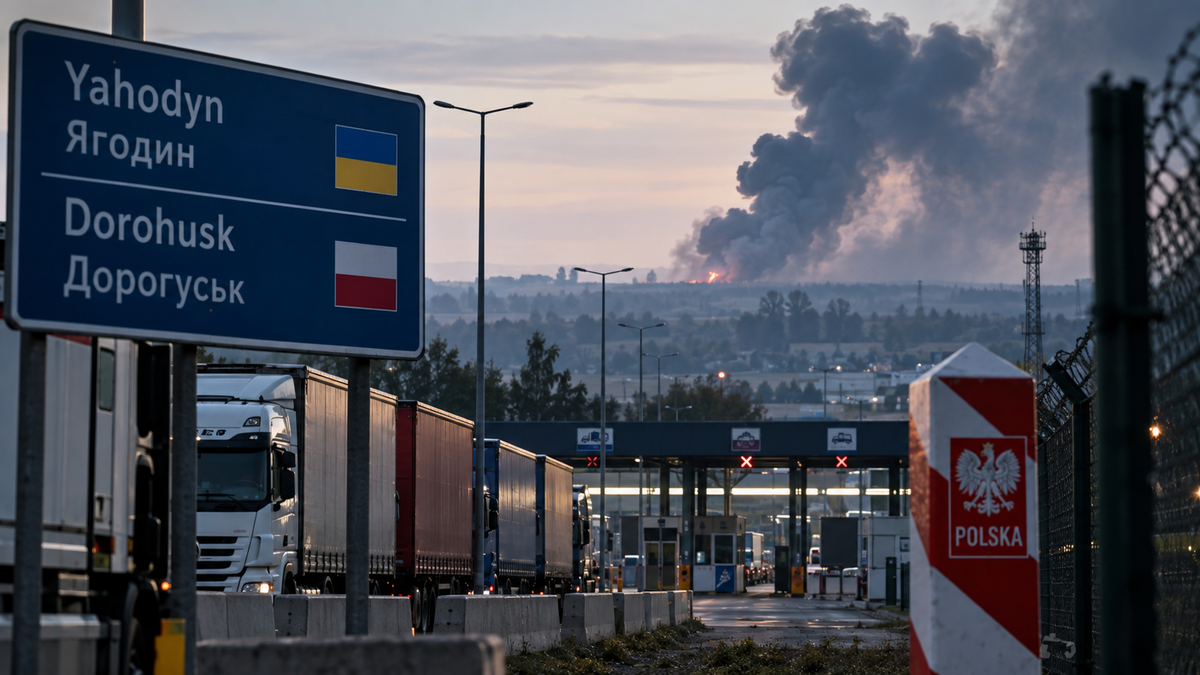
Overnight and into the morning of 13 September, Russia struck a truck near the Yahodyn-Dorohusk international crossing on Ukraine's border with Poland — roughly 800 metres from Polish territory. According to a spokesperson for Poland's Border Guard, the crossing briefly stopped operating during the attack and resumed shortly after. The same morning, a separate Russian drone hit the locomotive of a Kyiv-Warsaw passenger train in Volyn Oblast, just 2 km from the Polish border; preemptive warnings prevented casualties among passengers.
Russia's Defence Ministry said its strikes in western Ukraine targeted infrastructure facilitating military cargo shipments from Europe. That's Moscow's stated rationale; it doesn't by itself establish that the specific truck or site hit was carrying military cargo.
BSM analysis: What matters is the shift from an abstract warning to a concrete incident at an actual crossing. Yahodyn-Dorohusk isn't a peripheral checkpoint: it's part of the EU-Ukraine Solidarity Lanes/TEN-T transport network and Ukraine's largest road border crossing with Poland for freight traffic. Ukraine's Foreign Minister Andrii Sybiha called the strike Putin's terror "knocking directly at the door of the EU and NATO," and demanded a total trade embargo and full sanctions against Russia's defense sector.
What's still uncertain
🟡 Earlier this week Tusk reported a separate, unconfirmed "direct threat" to a Polish crossing, prevented by Polish-Ukrainian cooperation. There's no public evidence connecting this morning's strike to that earlier incident — they should be treated as separate stories.
🟡 Russia's Defence Ministry is now explicitly presenting western-Ukrainian logistics infrastructure linked to European military cargo as a target category. Whether the specific Yahodyn strike was precisely aimed at military cargo remains unverified.
Regional context
A telling historical reference point: in March 2022, a Russian missile strike on the International Center for Peacekeeping and Security in Yavoriv — also near the Polish border — killed 35 people and wounded 134. That earlier incident showed how severe the consequences of strikes near NATO territory can be, even without directly hitting the alliance. This case is far less destructive in outcome, but geographically closer to the border still.
The broader relevance for the Baltic region is Russia's growing focus on the infrastructure connecting Ukraine to NATO states. Poland, Romania and Moldova have already faced different versions of this problem — Moldova just pulled its border personnel off Ukrainian territory for 90 days under the same air-threat logic. The same planning considerations apply to Baltic logistics nodes supporting allied reinforcement and military movement.
Bottom line
If Russia develops this into a systematic campaign against Ukraine's western logistics gateways, temporary closures, rerouting and stepped-up protection requirements could start imposing real friction on both civilian freight and military-support flows. For now, this is a single incident — striking mainly for its proximity — but incidents like this one are exactly what builds the pattern worth watching next.
Baltic Security Monitor (osint-baltic.com) — an analytical outlet covering security on NATO's northeastern flank.
Compiled from open sources and BSM's automated OSINT monitoring system.