Russia Is Already Rehearsing a New Mobilisation: Western Intelligence Documents Preparation Nationwide and in Kaliningrad

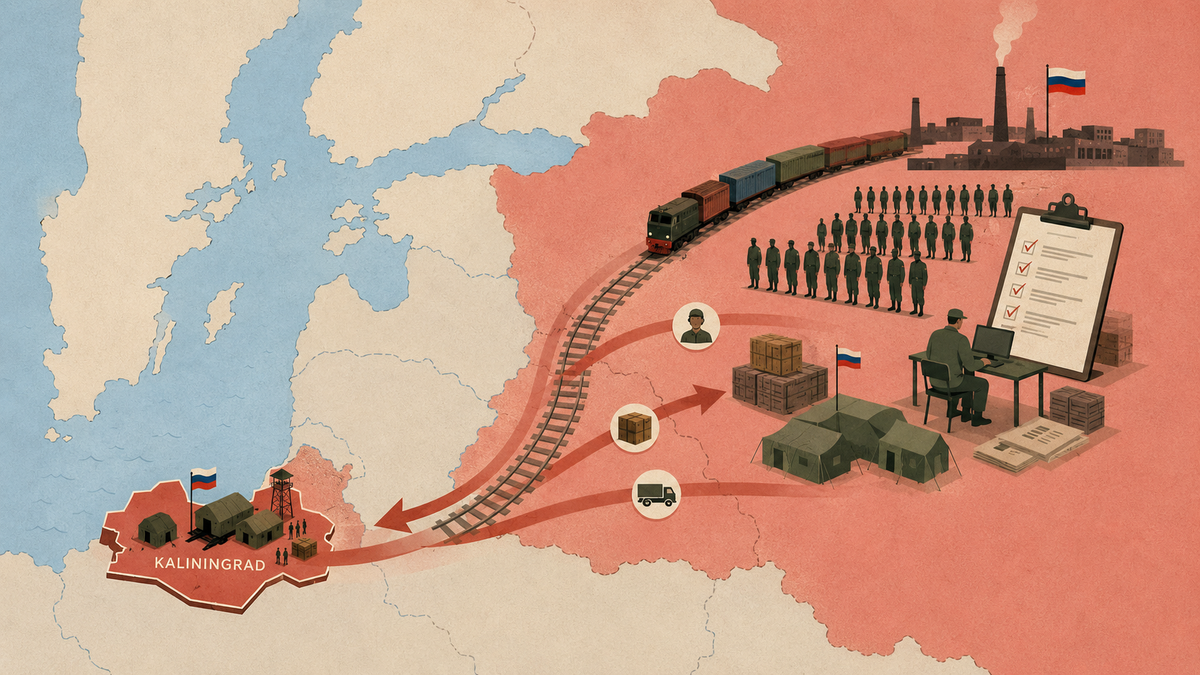
Baltic Security Monitor | Material Update
Published: 27 August 2026, 08:00
The Kremlin's denial this time sounds strikingly familiar: it's nearly word-for-word what Dmitry Peskov said on 13 September 2022 — eight days before Putin announced the mobilisation of 300,000 reservists. Now the Wall Street Journal, citing Western intelligence, reports that Russia is already rehearsing the practical mechanics of a new mobilisation — including a dedicated exercise in Kaliningrad, the exclave wedged between Lithuania and Poland. This doesn't confirm Zelensky's specific figure, but it materially changes the status of the story itself: from political statement to documented administrative preparation.
What happened
According to the Wall Street Journal, citing Western intelligence officials, the Russian military has been running mobilisation-readiness exercises across the country — testing how quickly it could house, feed and arm a large number of additional personnel if the Kremlin orders a new call-up. One such exercise took place in July in the Kaliningrad region: officers who flew in from St Petersburg reviewed procedures for mobilising local residents of the exclave — accommodation, food, weapons for potential recruits. According to the WSJ, the Kaliningrad drill was just one of many conducted nationwide; sources didn't specify where the others took place.
This is an important verification shift for the WATCH item BSM had been tracking based on President Volodymyr Zelensky's 23 August claim that Russia could mobilise another 300,000 personnel after the September parliamentary elections. Reuters confirmed Zelensky made the claim, but the figure itself remained uncorroborated. The Western-intelligence report now provides evidence of concrete preparatory activity, while still not confirming either the 300,000 figure or that Vladimir Putin has decided to order mobilisation. 🟡
The Zelensky claim itself is worth unpacking further: the president described a "peripheral mobilisation" — targeted recruitment concentrated away from major cities to avoid public backlash — with a possible ramp-up to 500,000 by 2027. This wasn't a one-off statement: Zelensky has made similar warnings before, including in a 27 July Sky News interview and an 11 August statement citing what he described as internal Russian documents. Russia's UN Ambassador Vasily Nebenzya struck a more hedged tone than a flat denial on 21 August: "not planned or expected, as far as I know... but let's see what happens after the elections." Kremlin spokesman Dmitry Peskov followed on 25 August, dismissing the reports as "information canards" deliberately planted by Ukraine.
BSM analysis: Worth recalling the precise historical precedent here. On 13 September 2022, Peskov said in almost identical terms that neither full nor partial mobilisation was "on the agenda." Eight days later, on 21 September, Putin announced the mobilisation of roughly 300,000 reservists. This isn't proof history will repeat exactly — it's an exact precedent for what the Kremlin's denial sounds like immediately before an actual decision. BSM flags this as an analytical parallel, not a confirmed fact: the denial itself guarantees nothing in either direction.
Why it matters for Ukraine and the Baltic region
For Ukraine, the exercises indicate Russia is keeping open a mechanism for another substantial manpower injection, in case contract recruitment continues to fall short of battlefield losses. Ukraine's General Staff puts cumulative Russian losses since 24 February 2022 above 1.48 million; per the WSJ, the growing use of Ukrainian drones has cut the average Russian soldier's lifespan on the front to a matter of minutes, days or weeks — cited as a key driver of the manpower shortfall. A mobilisation ordered late in 2026 might have limited immediate battlefield effect but could materially shape Russian force generation for the 2027 campaign. 🟡
The Kaliningrad component gives this direct Baltic relevance — and here's a detail the source digest didn't surface: Western intelligence assesses that, in the event of escalation with the West, Russia could attempt to seize part of the Suwałki Gap — the strip of land linking Kaliningrad to Belarus through Polish and Lithuanian territory that connects the exclave to mainland Russia. Testing mobilisation procedures inside the exclave itself demonstrates contingency planning in one of Russia's most militarised regions — bordered by Lithuania and Poland, geographically cut off from the Russian mainland. NATO will therefore need to distinguish mobilisation intended primarily to replenish forces fighting in Ukraine from any parallel build-up of forces retained directly in Kaliningrad.
Recent Lithuanian Defence Ministry reporting also shows continuing NATO monitoring of Russian military aviation moving to and from Kaliningrad, underscoring the exclave's ongoing operational relevance to Baltic security.
BSM analysis: For the Baltic states, the key analytical distinction isn't "will mobilisation happen" but "where do the mobilised troops go": replenishing Russia's grouping in Ukraine is one scenario; building up the garrison directly in Kaliningrad, near the Suwałki Gap, is a fundamentally different one with direct NATO implications. The July exercise alone doesn't establish which scenario is more likely — and that's precisely the indicator worth watching in coming cycles.
Likely implications
If Russia ultimately orders another mobilisation, the readiness work documented by Western intelligence could reduce some of the administrative and logistical disruption seen during the 2022 partial mobilisation. 🟡
Newly mobilised personnel would most likely be used initially to replenish forces fighting Ukraine and build reserves for 2027, rather than automatically expand Russia's combat posture against NATO in the Baltic. 🟡
Poland, Lithuania and NATO are likely to pay particular attention to military commissariats, training areas, rail movements and garrison strength in Kaliningrad for evidence that contingency planning is moving into execution. 🟡
The 300,000-person figure remains unverified and should not be reported by BSM as established fact. 🟡
Bottom line
This is a rare case where Western intelligence and a Ukrainian political claim move toward each other without fully merging: the WSJ confirms administrative preparation, but confirms neither the specific figure nor an actual mobilisation decision. The Kremlin's denial sounds almost word-for-word like September 2022 — eight days before the real announcement. That isn't a prediction. It's a reason to keep this story in active WATCH rather than close it out as debunked.
Baltic Security Monitor (osint-baltic.com) — an analytical outlet covering security on NATO's northeastern flank.
This report draws on an automated monitoring digest cross-checked against independent open sources.