Russia Sets a Record 17.1 Trillion Rouble Defence Budget for 2027 and Expands the Army's Authorized Strength for the Fourth Time This Year

Baltic Security Monitor | Analytical Brief Material Update: 29 September 2026, 08:00
What happened
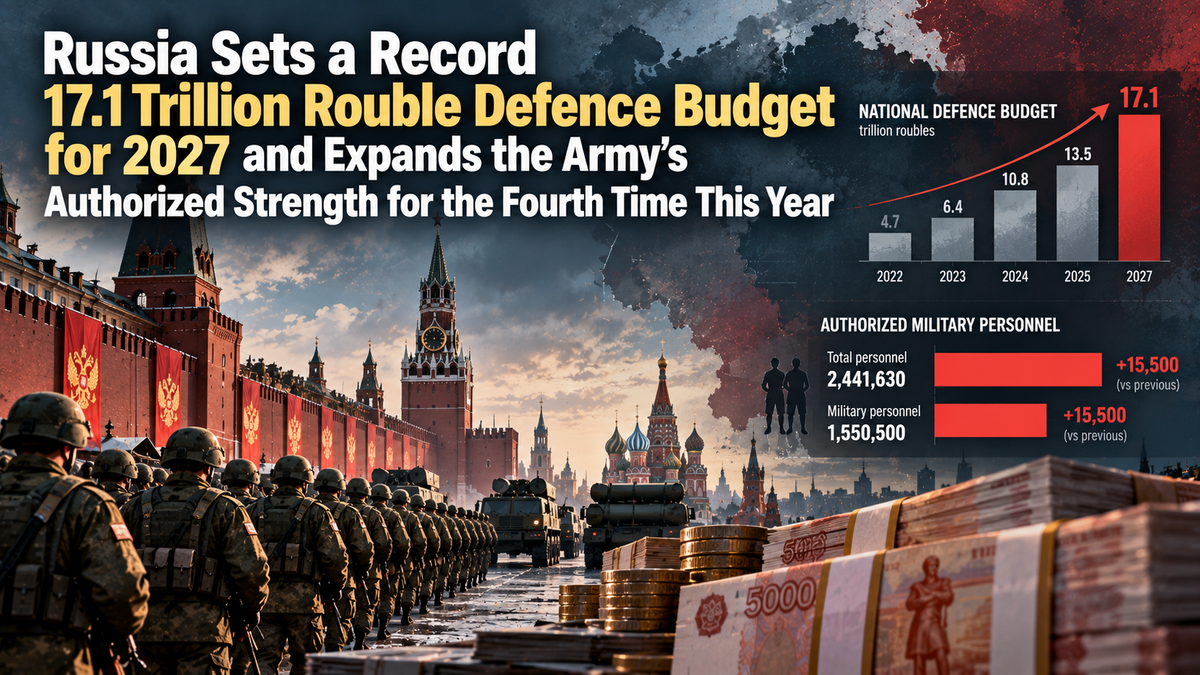
Russia plans to allocate 17.1 trillion roubles ($202.6 billion) to national defence in 2027, according to government budget documents reviewed by Reuters. That is roughly 27% above the 13.5 trillion roubles previously budgeted and the highest nominal national-defence allocation since Russia's full-scale invasion of Ukraine began. Planned defence expenditure for 2027–2029 totals about 50 trillion roubles.
On the same day, 28 September, Putin signed a decree raising the authorized Russian Armed Forces establishment to 2,441,630 personnel, including 1,550,500 military personnel, an increase of 15,500 posts from the previous ceiling. This is the fourth expansion of authorized strength in 2026, following increases in March, June and July, with a combined rise of 47,860 positions since March.
A necessary caveat: this is an authorized staffing ceiling and budgetary establishment, not evidence that all 1.55 million posts are currently filled.
The cost of the decision
The spending increase comes with rising fiscal pressure, not fiscal headroom. The documents raise the projected 2026 federal deficit from 1.6% to 3.2% of GDP, increase borrowing, and envisage using 459 billion roubles, about 11% of the liquid portion of the National Wealth Fund, to cover the shortfall. State debt is set to rise to 21.7% of GDP in 2027 from 19.9% in 2026, above the 20% level authorities consider safe. Total borrowing in 2027 will increase by 43%, to 7.7 trillion roubles. A new windfall tax on metals and mining companies is expected to raise about 200 billion roubles a year, a fraction of the increase in defence spending.
Why this is MATERIAL rather than another budget line
Two independent institutional decisions land on the same day: an expanded authorized army ceiling and a record multi-year defence budget, adopted alongside a deliberately worsened deficit, higher borrowing and new taxes. The Kremlin is not balancing spending at the edge of what it can afford; it is knowingly accepting a long-term fiscal burden to sustain a high level of military expenditure. This is not a one-off spike but a trajectory set three years out.
Why it matters for Ukraine and the Baltic region
The budget changes indicate that the Kremlin is planning to sustain a high level of military expenditure well beyond the current campaign year rather than budgeting for a near-term return to peacetime spending. That affects the strategic-endurance calculation for Ukraine and its European supporters: Russian production, replenishment and force generation are being financed on a multi-year basis.
For Estonia, Latvia, Lithuania, Poland, Finland and the wider NATO north-eastern flank, the important signal is not an immediate increase of 15,500 deployable troops. It is the combination: a larger authorized force, a record planned defence budget, and a willingness to absorb greater fiscal costs while the war against Ukraine continues. That strengthens the case for evaluating European defence-industrial capacity against a sustained Russian expenditure trajectory rather than assuming economic pressure will rapidly force Moscow to cut military spending.
What to check next
The complete draft budget, including classified and off-budget military-related expenditure, was not publicly available at this snapshot; the government is expected to submit it to parliament by 1 October. BSM's next check: the final budget text, its breakdown by category, and whether the Finance Ministry confirms the stated deficit level when the draft reaches the State Duma.
Baltic Security Monitor (osint-baltic.com) — an analytical publication on security on NATO's northeastern flank.