Two Minutes and Five: Romania Shoots Down Jet-Powered Gerans Over Its Own Waters

Baltic Security Monitor | Security Watch morning review 18 October 2026, 08:00 cycle
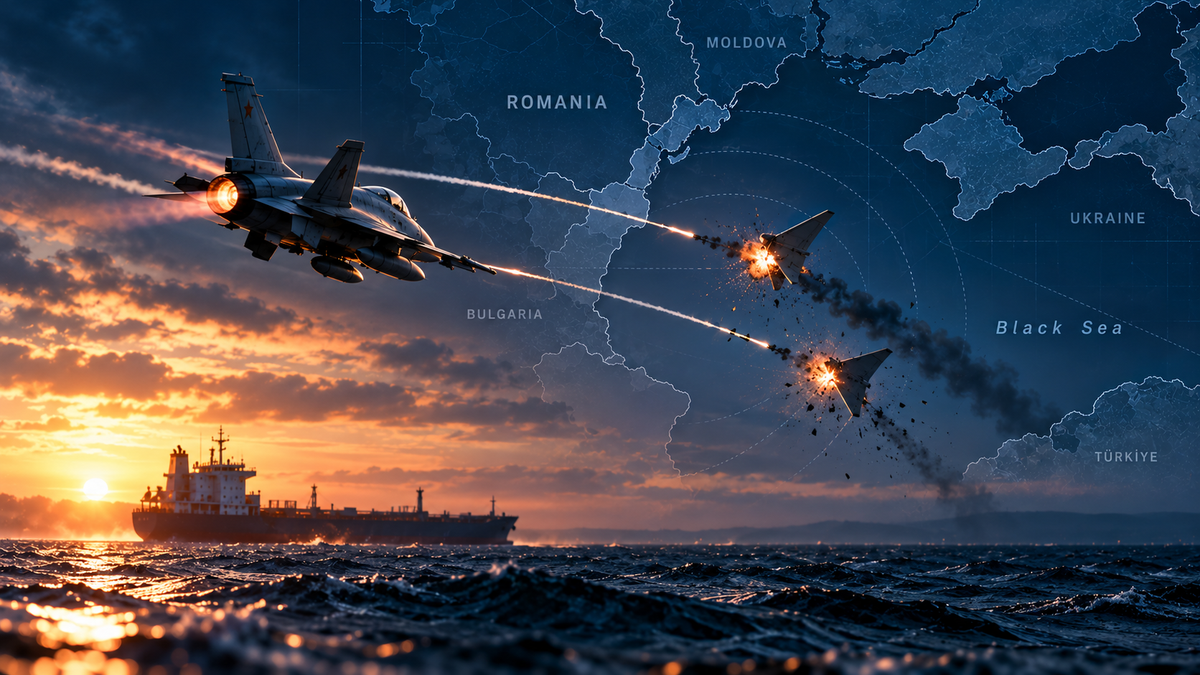
On the evening of 17 October, two attack drones entered Romanian airspace over the Black Sea. The first lasted two minutes in NATO skies, the second five. Romanian F-16s shot down both, and the defence ministry identified them as jet-powered drones of the Geran family.
The interceptions came two days after drones struck two chemical tankers near the mouth of the Danube. This week, an ally has now answered with a missile rather than a search-and-rescue operation.
Interception timeline
| Time (EEST) | Event |
|---|---|
| ~17:43 | Radar detects a group of aerial targets about 120 km east of Snake Island, heading southwest. Two F-16s on air-policing duty scramble from Borcea Air Base |
| 17:59 | First target enters Romanian airspace |
| 18:01 | First drone shot down about 25 km southeast of Sulina |
| 18:01 | Second target enters Romanian airspace |
| 18:05 | Second drone shot down about 20 km east of Sulina |
Both interceptions took place over Romanian territorial waters. The ministry later specified that the targets were jet-powered Geran-family attack drones.
Cycle indicators: 1 MATERIAL UPDATE (HIGH, late capture) · 1 new WATCH (Moldova) · 1 updated WATCH (Starshield) · uncertainty markers: 🟡 10 / 🔴 0.
The 17 October interceptions are not Romania's first shots, but they are the first fired in the middle of a maritime crisis. They show that NATO can see and kill jet-powered Gerans over open sea within minutes. The real gap this week lies elsewhere: low-flying targets near ships and along borders keep dropping out of the radar picture. On 20 October, the North Atlantic Council will weigh whether a pair of alert fighters is enough.
What is new compared with July
Romania has shot down drones before. The first time was on 24 July 2026, when an F-16 destroyed a Shahed near Padina in Buzău County. Two more interceptions followed over the next two days, including one near Sulina.
What is new on 17 October comes down to three details:
- Platform. The ministry explicitly called the targets jet-powered. These Gerans are faster than classic propeller-driven Shaheds, leaving less time to decide. The first drone was destroyed two minutes after crossing the border.
- Pairing. Two targets in four minutes means a group entry, not a single drone that drifted off course.
- Context. The strike came in the same area where drones hit at least seven civilian ships off Romania and Bulgaria over the previous ten days.
The ministry also released retrospective figures: in the preceding week, radar recorded eight episodes involving aerial targets near the Ukrainian border, four of which included brief incursions into Romanian airspace.
BSM analysis: Between July and October, what changed is not Romania's willingness to fire but the density of the threat. In July, three interceptions were an event. In October, they are part of a week in which four other targets slipped in and out.
Attribution: what is established and what is not
Romania's defence ministry did not name the launch operator. Formally, Russian responsibility for these two specific drones remains 🟡 unresolved.
But the formal and the practical picture differ. "Geran" is the Russian designation for Shahed-type drones. Separately, a NATO military source told Reuters that the two tankers struck earlier in the week were hit by Russian drones.
BSM analysis: The platform type already narrows the list of possible operators to one. Formal attribution awaits debris analysis. The restraint from Bucharest and Sofia on naming Moscow is a deliberate choice to keep escalation under control.
Blind spots: a refinement
BSM's 17 October evening review argued that allied radars keep missing drones. The 17 October interceptions refine that point rather than refute it.
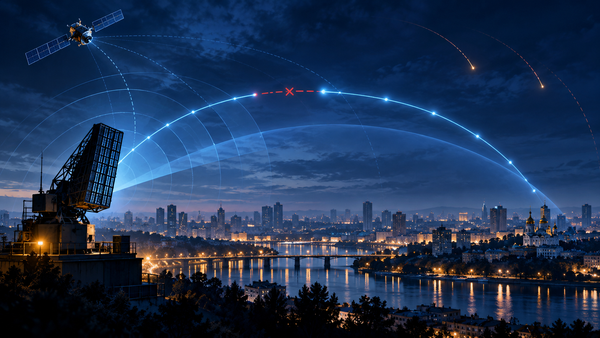
Romania saw a group of jet-powered targets at altitude over open sea from 120 km away and intercepted them in time. But radar did not pick up the drone that hit Yara J. And in Moldova on 16 October, a drone crashed and exploded near Scăieni in Dondușeni district, with police recovering fragments, including an engine and fuel tank, scattered up to 100 metres.
The conclusion is simple: NATO does not see nothing. It sees poorly when targets fly low and close.
20 October: what NATO will decide
At Romania's initiative, the North Atlantic Council will discuss defence and deterrence in the Black Sea region on 20 October. The meeting was announced on 15 October, so it is not a reaction to the interceptions. Still, the shootdowns strengthen the case of Bucharest and Sofia, which have already asked for more fighters and counter-drone assets.
Romanian Foreign Minister Oana Țoiu stressed that the Black Sea is a key artery for global exports of grain, energy and raw materials.
BSM analysis: The real question on 20 October is whether the alliance extends protection to exclusive economic zones, where most sailors have died. Interceptions over territorial waters already work. Strikes a mile beyond that line remain outside the umbrella.
Why it matters for the Baltic
Romanian F-16s have done this work in the north already: in May 2026, a Romanian fighter on NATO's air-policing mission shot down a drone in Estonian airspace.
The same pilots and procedures protect both ends of the flank. Whatever NATO decides for the Black Sea on 20 October will set a precedent for the Baltic too. If the alliance learns to act at the edge of territorial waters in the south, the model can be carried over to the Gulf of Finland and the Baltic Sea.
Other items this cycle
Starshield. Speaking to the Financial Times, Zelenskyy called the speed restriction a deliberate operation rather than a technical fault. That strengthens his position but is not independent proof. Who authorised the restriction, and why, remains unestablished.
Moldova. New WATCH. Authorities report seven unauthorised drone flights on 15–16 October. The difference from the five crashed drones cited by the foreign ministry reflects what is being counted: flights versus crashes. The type and origin of the Scăieni drone are not established.
Unchanged: Patriot interceptor shortage, ZNPP power repairs, missing Wine Trader and HS Dignity sailors, grain transit.
Conclusion
Two shots over Sulina proved that Romania can defend its own sky. Now the alliance has to decide whether it will also defend the sea a mile beyond it.
Baltic Security Monitor (osint-baltic.com) — an analytical publication covering security on NATO's northeastern flank. This review is based on BSM's automated Security Watch v2 monitoring cycle (17.10.2026 20:00 – 18.10.2026 08:00 EEST, 24-hour lookback), supplemented with verification from Romania's Defence Ministry, Reuters, Euronews, UNN, Xinhua, Radio Moldova and Romania Insider.