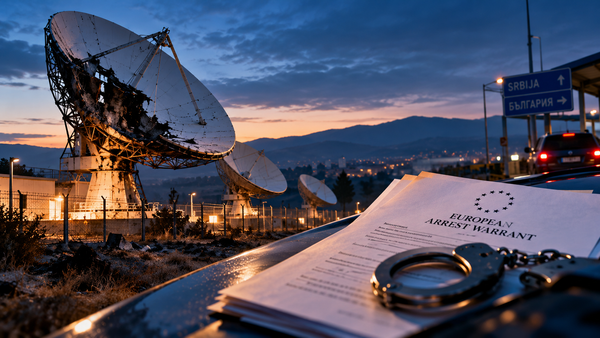
A Warning Without an Explanation: Kyiv's Skies, US Intelligence and an Unnamed Fault


Kyiv says early warnings of ballistic missiles are working again. The cause of the lapse has still not been named, and Washington and Kyiv describe it differently.
Baltic Security Monitor | Analytical Review Security Watch: 21 October 2026, 08:00 EEST · 1 MATERIAL UPDATE (HIGH) · event of 20 October, late capture
Ballistic-Missile Early Warning: Working Again?
MATERIAL UPDATE — HIGH
On 20 October, at a press conference in Oslo, Volodymyr Zelenskyy said Ukraine was again receiving early warnings of incoming Russian ballistic missiles, following his conversation with US Secretary of State Marco Rubio. AP, the Washington Post and Reuters independently reported his remarks.
The chronology explains why the statement matters. On the night of 18–19 October, Russia struck with ballistic missiles in several waves. According to European Pravda, Ukraine received no warning from partners before the first wave but did before the second. Zelenskyy said 16 ballistic missiles were fired at Kyiv and the surrounding region, again without prior warning. Ukraine had faced the same problem before: per the digest, Reuters reported a restoration claim on 18 October, after which complaints about missed warnings resurfaced.
The two sides' accounts do not match. In an NBC interview, Zelenskyy said Washington had paused intelligence sharing and later "unblocked" it. Rubio denied any pause. Asked by a reporter, he said that a few nights earlier there had been a software problem in the early-warning system, and that he could not comment on the latest night. He added that US European Command is reviewing the matter and will report.
The new delta is an explicit assurance from the Ukrainian president that the service is functioning.
🟡 The technical cause, the investigation's findings and the system's long-term reliability are unverified. Both the "software fault" explanation and the "selective restriction" suspicion remain unconfirmed.
BSM analysis: the president's statement describes the current state; it is not a technical verification. Ballistic-missile warning buys minutes, and minutes decide whether people reach shelter. The episode shows Ukraine's dependence on allied intelligence infrastructure. For the Baltic region the lesson is different: shared warning systems need redundancy and transparent failure protocols. There is no evidence the incident affected NATO's own capabilities in the region. The next markers are EUCOM's findings and independently documented performance during the next strikes.
New WATCH: Unidentified Drones over Dutch Infrastructure
Reports on 20 October describe repeated sightings of unidentified drones near Eemshaven and other critical infrastructure in Groningen province. The port authority confirmed several reports over the weekend and on Tuesday night. A witness says the first sightings date to 3 October, and one report mentioned a large drone releasing smaller ones. Police have opened an investigation.
🟡 Operators and intent are unknown. No evidence points to Russia, and the incident does not yet reach the MATERIAL threshold. It does fit a European pattern of repeated sightings near energy and port facilities that the Baltic region knows well.
Oslo and Other Threads
The Oslo consultations involving Ukraine, Norway, Finland and US representatives remain at WATCH. No signed military-assistance agreement, binding security guarantee or completed weapons transfer was established.
Also under watch: early-warning reliability, Starlink/Starshield restrictions, the 18 October drone incursion into Lithuania and the Lithuanian Starlink sabotage, the Cosmos 2612/ICEYE encounter, the Finnish-linked missile-component supply network, NATO's Black Sea reinforcement (announced and already MATERIAL; deployment unverified), the Zaporizhzhia plant, Saint Petersburg oil infrastructure, Ukraine's power grid and PURL/Patriot interceptor deliveries. No new confirmed decisions on these during the cycle.
Conclusion
A system on which minutes depend runs on trust: Kyiv has to believe partner data will arrive in time. The Oslo statement restores that trust in words, not in documents. Until a report and an explanation appear, the assessment stays cautious: the warnings are back, but nothing guarantees they will not vanish again.
An alert that arrives a minute late is no longer an alert.
Sources: AP, Washington Post, Reuters (Zelenskyy's Oslo statement, 20 October); European Pravda (Rubio on the fault and the night of 18–19 October); Euronews (Rubio's denial of a pause in intelligence sharing, 19 October); Bloomberg (Kyiv's suspicion of selective restriction); Current Time (Rubio on the EUCOM review); RTV Noord / NOS (drones over Eemshaven); Office of the President of Ukraine (Oslo meetings).
Verification note: the content of the 20 October statement and the 18 October Reuters report rest on the Security Watch report; primary texts were not re-opened independently.
Baltic Security Monitor (osint-baltic.com) — an analytical publication on security on NATO's northeastern flank. All OSINT indices are calculated by an automated indexing system based on open sources.