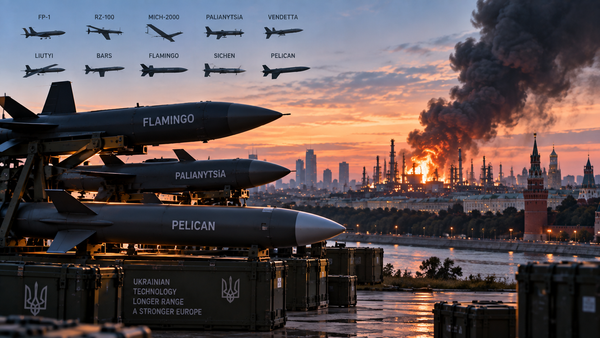
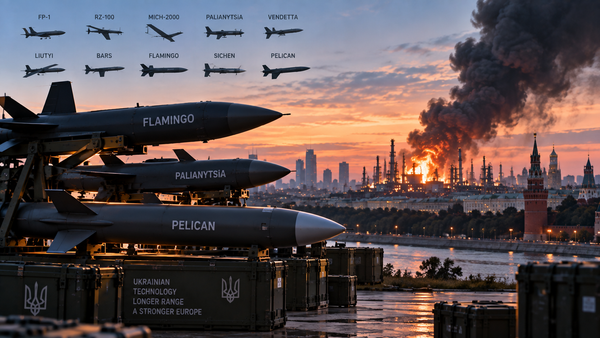
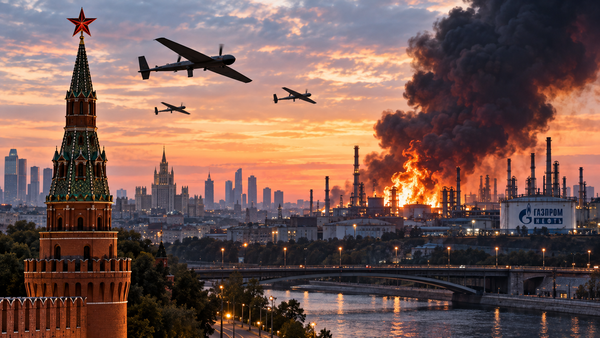
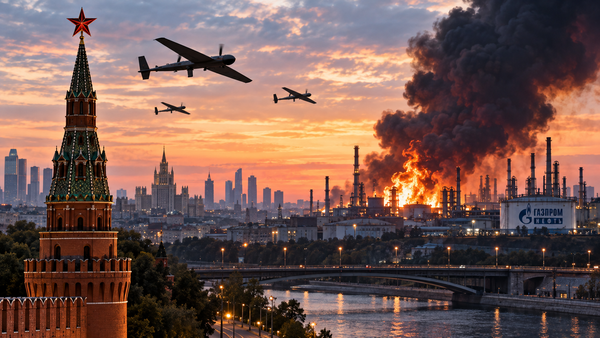
Refinery Strikes Force Moscow to Keep Diesel Exports Closed for Another Month: Ukraine's Campaign Is Already Reshaping Russian Fuel Logistics

Baltic Security Monitor | Analytical Brief
As of 30 August 2026, 08:00 EEST
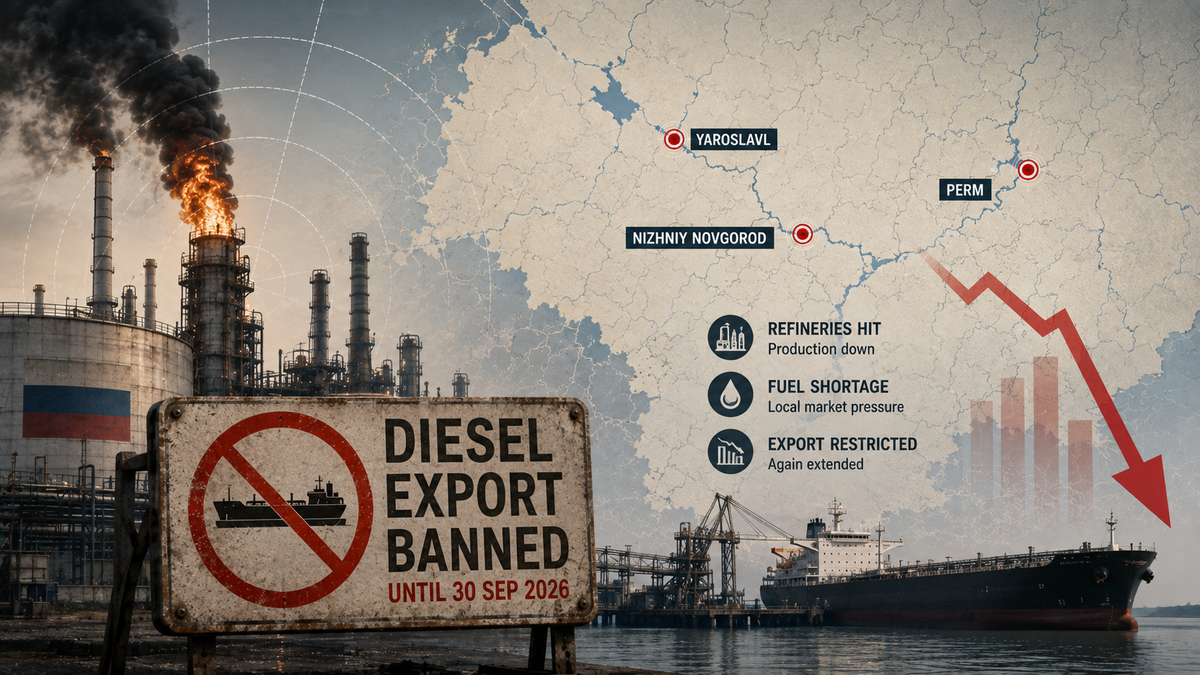
On 29 August, the Russian government extended its ban on diesel, marine fuel, and gas oil exports by direct producers through 30 September. This is the third consecutive extension of the measure: first imposed from 8 to 31 July, then extended to 31 August — a deadline that was supposed to let producer exports resume from 1 September. Instead, Moscow cancelled that planned reopening and kept the restriction in place for another month. The government's statement cited the need to "maintain stability in the domestic fuel market." Reuters, citing industry sources, tied the decision directly to persistent fuel shortages and continued refinery outages following repeated Ukrainian drone strikes.
The production numbers behind the decision are stark. By late August, Russian gasoline output had fallen to roughly 70% of domestic demand, according to Reuters, after drones halted operations at major refineries in Perm, Nizhny Novgorod, and Yaroslavl over the preceding week — all significant gasoline producers. The Perm plant reportedly lost around 86% of its processing capacity. The gap between production and demand widened to about 35,000 tons a day, with output of roughly 80,000 tons covering only about 70% of an estimated summer demand of 115,000 tons. That puts output back near the level seen in early July, at the peak of the first wave of this year's fuel crisis. Bloomberg counted at least 18–21 Ukrainian strikes on Russian refineries in August alone — the highest monthly total of the war.
The extension itself is not the surprise — it had been signaled since 25 August. What matters is that Moscow could not hold to its own planned return to normal producer exports. That converts what looked like temporary, facility-level repair delays into a government-confirmed admission: damage from Ukraine's refinery campaign is now accumulating faster than Russia can repair it.
BSM analysis: from isolated strikes to systemic pressure
The difference between August's decision and earlier extensions is trajectory, not substance. The ban was introduced in July as a three-week emergency measure; it is now in its third consecutive month, with government sources not ruling out a further extension through the end of the year. Deputy Prime Minister Alexander Novak said last week that no decision had yet been made on lifting the ban and insisted there was no domestic diesel shortage. The extension itself, adopted after those remarks, points the other way: had the market genuinely stabilized, the planned 1 September reopening would have gone ahead.
At the same time, Russia is scaling up fuel imports: seaborne supplies from Asia are estimated at around 270,000 tons in August, with roughly 150,000 tons more expected from Belarus, alongside a new arrangement to refine Russian crude at a facility in Kazakhstan. Separately, the export ban on diesel and gasoline by non-producers remains in force until 31 January 2027, and the jet-fuel export ban until the end of November 2026 — the list of restrictions is lengthening, not narrowing.
Why it matters for Ukraine and the Baltic region
For Ukraine, the extension is indirect but measurable confirmation that the refinery-strike campaign is producing cumulative, not merely episodic, effects on Russia's economy and wartime logistics. Moscow is deliberately sacrificing export flexibility to protect domestic supply — meaning resources that once generated export revenue are now being redirected toward sustaining the home front.
The Baltic connection is direct. Primorsk and Ust-Luga are Russia's principal outlets for refined-product as well as crude exports, and both have been repeatedly targeted by Ukrainian drone strikes throughout 2026, with recurring loading suspensions. A prolonged producer export ban on diesel could further reduce or reshape the flow of refined products through Baltic terminals and increase the relative weight of crude in Russia's export mix — though the precise effect on Primorsk and Ust-Luga volumes will depend on exemptions, the pace of refinery repairs, and the balance between crude and product loadings.
Bottom line
This does not show that Russia is currently short of diesel for military operations — the government continues to publicly deny any shortage. But the fact that Moscow has now pushed back its return to normal export operations for the third time in a row shows the domestic fuel balance remains stressed enough that the government keeps abandoning its own reopening plans. If Ukrainian strikes continue to take large refining units offline, the next step could be another extension or additional administrative measures — regional allocation, pricing intervention, or expanded import quotas. Perm, Nizhny Novgorod, and Yaroslavl have already shown how quickly a single week of strikes can shift the national fuel balance; the open question is whether Russia can rebuild capacity faster than Ukraine can take it out.
Baltic Security Monitor (osint-baltic.com) — an analytical publication covering security on NATO's north-eastern flank.
All OSINT indices are calculated by an automated indexing system based on open sources.