Poland Probes WB Electronics Drone-Plant Fire as Possible Foreign-Intelligence Operation: Attack Hit a Drone Maker Supplying Both Poland and Ukraine

Baltic Security Monitor | Analytical Brief
As of 1 September 2026, 08:00 EEST
Polish prosecutors said on 31 August that the fire at a WB Electronics facility in Skarżysko-Kamienna was set deliberately, using a device containing flammable materials, and opened an investigation covering both participation in a foreign intelligence service's activities against Poland and a terrorist offense. The fire broke out at around 12:23 a.m. local time on 31 August and destroyed warehouse facilities; prosecutors put the damage at at least 15 million zloty (roughly €3.46 million). No injuries were reported. According to Euronews, CCTV footage showed a person in a balaclava climbing over the perimeter fence shortly before the fire started; a backpack and a sweatshirt were found near the site. Poland's Internal Security Agency (ABW) is participating in the investigation alongside prosecutors.
WB Electronics is part of WB Group, Poland's largest private defence company and a producer of unmanned systems, loitering munitions, and communications and fire-control equipment used by the Polish armed forces and by Ukraine. Company spokesman Remigiusz Wilk told TVN24 that WB Group has enjoyed the trust of the Polish military and other armed forces for years; the company says it expects to resume production once investigators release the site and does not currently anticipate delays to military deliveries. No suspects have been publicly identified.
The notable part isn't that a defence-industry facility caught fire — it's that Polish prosecutors classified it within hours as a deliberate arson with a foreign-intelligence dimension, rather than an industrial accident. That moves the incident from a possible mishap into a confirmed sabotage attack on a NATO defence-industrial facility, with a formal counter-intelligence angle attached even before any sponsor has been named.
BSM analysis: a Baltic thread inside a Europe-wide pattern
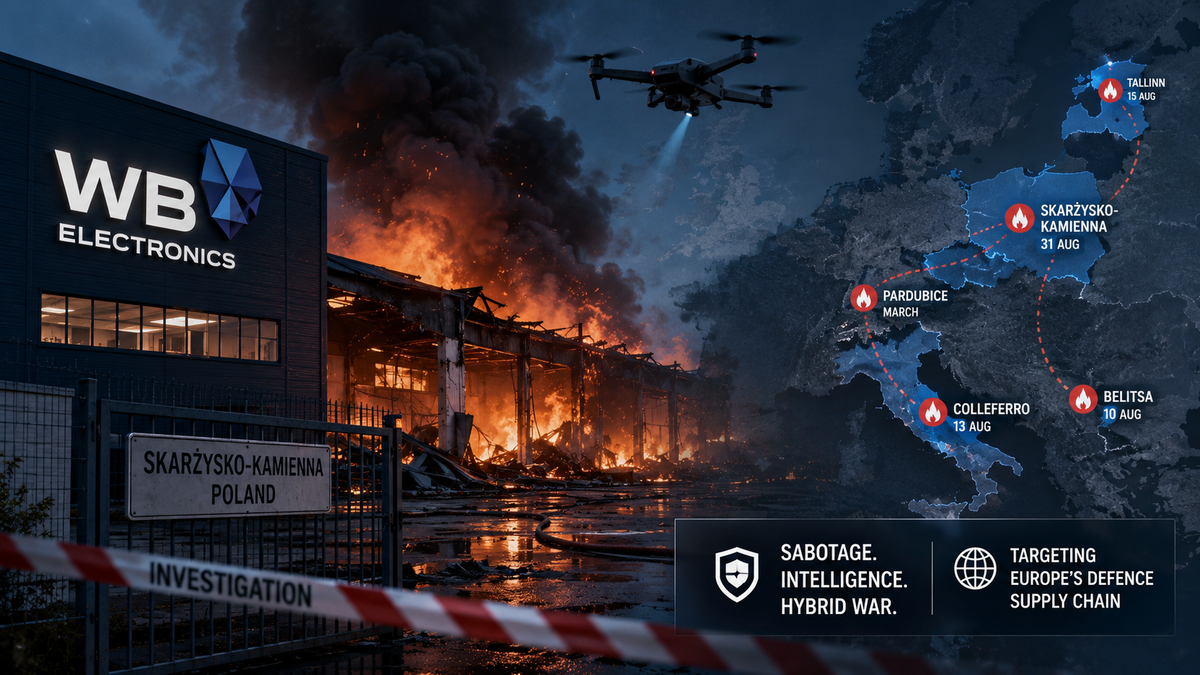
Skarżysko-Kamienna is not an isolated case. It's the latest in a series of suspected sabotage incidents against European defence manufacturers and logistics tied to support for Ukraine — a pattern Western intelligence sources increasingly describe as part of a hybrid campaign with a suspected Russian dimension, carried out through recruited local proxies and methods designed for plausible deniability. In March, a fire at LPP Holding's optics-and-drone facility in Pardubice, Czechia, damaged production buildings but did not stop a planned delivery of 40 attack drones to Ukraine. The pace accelerated in August: on 10 August, a fire and explosion destroyed an ammunition storage building at EMCO's plant near Belitsa, Bulgaria; three days later, a fire and explosion hit the KNDS Ammo Italy plant at Colleferro, which produces medium- and large-caliber ammunition.
The most direct Baltic link is the 15 August fire at a building used by Milrem Robotics in Tallinn, maker of the THeMIS unmanned ground vehicle supplied to Ukraine. Estonian prosecutors called that fire a deliberate, premeditated act — and three suspects were subsequently detained in Latvia. That means a comparable sabotage network has already operated physically inside Baltic territory, not just in Central or Southern Europe.
Why it matters for Ukraine and the Baltic region
For Ukraine, an attack on a manufacturer whose reconnaissance and strike drones the Ukrainian military relies on directly touches the industrial base sustaining its defence and NATO's eastern flank. WB Group currently reports no significant impact on deliveries, but the true scope of the damage — whether it affected tooling, component inventories, or supply-chain nodes — could still turn out to be larger than initially disclosed.
For Poland and the Baltic states, the case underscores the importance of physical security, counter-intelligence, and continuity planning around defence factories and logistics hubs that would be high-value targets in a sustained hybrid campaign. The detention of suspects in the Estonian case specifically in Latvia is not an abstract parallel — it is concrete evidence that operatives behind this kind of network can move and act inside the Baltic states themselves, not merely provide logistical support from a distance.
Bottom line
The next indicator to watch is not the opening of the investigation itself — that has already happened — but whether it identifies a specific network of operatives or a sponsor, and whether the case gets linked to other 2026 incidents, including the Tallinn-Latvia one. If a foreign state is formally attributed, Warsaw could respond with arrests, expulsions, sanctions, or allied consultations — the scale depending on the evidence and on whether investigators can demonstrate a systemic link across all these episodes. For now, the main takeaway is that the campaign against Ukraine's supporting defence-industrial base is expanding geographically, and the Baltics are no longer a potential node on that map — they are a confirmed one.
Baltic Security Monitor (osint-baltic.com) — an analytical publication covering security on NATO's north-eastern flank.
All OSINT indices are calculated by an automated indexing system based on open sources.