No Visual Confirmation Required: Poland Changes the Logic Behind the Shoot-Down Decision Itself

Baltic Security Monitor | Analytical Brief Snapshot: 1 October 2026, 20:00 (Europe/Tallinn) · Material OSINT Update
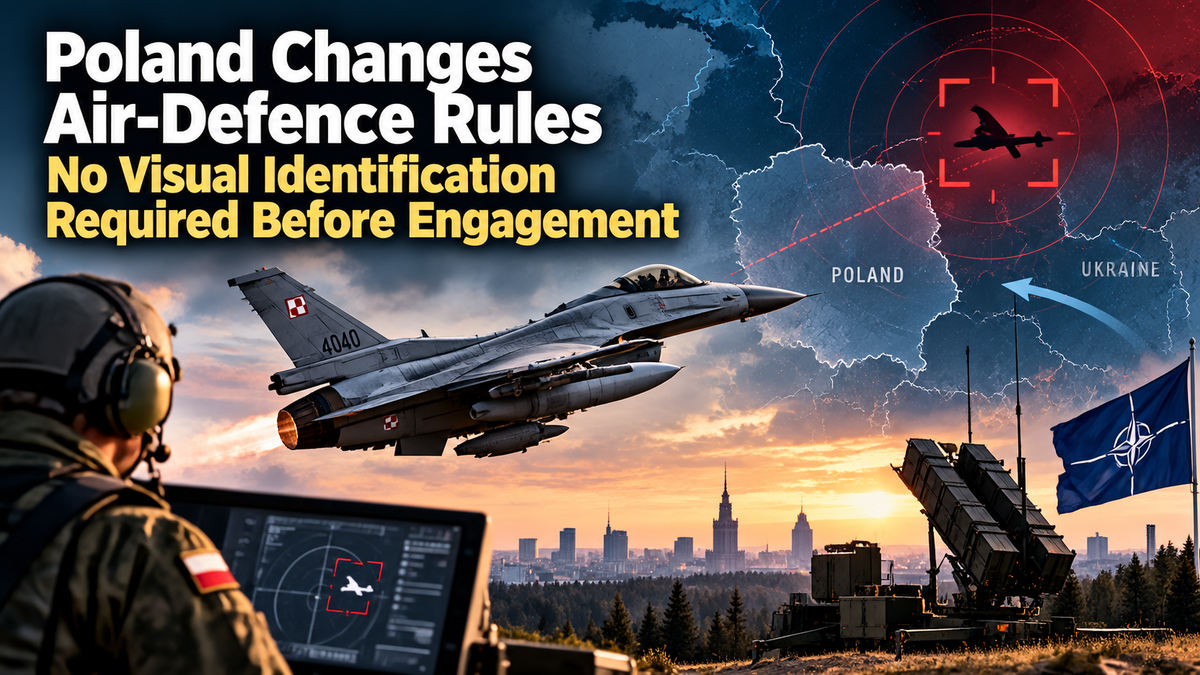
This isn't another readiness statement or procurement contract. It's a change in how a Polish pilot or operator actually reaches the decision to engage. As of October 1, seeing the target with your own eyes is no longer required first.
What happened
On October 1, Poland's simplified air-defence engagement procedures took effect. Defence Minister Władysław Kosiniak-Kamysz said the procedures were fully ready after receiving a readiness report from Operational Commander Gen. Ireneusz Nowak. Under the new framework, a pilot or operational commander can decide to engage an unidentified object based on radar and other sensor information, without first closing to visual-identification range.
Deputy Defence Minister Cezary Tomczyk had described the planned change on September 28: the requirement for visual verification would be loosened to "positive verification" — for example, a radar reading, an object entering a no-fly zone, or information supplied by the Ukrainian side. Kosiniak-Kamysz said no new legislation was needed to bring in the rules. "In conversations with soldiers — those operating in air, missile, and anti-defence, whether in ground-based systems or as pilots — it was crucial to achieve clarity and precision of action and interpretation, for the times we find ourselves in today," the minister said.
Confirmed versus outstanding
| Claim | Status |
|---|---|
| New rules took effect October 1 | ✅ Confirmed by Poland's defence minister |
| Visual-identification requirement before engagement removed | ✅ Confirmed by Reuters |
| Decisions can rest on radar data, no-fly-zone entry, or Ukrainian intelligence | ✅ Confirmed (Deputy Minister Tomczyk) |
| No new legislation required to implement | ✅ Stated by the defence minister |
| Classified engagement thresholds, command-authority matrix, sensor-confidence requirements | 🟡 Not publicly disclosed |
| Whether this means automatic shoot-down of every unidentified object | 🟡 Public reporting explicitly cautions: no, this is not an automatic shoot-everything policy |
BSM analysis: a change in decision logic, not capability
This is a fundamentally different category of news from the usual procurement or support-pledge update. It's not about new hardware or a new squadron — it's about how existing hardware gets used. The previous peacetime procedure required visual identification partly to minimise the risk of mistakenly engaging a civilian aircraft. The new procedure replaces that constraint with a more dynamic identification process built on the available sensor picture.
The context this arrives in is telling. A year ago, on September 10, 2025, Poland recorded 19 airspace violations in a single night during a massive Russian strike on Ukraine, shot down at least three drones, and invoked NATO's Article 4 for the first time in the war. That episode exposed exactly the problem the new procedure addresses: very short decision windows against drones or missiles approaching from Ukraine.
BSM analysis: The most consequential element is the ability to fold Ukrainian data into the identification picture. Ukraine often tracks Russian missiles and drones before they approach NATO territory, potentially giving Polish command structures additional warning and identification data before an object even crosses the border. This formalises something that likely happened informally or with delay before — a direct integration of Ukrainian radar and intelligence feeds into Polish decision-making.
What this does and doesn't mean
Public reporting is explicit on this point: the change should not be read as an automatic policy of shooting down every unidentified object entering Polish airspace. The classified engagement thresholds, command-authority matrix, and sensor-confidence requirements used under the revised procedures remain undisclosed. That's an important guardrail — the procedure speeds up the decision, it doesn't remove risk assessment from it.
Checking other items from today
A reported warning from Garry Kasparov about an assassination threat in Lithuania has not gained sufficient official corroboration to be treated as evidence of a new Russian operation — its WATCH status is unchanged.
Estonia's ban on Russian/Belarusian grain transit remains in force but has little immediate operational effect, since such transit through Estonia was previously negligible.
Fresh remarks from German Chancellor Friedrich Merz warning of further Russian hybrid attacks — including a reference to an attempted drone attack at Leipzig airport — were also reviewed. Available reporting at this snapshot doesn't provide enough independently verified operational detail to treat that reference as a separate material incident.
What it means for the Baltic states
The problem Poland is solving isn't unique to it. NATO's eastern-flank states all face the same challenge: distinguishing accidental spillover, ambiguous incursions, and deliberate penetration quickly enough to respond. Poland is adapting a peacetime decision-making process to the security environment created by Russia's ongoing war — and this precedent is likely to be studied by other states in the region with similar risk geography.
Conclusion
This is a change in response logic, not new hardware or a new pledge. Polish forces should now be able to move from detection to an engagement decision faster, since a fighter no longer has to close to visual range first.
Next checks: whether the new procedure produces its first engagement under the simplified rules; whether other eastern-flank states adopt comparable changes; whether details of the classified decision thresholds surface in the event of an incident.
Baltic Security Monitor (osint-baltic.com) — an analytical publication on security on NATO's northeastern flank. All OSINT assessments are produced by an automated monitoring system using open sources.