Latvia Five Days Before the Vote: OSINT Digest, 28 September 2026

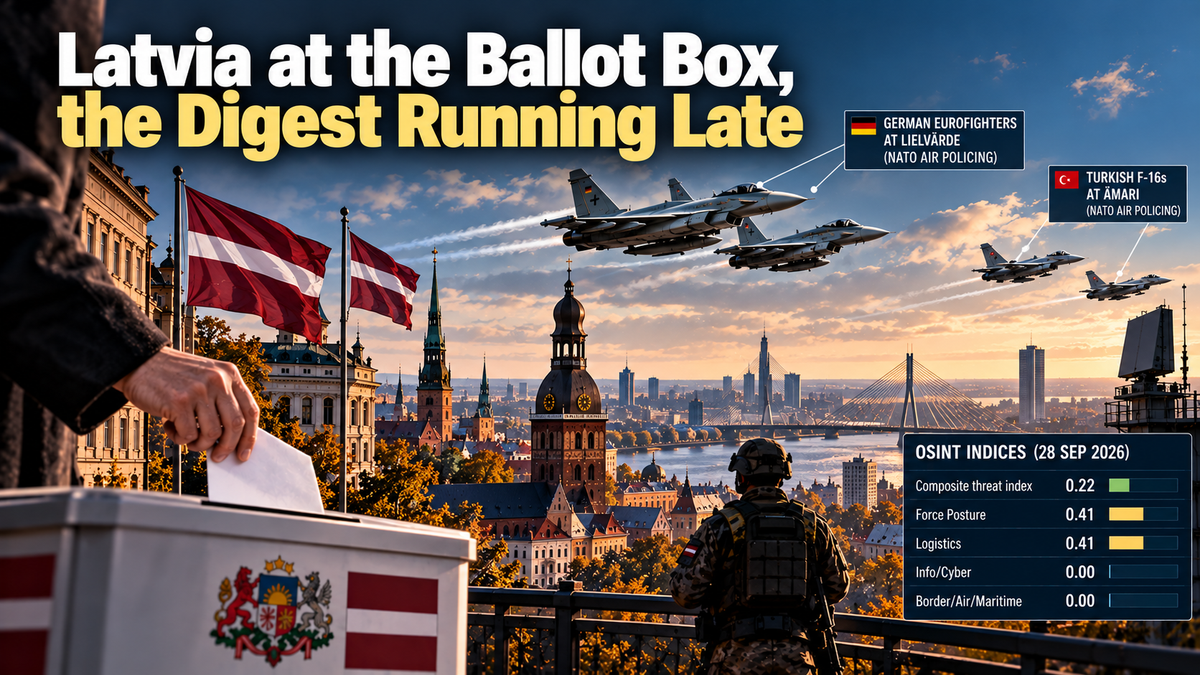
Baltic Security Monitor | Analytical Brief Snapshot: 2026-09-28T18:08:15Z
Today's OSINT indices
| Indicator | Value | Change (24h) |
|---|---|---|
| Composite threat index | 0.22 | flat (Δ6h 0.00, Δ24h 0.00) |
| Force Posture | 0.41 | joint-highest sub-index, identical to Logistics |
| Logistics | 0.41 | identical to Force Posture |
| Info/Cyber | 0.00 | zero |
| Border/Air/Maritime | 0.00 | zero |
Events in 24h: 1 · High-confidence: 0 Quarantine: 10 (invalid-json) · Source failures: 0
A composite of 0.22 sits at the top of the calm band, and its structure is telling: the whole load rests on two matching sub-indices, Force Posture and Logistics (0.41 each), while Info/Cyber and Border/Air/Maritime stay at zero. That is the profile of exercise-driven activity with no recorded hostile signals in the cyber, border, air or maritime dimensions. The 6h and 24h deltas are flat: the configuration holds. The main test of the period is still ahead: early voting began in Latvia today, and the parliamentary election is on 3 October.
Top-5 events
🔵 1. Latvia to introduce border controls on grain shipments
OSINT score: 0.16 — WATCH
The Saeima passed, under urgent procedure, amendments to the animal feed law. The Food and Veterinary Service will inspect consignments and take samples for laboratory testing, and a parallel resolution calls on the government to draft a legal framework to halt imports of Russian and Belarusian grain immediately, transit included (LSM). The trigger: Ukraine gave Latvia information about large volumes of grain taken from occupied territories, with a risk that it moves through Latvian ports on documents declaring Russian origin. Until now, food-grade grain was not tested against its declared origin. Prime Minister Kulbergs said inspections could take up to a month; shipments cannot be held in port for the full duration of testing, and buyers will be notified if a cargo is later found to be stolen.
BSM analysis: a sanctions story rather than a border story in the military sense, which is why Border/Air/Maritime stays at zero. Latvia is closing a gap in EU external-transit rules: the ban covered the domestic market while transit cargo passed through untouched. Because cargo is not held during testing, the mechanism works chiefly as pressure and reputational risk for shippers. The next step belongs to the Cabinet: which consignments are covered, and by what procedure.
🔵 2. Four Italian soldiers injured at Ādaži
OSINT score: 0.20 — WATCH
On 25 September, during training at the Ādaži range, four soldiers from the Italian contingent (11th Bersaglieri Regiment) were injured. The National Armed Forces say none is in life-threatening condition. Italy's Ministry of Defence says the incident happened during live-fire training with a non-automatic weapon mounted on an Italian vehicle, and the rounds struck another Italian vehicle carrying four soldiers (LSM). Some secondary reports mention one serious injury; that is not officially confirmed.
BSM analysis: a training-safety incident, not a combat event, with no sign of external interference. Its weight lies elsewhere: more than 300 Italian soldiers serve in a multinational brigade, and live fire in the dense shared infrastructure of the range demands flawless safety discipline. The investigation is Italian; we expect no effect on NATO's presence in Latvia.
🔵 3. Latvia to send up to 20 soldiers to clear Hormuz
OSINT score: 0.14 — WATCH
On 24 September the Saeima approved National Armed Forces participation in multinational operations to secure the Strait of Hormuz, by 73 votes to none with no abstentions. Latvia will contribute an underwater ordnance-disposal unit with autonomous mine-clearance systems, plus staff officers and instructors (LSM). The mandate runs to 1 September 2028, since clearance may take 12 to 16 months. The key caveat: Latvian soldiers will not join operations that would support the US as a belligerent in the conflict with Iran.
BSM analysis: geographically far from the Baltic, politically close. Latvia joins the restoration of freedom of navigation with maritime partners and writes the limit into the mandate: mine clearance, not participation in the war. For a country with a small navy, 20 mine-warfare specialists are a noticeable share of scarce capability, so the balance between an external mandate and Baltic tasks will be a topic of domestic debate.
🔵 4. Lithuania: restore warning shots for police and border guards
OSINT score: 0.10 — WATCH
The Interior Ministry proposes restoring officers' ability to fire warning shots, abolished about a decade ago, and easing some limits on firearm use, including dropping the requirements of imminent danger and extreme necessity. Border guards would gain more room to use firearms against equipment used to cross the border. Police unions are sceptical and say they were not consulted (LRT). The debate sharpened after a July incident at the Kapčiamiestis post, where about 20 foreigners allegedly attacked officers.
BSM analysis: a domestic story about limits on force on the Belarus border, and its main dimension is legal. A Vilnius court is hearing a murder case against a border guard who shot a driver fleeing after a smuggling incident. The proposal answers a dilemma in which officers hesitate to use weapons for fear of prosecution. Next check: whether the bill reaches parliament and in what form.
🟡 5. Latvian troops train for rapid mobilization and infrastructure protection
OSINT score: 0.28 — WATCH (highest in the digest)
The National Armed Forces describe the goal of the "Namejs" mobilization exercises as testing and improving how National Guard and reserve soldiers are folded into the combat structure, along with mobilization and provisioning procedures (LSM). Drills run in urban areas and at state, municipal and critical-infrastructure sites, including checkpoints and anti-mobility obstacles in Riga.
BSM analysis: the mobilization exercise explains why Force Posture and Logistics match at 0.41: one activity registers both as deployment and as support. Reserve mobilization and protection of critical infrastructure are themes that grow louder in Latvia every year, and "Namejs" shows them moving into practice, including in the urban environment of the capital.
Ahead: an election under an allied umbrella
Early voting for the 15th Saeima opened today, 28 September, and runs until 2 October at 933 polling stations, with the main vote on 3 October (LSM). At the end of September four German Eurofighters arrive at Lielvārde to temporarily reinforce Latvian airspace, including during the elections. It is Defence Minister Raivis Melnis's initiative, and according to LSM air defence has not previously been reinforced specifically for an election period. Turkish F-16s operating from Ämari also add to the cover.
BSM analysis: the story has two layers. The public one: the state shows that the vote takes place under an allied umbrella. The practical one: the deployment tests NATO's ability to move and receive allied forces quickly and Lielvārde's readiness to host allied air power. Election week is the first trial of this model, and how it registers in BSM's indices, above all Info/Cyber and Border/Air/Maritime, will be the main subject of tracking in the coming cycles.
Conclusion
A composite of 0.22 describes a day in which Latvia is mostly preparing: mobilization drills, Hormuz mine clearance, grain controls. The real test begins with early voting. Three vectors to keep in view: the information environment of election week, the airspace over Latvia under allied cover, and whether the grain controls begin to change the behaviour of transit shippers.
Five days to the Latvian election.
Baltic Security Monitor (osint-baltic.com) — an analytical publication on security on NATO's northeastern flank. All OSINT coefficients are calculated by an automated indexing system based on open sources.