One Night, Two Flashpoints: Baltic Friction Tests Both Sea and Sky

Baltic Security Monitor | Analytical Briefing Material OSINT Update: 15 September 2026, 14:00
This is an off-cycle Material OSINT Update rather than a routine indexed digest. The trigger is two near-simultaneous incidents between NATO forces and Russia/Belarus-linked activity in the Baltic region within roughly the same 24-hour window: a Russian frigate firing flares at a Danish military helicopter, and NATO fighters shooting down an unidentified drone over Lithuania.
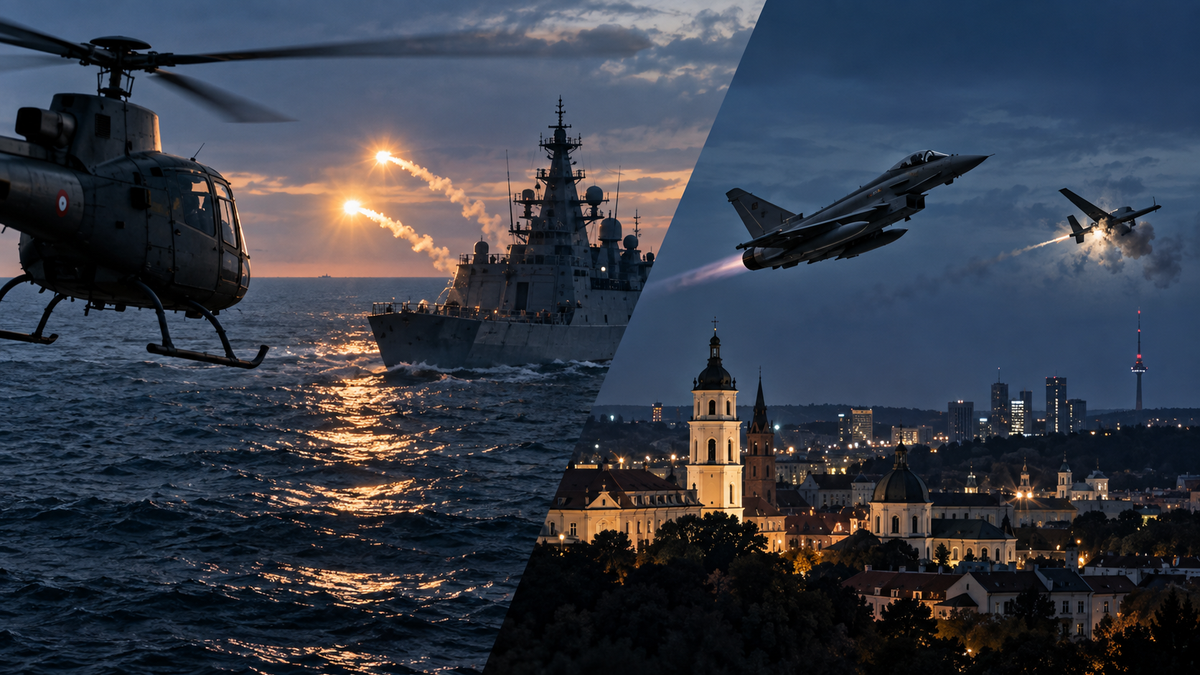
Within a few hours overnight into 15 September, the Baltic region registered two separate, physical — not merely rhetorical — contacts between NATO and Russia/Belarus-linked forces: at sea, a Danish helicopter came under flare fire from a Russian frigate; in the air, Italian fighters carried out the first lethal intercept of NATO's Baltic Air Policing mission against a drone that crossed in from Belarus and overflew Vilnius before being shot down. Neither episode caused casualties or damage, but both show routine operations — ship shadowing, airspace patrol — increasingly tipping into direct physical interaction. This does not indicate a single coordinated Kremlin decision, but it does mark a broader trend: the threshold of what both sides treat as routine keeps shifting.
Event 1: Russian frigate fires flares at Danish military helicopter
Status: WARNING (new entry)
On 14 September, a Danish Air Force Fennec helicopter was conducting routine photographic surveillance of a Russian frigate in international waters off Gedser, at the southern tip of Falster island — on the approach to the Danish Straits, a key corridor linking the Baltic and North Seas. According to a Danish Defence Command statement issued late that evening, the frigate fired two flares toward the helicopter; one passed at close range. The crew aborted the mission and left the area; no injuries or equipment damage were reported.
Denmark's response escalated to state level: on 15 September the Foreign Ministry summoned Russian ambassador Vladimir Barbin. Prime Minister Mette Frederiksen called the frigate's action reckless. Foreign Minister Lars Lokke Rasmussen described the incident as "completely unacceptable" and said Russia is gradually moving the line of what it considers acceptable conduct at sea. Defence Minister Jeppe Bruus went further, calling the episode "serious and without precedent" and describing the frigate crew's conduct as highly unprofessional seamanship — evidence, in his assessment, that Moscow's appetite for risk has shifted.
Moscow does not dispute that the contact occurred but rejects Copenhagen's framing: Ambassador Barbin delivered a protest note accusing Danish helicopters of dangerous manoeuvres near Russian warships and demanding measures to prevent recurrence. Kremlin spokesman Dmitry Peskov said he lacked sufficient details to comment.
BSM Analysis: Signal flares are pyrotechnic devices meant to warn or attract attention, not weapons of engagement. But firing them toward an aircraft at close range creates a genuine safety risk — a forced evasive manoeuvre, a collision, a loss of control. What distinguishes this episode from routine shadowing is that it is the first documented case in 2026 of a Russian-Danish military contact turning physical rather than remaining purely visual or electronic. There is no evidence yet that this reflects a formal change in Russian naval rules of engagement — it may be a single commanding officer's decision. But the fact that Denmark's own defence minister publicly used the word "unprecedented" signals how seriously Copenhagen is treating the episode politically.
Event 2: Italian NATO fighters shoot down a drone over Lithuania for the first time
Status: WARNING (new entry)
Around midnight into 15 September, Lithuania's National Crisis Management Centre detected an unidentified drone entering the country's airspace from the direction of Belarus. Lithuanian authorities say the drone remained airborne for roughly 30 minutes and passed over the capital, Vilnius, before duty forces acted. At approximately 00:20 local time, two Italian Air Force Eurofighter Typhoons from the "Baltic Thunder III" Air Task Force, operating out of Šiauliai Air Base under NATO's Baltic Air Policing mission, intercepted and destroyed the drone; wreckage was located near the village of Pratkūnai in Kaunas district. No casualties or damage were reported.
Lithuanian President Gitanas Nausėda confirmed the operation, crediting allied forces' rapid response amid Russia's escalating war against Ukraine. Foreign Minister Kęstutis Budrys called the intercept a clear signal of alliance unity and collective defence. Italian Defence Minister Guido Crosetto noted this was the second such incident involving Italian jets within a month, calling the presence of Italian forces on the eastern flank essential to collective security.
The drone's origin and purpose remain unconfirmed. Lithuanian officials suspect a Belarusian route of entry but have not established the operator or whether the device carried any payload, and have explicitly cautioned against premature conclusions. The wreckage is being examined under a secured military-police perimeter.
BSM Analysis: This is the first documented case of NATO's Baltic Air Policing mission using lethal force against an airborne target over a member state's own territory — a qualitative shift from patrol and escort toward actual peacetime combat engagement. That the drone had time to overfly the capital before interception points to a real reaction-time gap even with fighters on standing alert. Crosetto's framing of this as "the second incident in a month" suggests it is no longer an isolated episode but part of a pattern worth tracking as its own thread in future updates.
Signal of the day: two domains, one night
The near-coincidence of both events — sea and air, Denmark and Lithuania, flares and a drone — within roughly the same 24 hours is worth flagging as a pattern rather than two unrelated incidents. Nothing indicates direct coordination: the actors involved (the Russian navy, and a drone likely routed through Belarus) sit on different segments of the periphery adjoining NATO. But the combined effect placed simultaneous load on two distinct alliance response mechanisms — diplomatic (an ambassador summoned) and military (a live intercept). Both resolved without escalating into direct confrontation, which itself speaks to the functioning of existing deconfliction procedures — procedures that were tested twice in a single night.
Regional context
Both incidents sit within a longer series of Baltic airspace and maritime friction over the past year: balloon incursions across the Lithuania-Belarus border in autumn 2025 that forced temporary border-crossing closures; brief Russian aircraft incursions into Lithuanian airspace; and Russian reconnaissance aircraft overflying the German frigate Hamburg at altitudes reportedly below 100 metres in September 2025. Lithuania and other NATO eastern-flank states continue to post some of Europe's highest defence spending as a share of GDP against this backdrop.
The Danish episode also underscores Denmark's geographic role: control over the Danish Straits, a corridor carrying much of the maritime traffic between the Baltic and North Seas, including suspected sanctions-evading "shadow fleet" tankers that are occasionally escorted by Russian naval vessels.
Conclusion
Neither episode is, on its own, a turning point: the flares caused no harm, and the drone was destroyed without civilian consequence. But their coincidence in time — and their symbolic weight, as the first lethal Baltic Air Policing shot against a target over allied territory and, by Denmark's own defence minister's assessment, an unprecedented maritime contact — points to a threshold that keeps moving on both sides. Future cycles should track whether these remain isolated episodes or, as Minister Crosetto's "second incident in a month" comment suggests for the drone case, part of an emerging pattern, and whether NATO's formal response procedures adjust as a result.
Baltic Security Monitor (osint-baltic.com) — an analytical publication on security along NATO's northeastern flank. Prepared from open sources; part of the factual base draws on automated OSINT monitoring.