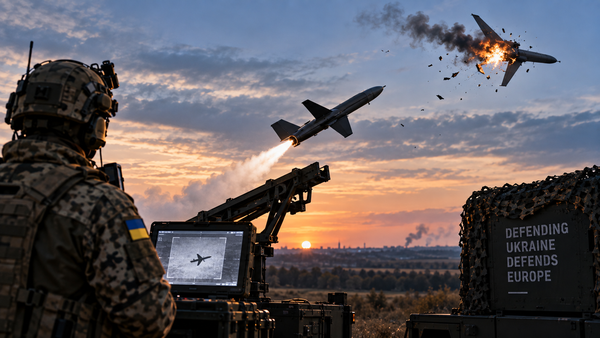
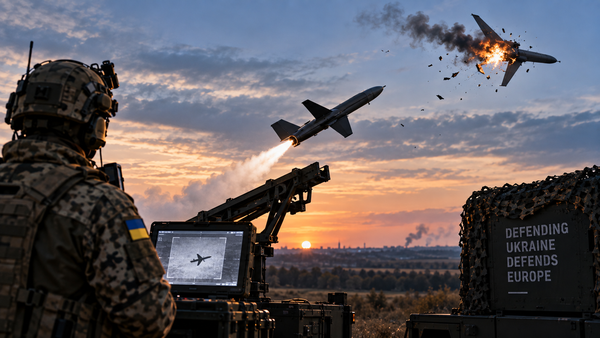
Not Strays. Redirects.

Baltic Security Monitor | Analytical review Material update snapshot: 9 September 2026, 14:00 Europe/Tallinn (processed 14:01:54–14:03:32)
Cycle indicators
| Indicator | Value |
|---|---|
| Cycle type | MATERIAL UPDATE (second of the day) |
| Category | Border / Air / Electronic warfare |
| Materiality | medium-high |
| 🟡 WATCH signals | 3 |
| 🔴 WARNING signals | 0 |
| Composite / Force Posture / Logistics / Info-Cyber / Border-Air-Maritime | not computed in this cycle |
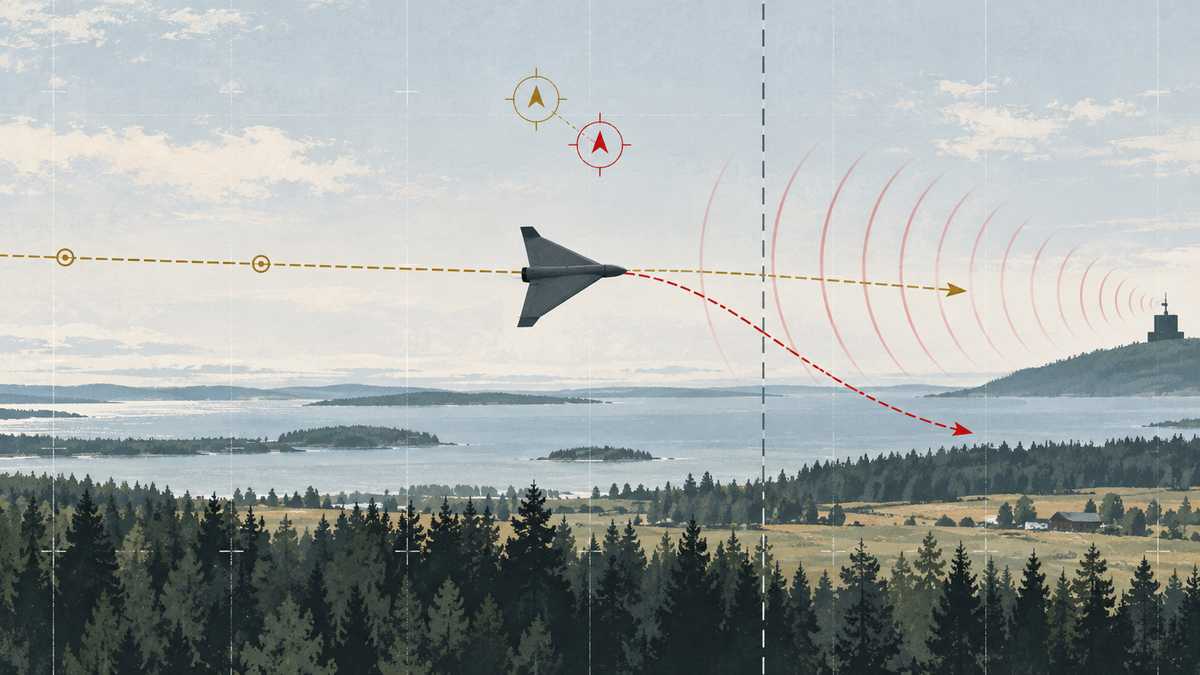
Four armed drones that came down in Finland last spring have now been officially established as Ukrainian. That looks like a case being closed, which is exactly why it deserves attention. The operative words in the Finnish finding are not "of Ukrainian origin" but "thrown off course": strong GNSS jamming detected in the eastern Gulf of Finland, combined with a wind blowing almost directly from the south. And a British investigation identified, back in spring, a transmitter in Kaliningrad using GPS jamming and spoofing to push Ukrainian drones away from Russia and toward NATO airspace. This is not war spilling accidentally across a border. It is somebody else's weapon being redirected onto a third country — and the method works.
What happened
🟡 1. The investigation is closed; the violation is not undone
On 9 September Finland's National Bureau of Investigation and the Border Guard announced the completion of pre-trial investigations into four unmanned aircraft found in March at Kouvola, Luumäki and Parikkala, and in April at Iitti. All four carried explosives. In the Luumäki case police suspect the aircraft detonated in the air. There were no injuries and no property damage.
The legal architecture matters and the update leaves it out. The Border Guard handled the cases as violations of territorial integrity; the National Bureau of Investigation treated them as negligent endangerment, including in its aggravated form. The prosecutor terminated the proceedings after finding no grounds to continue establishing criminal liability. Finnish authorities stated separately that ending the investigations does not mean the aircraft did not enter Finnish airspace unlawfully.
BSM analysis: this is neither exoneration nor amnesty. It is an acknowledgement that no liable party exists within Finnish jurisdiction. The violation is on record, the negligence element was worked through, and there is nobody to charge. Analytically the case is legally shut and operationally wide open: the mechanism that put four armed airframes on Finnish soil has not gone anywhere.
🟡 2. A formulation worth reading literally
The Finnish Border Guard's finding runs as follows: the aircraft originated in Ukraine and formed part of Ukraine's countermeasures in response to Russia's war of aggression; they had not been aimed at Finland but were thrown off course by strong GNSS jamming detected at the time in the eastern Gulf of Finland, combined with prevailing weather. On the weather the Finns were specific — the wind during the incidents blew almost directly from the south, and these factors together are assessed to have affected the aircraft's navigation and their deviation from the original route.
BSM analysis: note the structure of that sentence. Finland simultaneously established Ukrainian origin and removed Ukrainian intent. This is not diplomatic softening but a technical conclusion that the airframe's track had ceased to reflect its operator's plan. Volodymyr Zelensky apologised to Finland in the spring after the Kouvola find, stressing that Ukraine does not under any circumstances target Finland.
For BSM the methodological point is the one to carry forward: platform, operator, target and actual track are four separate variables, and in this region they routinely point in different directions. Ukrainian airframe, Ukrainian mission, Russian target, Finnish impact site.
🟡 3. The transmitter in Kaliningrad
The update notes that the Finnish findings do not publicly identify the specific transmitter responsible for the interference. Formally true. But outside the official Finnish document, an answer surfaced in the spring: Britain's Telegraph uncovered evidence that a transmitter in the Russian exclave of Kaliningrad uses GPS jamming and spoofing to steer Ukrainian drones away from Russia and toward the airspace of NATO member states.
That is not an isolated reading. Finnish Prime Minister Petteri Orpo was among those saying the aircraft were presumably driven off course into NATO countries by Russian electronic jamming. Latvian military sources similarly attributed a drone's entry into Latvian airspace to Russian electronic warfare.
BSM analysis: the distinction between jamming and spoofing is not a technical footnote here; it is the whole argument. Jamming strips an airframe of navigation and makes its behaviour erratic. Spoofing substitutes false coordinates and makes it externally steerable — the aircraft flies confidently, just not where intended. If the second is confirmed at the level of official attribution, the classification of the event changes: not a side effect of defending Russian facilities, but the use of somebody else's munitions as an instrument of pressure on third countries. Cheap, unaddressed, and formally unconnected to Russia.
No such official attribution exists yet. BSM logs the confidence levels separately: the Finnish finding is official, the Kaliningrad transmitter is journalistic investigation, Moscow's intent is hypothesis.
Verification corrections to the update
"Accidental spillover" understates it. The update frames the incidents as accidental spillover from Ukrainian operations. The evidence supports something more precise: the deviation was caused by external interference with navigation, not by operator error or technical failure. "Accidental" describes the outcome but not the cause.
The legal ending is missing from the update. The prosecutor terminated proceedings for want of grounds to establish criminal liability, and the Finnish side stated explicitly that this does not legalise the airspace violation itself. That is materially more than "investigations completed."
Details absent from the digest: all four airframes carried explosives; the Luumäki drone is suspected of detonating in the air; the wind on the days in question was almost directly southerly.
Key signal: two halves of one problem in a single day
This morning BSM covered Romania, where a Shahed-type aircraft ran a hundred kilometres inland under Spanish F-18 escort and was not engaged, because rules of engagement over populated areas demand identification and separate authorisation. Finland now supplies the other half of the same problem.
Picture the Romanian decision under Baltic conditions. A pilot has minutes to determine the fate of a slow airframe approaching from the direction of Russia. But that airframe's origin, its operator, its target and its actual heading may point in four different directions — and on the morning of 9 September, and in Finland last spring, that is precisely what they did.
This is not theoretical. Over the Latvian village of Rugaji in Balvi Municipality, an Italian NATO fighter shot down a Ukrainian drone. The flank has already fired on Ukrainian weapons redirected by Russian interference. On 7 May two suspected stray Ukrainian drones entered Latvia; one detonated at an oil storage facility in Rēzekne.
BSM analysis: the full formulation of the flank's problem therefore reads like this. Permission to fire exists. Terrain on which it is comfortable to use does not (Romania). And where firing is possible, identifying the target does not establish whose weapon it is or who is effectively steering it at the moment of the shot (the Baltics and Finland). Both halves share one source: the region's degraded navigation environment.
Regional context
- The 2026 chain. The first known incident of the series was in Lithuania on 23 March, followed by crashes in Latvia and Estonia on 25 March. The backdrop is the intensification of Ukrainian strikes on Russian oil export infrastructure, notably the ports of Ust-Luga and Primorsk, which Reuters described as among the largest Ukrainian strikes on Russian oil export facilities of the war.
- Type identification. On 29 March the Finnish Air Force scrambled an F/A-18 and identified one aircraft as a Ukrainian AN-196 Liutyi. The next day Reuters reported that the drone found north of Kouvola carried an unexploded warhead, destroyed in a controlled detonation.
- On 3 May a UAV was observed near Virolahti and left Finnish airspace toward Russia, during a Ukrainian strike on Primorsk.
- Not everything is Ukrainian. On 1 September a drone washed up on a shore in the Pellinki archipelago near Porvoo; the Border Guard identified it as a Russian-made Geoscan 701 survey aircraft carrying no explosives. President Alexander Stubb said Finland faces no direct threat, while describing such finds as a new normal the country must prepare for.
- Capability. In December the Finnish Armed Forces purchased hundreds of SkyWiper Omni Max jamming devices from a Lithuanian manufacturer to protect critical infrastructure and military sites.
Conclusion
Finland has done something rare for this region: taken an airspace incident through to a formal finding and published the cause, not merely the fact.
The finding is uncomfortable for all three parties. For Ukraine, because it confirms that its armed airframes came down on an ally's territory. For Finland, because four armed drones reached its soil and not one of them should have been there. For NATO, because it destroys the convenient presumption that direction of flight identifies ownership.
The third implication is the important one. If a region's navigation environment can be manipulated from outside, any country on the flank risks receiving somebody else's weapon with no decision to attack behind it — and no addressee for a response. The case is legally closed for want of anyone to charge. That is precisely the outcome the method was designed to produce.
Poland's three-month restricted airspace zone opens over the east of the country tomorrow. It settles the question of where air defence has freedom of action. It does not settle the question of whose aircraft is flying inside it.
Baltic Security Monitor (osint-baltic.com) — an analytical publication on security along NATO's northeastern flank. All OSINT coefficients are produced by an automated indexing system drawing on open sources. Every item above was verified independently of the digest.