Not a New Capability — a Renewed Commitment: Sweden Sends Gripens Back to Guard Ukraine's Aid Hub

Baltic Security Monitor | Analytical Brief Snapshot: 30 September 2026, 20:00 (Europe/Tallinn) · Material OSINT Update
This isn't Sweden's first Gripen deployment over Poland — it did the same in 2025. What matters about today's announcement isn't new capability, it's that Stockholm is repeating an operational commitment right as NATO's eastern-flank airspace is being probed more often than it has been in years.
Assessment
| Indicator | Value |
|---|---|
| BSM assessment | MATERIAL UPDATE |
| Category | NATO eastern flank / air defence / Ukraine logistics / military posture |
| Materiality | Medium-high |
| Uncertainty flags | 🟡 1 · 🔴 0 |
| Delta type | Renewed operational deployment with a defined start (October), not a new capability |
What happened
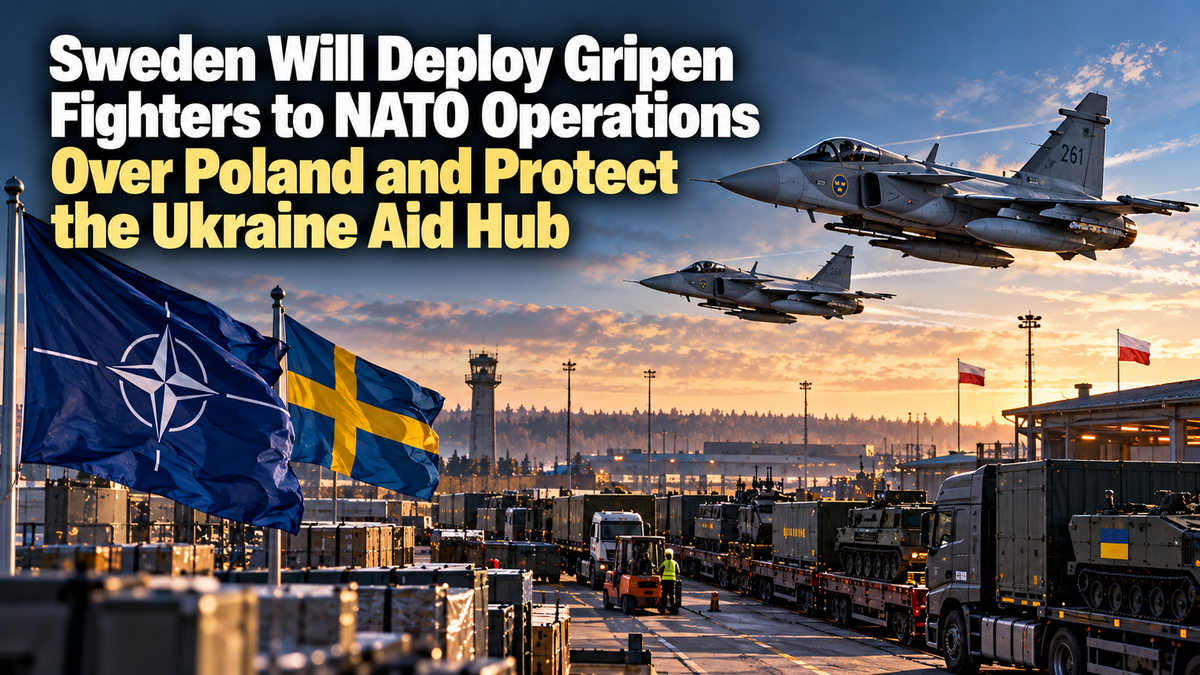
On 30 September, Sweden's government announced it will deploy JAS 39 Gripen fighter jets to a NATO airspace-surveillance operation over Poland starting in October. The jets will join the alliance's integrated air and missile defence and directly protect a logistics hub in southeastern Poland, centred on the Rzeszów-Jasionka area near the Ukrainian border, through which much of the Western military and civilian aid bound for Ukraine passes.
The aircraft will remain mainly based in Sweden, with a smaller forward presence in Poland. Defence Minister Pål Jonson said: "The serious security situation and the recurring violations of NATO airspace show the need for high military readiness on the eastern flank." Foreign Minister Maria Malmer Stenergard added that the move strengthens the security of Sweden and its allies and secures continued support to Ukraine, calling it the government's "foremost foreign policy objective."
This is Sweden's second such contribution: a first mission protecting the same hub ran in 2025 (up to eight Gripens and around 120 personnel from the Blekinge Wing), and that deployment was itself Sweden's first combat-aircraft deployment abroad under NATO's enhanced airspace surveillance.
Confirmed versus outstanding
| Claim | Status |
|---|---|
| Sweden will send Gripens to Poland from October | ✅ Official government statement, confirmed by Reuters |
| The mission protects a Ukraine-support logistics hub in southeastern Poland | ✅ Confirmed by the Swedish government and Reuters |
| This is Sweden's second such deployment (first was 2025) | ✅ Confirmed |
| Aircraft will be mainly based in Sweden with a smaller forward presence in Poland | ✅ Confirmed |
| Number of aircraft, sortie rate, Polish basing details, mission duration | 🟡 Not publicly disclosed |
BSM analysis: why repetition matters
The immediate military effect here is incremental rather than transformational — Sweden ran a comparable mission last year. The stronger signal is continuity of commitment: Stockholm is again assigning combat aircraft to defend allied airspace and Ukraine's support corridor, not simply repeating a political statement of support.
Context matters here. Less than a week ago, Swedish Gripens and Finnish F/A-18s flew their first-ever joint identification mission, intercepting a Russian formation over the Gulf of Finland (already covered by BSM on 29 September). Together, the two episodes point to increasingly operational Nordic integration into NATO's eastern-flank air posture: Sweden is simultaneously coordinating QRA duty with Finland and assigning Gripens to a NATO mission in Poland.
BSM analysis: The decision also spreads the burden of eastern-flank air patrol across more allied air forces, freeing Polish aircraft and crews for national and Alliance tasks. And the fact that Stockholm explicitly tied the mission to "recurring violations of NATO airspace" signals this was framed as a response to recent dynamics — the same pattern already flagged in earlier BSM updates on drone incursions and eastern-flank activity — rather than a routine rotation.
Checking earlier items from today
This morning's preventive Polish fighter scramble during Russia's large-scale strike on Ukraine — aircraft and ground air-defence systems activated and stood down before 08:00, with no reported violation of Polish airspace — does not meet BSM's materiality threshold and is not treated as a separate item.
On the earlier 14:00 update regarding Russia's non-paper nuclear warning over Kaliningrad: as cited in the digest, NATO leadership subsequently said there is no imminent threat to Alliance territory and that its assessment of Russia has not changed. 🟡 This specific statement could not be independently confirmed in open-source search for this snapshot and should be treated with caution rather than as fully verified. If confirmed, it would not reverse or materially escalate the earlier Russian document — it would serve as a clarification.
What it means for the Baltic states and Ukraine
For Poland and the wider region, Sweden's decision shows a transition from NATO accession (2024) to repeated operational participation in Alliance air-defence missions. It also lands against a backdrop of recent airspace incidents that have raised NATO's attention to the eastern flank — Sweden's own government cited recurring violations as part of the rationale.
For Ukraine, the link is direct and officially stated: protecting the hub means protecting the channel through which Western equipment is supplied — including what was already confirmed in this morning's BSM update on Belgian F-16s and NASAMS missiles. Logistics and hardware are two sides of the same supply chain, and today both got a confirmed protection story on the same day.
Conclusion
This isn't a new capability — it's confirmed willingness to repeat operational commitment when the situation calls for it. The next material delta isn't the deployment itself (already confirmed) but the details: aircraft numbers, mission duration, or any scale-up in response to further airspace violations.
Next checks: the number of Gripens and personnel involved; deployment duration; whether other Nordic countries join similar rotations over Poland.
Baltic Security Monitor (osint-baltic.com) — an analytical publication on security on NATO's northeastern flank. All OSINT assessments are produced by an automated monitoring system using open sources.