A North Korean Missile Specialist on the EU Sanctions List: What the Council Says About Help to Russia, and What It Does Not Prove

Baltic Security Monitor | Material OSINT Update Snapshot: 13 October 2026, 08:00 (Europe/Tallinn)
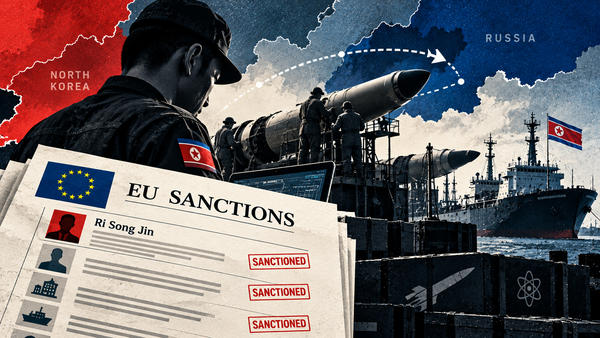
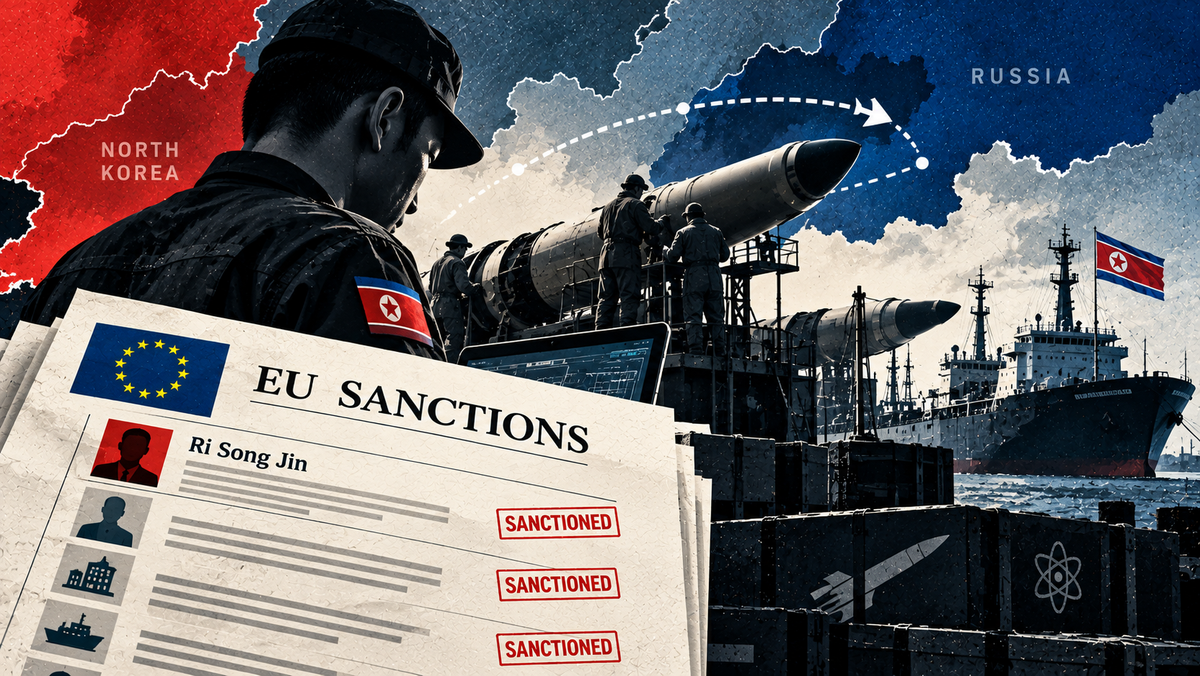
On 12 October the Council of the EU added three individuals and four entities to its sanctions lists over North Korea's nuclear and missile programmes and its ties with Russia. Among them is Ri Song Jin, whom the Council describes as a technician deployed to Russia to support its use of North Korean missiles. That is the EU's official position, not an independently verified fact about his activity.
Update status
| Indicator | Value |
|---|---|
| Cycle assessment | MATERIAL UPDATE — MODERATE |
| Category | Defence industry / military sustainability / sanctions |
| Event | 12 October 2026, Council of the EU decision |
| New designations | 3 individuals, 4 entities |
| Uncertainty markers | 🟡 3 · 🔴 0 |
| Delta type | Institutional decision; separate DPRK sanctions regime |
| Capture note | Late capture in the 13 October morning cycle |
1. What happened
According to the Council's press release, the following were listed:
- Ri Song Jin: a researcher at North Korea's National Aerospace Technology Administration and an official of its Missile General Bureau; deployed to Russia as a technician supporting Russia's use of DPRK missiles.
- Anna Akinshina: CEO of the developer Samolet Group, listed for responsibility for a company that employed DPRK workers on construction projects in Vladivostok in violation of UN sanctions.
- Vladimir Sokolov: founder and president of Black Horse, listed for promoting commercial and industrial cooperation with the DPRK, including an investment project in Primorsky Krai.
- Entities: Samolet Group, Black Horse, the Golden Autumn agroholding (a Black Horse subsidiary) and Paekyangsan Shipping Co Ltd, which operates the DPRK-flagged vessel Paek Yang San 1, involved, per the Council, in shipments of refined petroleum from Russia to the DPRK in violation of UN Security Council Resolution 2397.
Measures: asset freeze, a ban on making funds and economic resources available, and an EU travel ban for the individuals. With these listings the EU has autonomously listed 80 individuals and 25 entities under the DPRK regime.
Separate from the Russia packages. This is not part of the 1,569 military-industrial listings or the 77 election-related designations covered in BSM's 12 October pieces.
2. Confirmed versus outstanding
| Claim | Status |
|---|---|
| On 12 October the Council added 3 individuals and 4 entities to the DPRK list | ✅ Council of the EU (press release) |
| The Council describes Ri Song Jin as a technician in Russia | ✅ as the Council's position; 🟡 his activity is not independently established |
| South Korea's Yonhap independently reported the decision | 🟡 Per the digest; I could not open the Yonhap text |
| Scale and effect of Ri Song Jin's activity in Russia | 🟡 Not established |
| Effect on Russian missile operations or DPRK deliveries | 🟡 Not shown |
3. BSM analysis
A new detail, not a new threat. Until now the EU and partners spoke of North Korean arms supplies to Russia in general. Now the Council names a person and a role: technical support for the use of missiles. That is the EU's official wording, and it suggests imported systems need people as well as munitions.
The practical effect is unknown. An asset freeze and travel ban work within EU jurisdiction. For a North Korean specialist in Russia they are unlikely to change anything immediately; the commercial part, covering Russian companies and financial channels, may matter more, but that too depends on enforcement.
For the Baltic states the significance is indirect: it concerns external networks supporting Russia's military capability, not a new deployment or a change in NATO's north-eastern posture.
Further coverage would be justified by confirmed enforcement, coordinated partner designations, or documented disruption of North Korean military assistance.
Conclusion
The EU has openly named a North Korean missile specialist working in Russia and tied sanctions to North Korean labour, industrial cooperation and "arms for oil". It is a clear official statement, but not proof that Russian missile capability has already shrunk.
Next checks: independent confirmation of Ri Song Jin's role; enforcement against the Russian companies; coordinated partner designations; documented changes in supplies or support.
Baltic Security Monitor (osint-baltic.com) — an analytical outlet on security on NATO's north-eastern flank. All OSINT assessments are prepared by an automated open-source monitoring system.