Arrests in Germany: What Is Known About the Starlink Station Arson in Poland, and What Warsaw Has Not Yet Proven

Baltic Security Monitor | Material OSINT Update Snapshot: 13 October 2026, 08:00 (Europe/Tallinn)
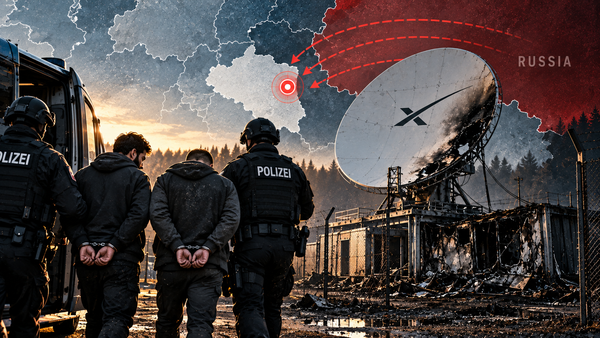
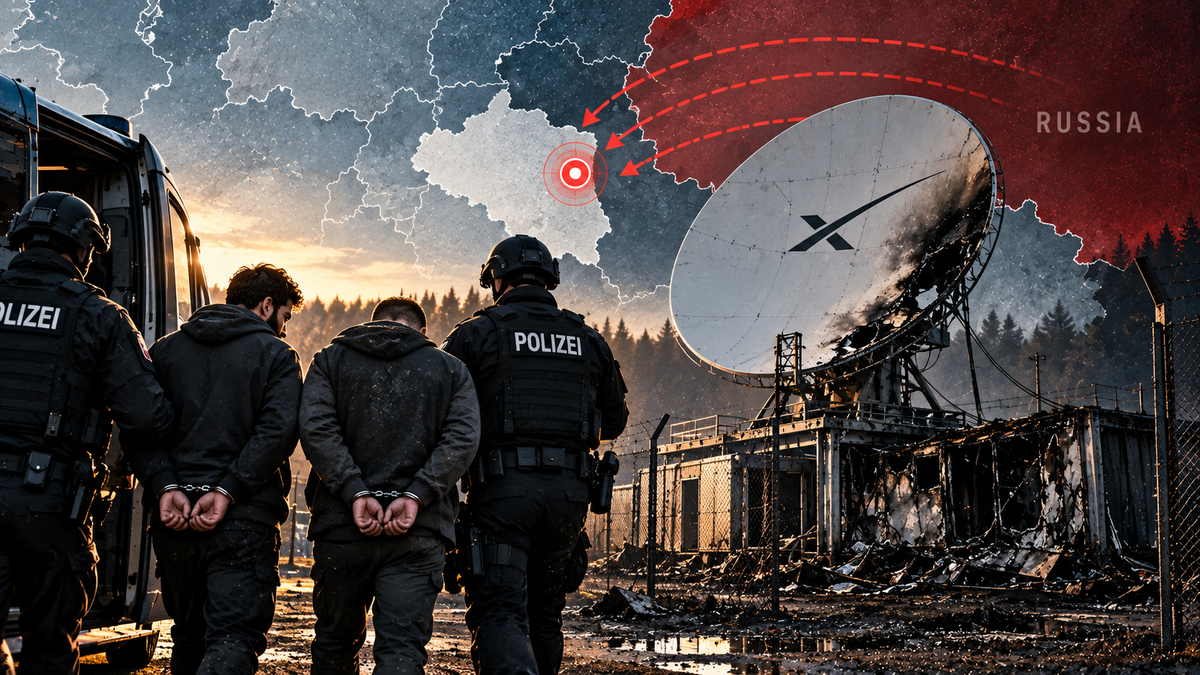
On 12 October Donald Tusk announced that German police had detained two Turkish citizens at Poland's request, suspected of setting fire to a Starlink station at Wola Krobowska on 23 September. Warsaw officially points to Russian intelligence. That is the assessment of Polish authorities and prosecutors, not a verdict and not published evidence.
Update status
| Indicator | Value |
|---|---|
| Cycle assessment | MATERIAL UPDATE — HIGH |
| Category | Hybrid warfare / sabotage / critical communications infrastructure |
| Original event | 23 September 2026 |
| New delta | 12 October: two arrests in Germany and renewed official attribution to Moscow |
| Uncertainty markers | 🟡 4 in the table below · 🔴 0 |
| Delta type | Investigative progress (from suspicion to detainees), not a new attack |
| Capture note | Late capture in the 13 October morning cycle; no overnight attack |
1. What happened
23 September. A Starlink ground station burned at Wola Krobowska in the Masovian region. According to the National Prosecutor's Office the fire was arson, with large property damage. Prosecutors opened an investigation into suspected acting on behalf of foreign intelligence against Poland, sabotage and an offence of a terrorist nature (Articles 130 § 7 and 163 § 1 point 1 of the Criminal Code). Prosecutors said investigators suspect the perpetrators acted on the orders of Russian special services, with the aim of disrupting Starlink traffic in Poland and other Central and Eastern European countries. Prosecutors carried out an on-site inspection on 24 September together with the ABW and CBŚP.
12 October. Tusk announced on X that German police had detained two suspects at Poland's request; both are Turkish citizens, per Reuters and AFP. He called it "another act of hybrid warfare". Special-services coordinator Tomasz Siemoniak said: "We have no doubt that Russian services are behind this act of sabotage", adding that those services increasingly use people from the criminal underworld. Interior Minister Marcin Kierwiński said the pair would be charged in Poland with sabotage on a foreign intelligence agency's orders (Reuters, AFP).
The station. According to Reuters the fire engulfed the station's power system and backup generator. Poland said at the time that the sabotage was meant to disrupt internet services, including those used by Ukraine's military. Reuters also notes that Ukraine's military uses tens of thousands of Starlink terminals and that Poland pays for Ukraine's subscription.
2. Confirmed versus outstanding
| Claim | Status |
|---|---|
| A Starlink station burned at Wola Krobowska on 23 September; the fire was arson | ✅ National Prosecutor's Office |
| An investigation is open on suspected sabotage on behalf of foreign intelligence | ✅ National Prosecutor's Office |
| Two Turkish citizens detained in Germany, announced 12 October | ✅ Tusk, Reuters, AFP |
| Poland officially points to Russian special services | ✅ Siemoniak, Kierwiński (Reuters) |
| Evidence linking the detainees to Russian intelligence | 🟡 Not published |
| German confirmation, European Arrest Warrant, transfer to Poland | 🟡 The digest cites a European Arrest Warrant; Reuters does not mention one, and Germany's BKA was unavailable for comment |
| Station owned by Polish operator Exatel, carrying traffic to Ukraine | 🟡 Per the digest (ARD); I could not open the ARD piece |
| Duration and consequences of disruption to Ukrainian forces | 🟡 Not established |
| Guilt of the detainees | 🟡 No one convicted; not even charged yet |
3. BSM analysis
The progress is real but narrow. Until now the public picture was an arson and a suspicion. Now there are two detainees abroad and a cross-border operation by Polish and German law enforcement. That is an investigative step, not proof of a chain of command.
Attribution to Moscow remains Warsaw's official position. Prosecutors speak of suspicion; Siemoniak of having no doubt. No published evidence shows it. BSM therefore writes "Poland says", not "Russia did it". The detainees cannot be called Russian agents: the sources report neither their motives nor links to Russia.
Why it matters. Per Polish authorities, the target was not an ordinary telecom installation but ground infrastructure serving satellite communications and, indirectly, military support for Ukraine. It shows that facilities outside Ukraine can become targets precisely because they work for it.
For the Baltic states the lesson is practical: protection of ground nodes, power supply and backup generators, and geographic distribution of services. The case does not show that similar attacks are being prepared against Baltic infrastructure.
What not to claim: that the attack knocked out Ukrainian battlefield communications (there is no such data), or that the detainees are convicted.
Next: charges and evidence in court may clarify the foreign-intelligence connection. No new NATO policy on protecting such sites is in view.
WATCH: updates
🟡 Energy ceasefire. Unchanged in substance. Per the digest, Ukraine's presidency confirmed on 12 October that attacks on energy continued after the American announcement; the Kremlin acknowledged discussions but has not confirmed an operating arrangement (see BSM, 12 October, 20:00, on Peskov's statement). Next check: terms, start date, changes in strikes.
🟡 US, possible limits on assistance. Per the digest, the Washington Post reported on 12 October that senior American military officials advised Ukraine to stop hitting Russian refineries and that continuing might jeopardise military or intelligence assistance. I did not verify the publication itself; no decision to suspend assistance is confirmed. Next check: official decisions and documented changes.
🟡 Poland, threat to Tusk and Kosiniak-Kamysz. A separate case from Starlink; no link to Russian intelligence.
Per the digest, not re-verified by me
| Item | State per digest |
|---|---|
| NATO, "Theory of Victory" | Presentation held; no adoption or orders |
| Ukraine, diesel shortage | No new data on effect on military logistics |
| Ukraine, sanctions on missile production | No measurable effect |
| Samara, Rostov, Redkino, Ukhta | No new independent assessments |
| Yandex | A fourth data centre not established |
| Black Sea, Molesworth, Hanning, Rybar | No new confirmation |
| Lithuania | No new US base agreement |
| Germany, intelligence-service reform | Proposals before legislators, not enacted |
Baltic states, grain transit. On 1 October Estonia banned the transit of grain from Russia and Belarus through its ports (Estonian Foreign Ministry); Tallinn, per that statement, is working with Latvia and Lithuania to keep Russian grain out of Baltic ports. The call for an EU-wide ban that the digest mentions does not appear in the ministry page I read; there is no new EU decision. Russian grain transit through Estonia, per the ministry, has so far been virtually non-existent.
Conclusion
The main point: the Starlink arson has moved from suspicion to detainees. Warsaw says Russia is behind it but has not shown the evidence. The right frame now is: arrests, yes; charges and trial still ahead.
Next checks: charges and evidence in Poland; confirmation and transfer procedure from German authorities; whether evidence of a foreign-intelligence link is made public; an assessment of the effect on communications; whether additional protection measures for such sites are adopted.
Baltic Security Monitor (osint-baltic.com) — an analytical outlet on security on NATO's north-eastern flank. All OSINT assessments are prepared by an automated open-source monitoring system.