Moldova Pulls Its Border Personnel Back for 90 Days: Russian Air Strikes Reshape Operations at Three Crossings

Baltic Security Monitor | Analytical Briefing Event: 11–12 September 2026 · Published: 13 September 2026
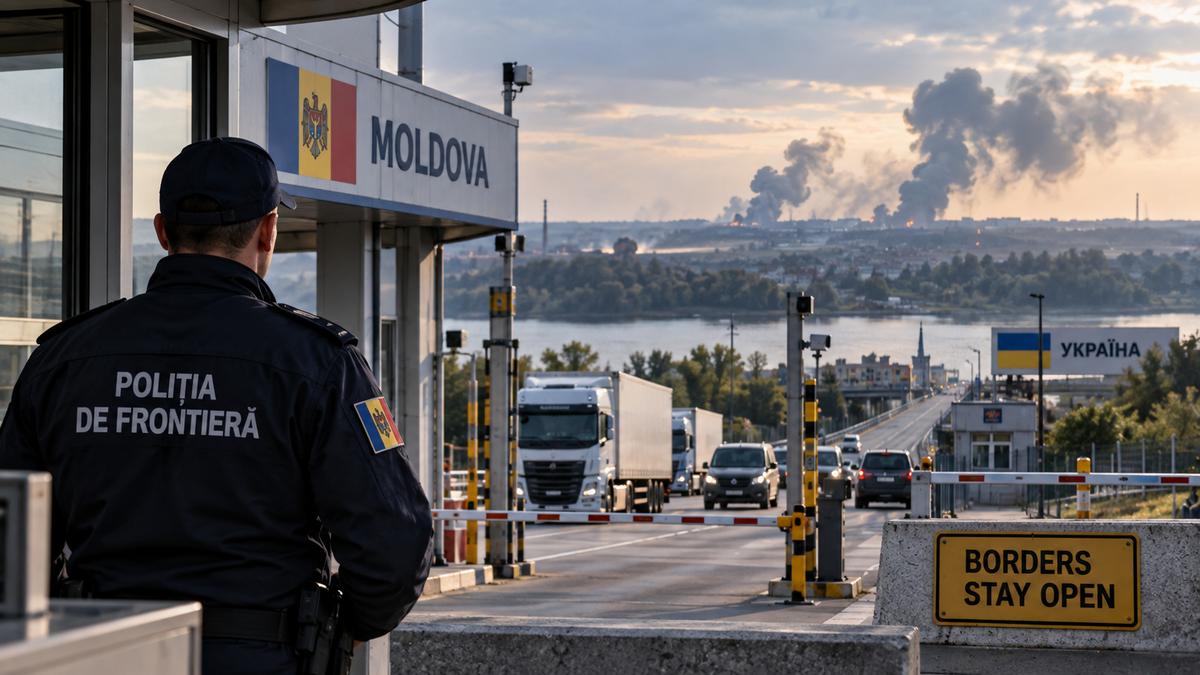
This isn't a sign of the border closing — it's an example of an allied state adapting to a persistent air threat without sacrificing a transport corridor. Moldova isn't stopping traffic through three crossings; it's simply pulling its own personnel back from Ukrainian territory, where they had been physically performing joint control duties, and continuing the same functions from the Moldovan side instead. The logic is simple: keep the corridor open, reduce the risk to people.
What happened
As of 08:00 on 12 September, Moldovan Border Police and Customs temporarily changed how they operate at three joint crossings with Ukraine — Giurgiulești–Reni, Briceni–Rossoșani and Criva–Mămăliga — for a planned 90-day period. Moldovan personnel had previously performed control procedures physically on Ukrainian territory; they now work exclusively from the Moldovan side. The crossings remain fully operational, and cross-border traffic of people and vehicles continues uninterrupted.
Moldova's Border Police explicitly attributes the decision to the risks created by Russian air attacks on Ukrainian infrastructure near the Moldovan border. The measure was announced late on 11 September and took effect the following morning.
BSM analysis: This continues a pattern rather than marking an isolated event. Over recent weeks Russia has struck at least five border crossings on Ukraine's western frontier with Moldova and Romania — including Tabaky–Myrne, Vynohradivka–Vulcănești and Starokozache–Tudora. The worst hit came overnight on 9 September at Starokozache, where drones killed two civilians and injured three, including a Moldovan bus driver. Russia claimed the crossing was being used for military logistics; Moldova denied this.
What's still uncertain
🟡 How long the new arrangement lasts depends on the intensity of Russian strikes near the border. Moldova has not announced any expansion of the personnel withdrawal to other functions or crossings at this stage.
Notably, amid these strikes, Moldovan police arrested a 49-year-old Azerbaijani national on suspicion of spying for the FSB — investigators allege he was gathering information on military targets in Moldova and American facilities in the country, and preparing possible sabotage against sites in both Moldova and Ukraine. In parallel, Russia's FSB announced the detention of a Moldovan citizen it says was preparing an assassination attempt against Russian Major General Nikolai Varpakhovich — the same officer linked to the strike on a children's hospital in Kyiv; separate reports indicate the general was in fact shot near Engels and survived.
Regional context
Polish Prime Minister Donald Tusk, commenting on 10 September on the attacks near Moldova's border crossings, said directly that he expects similar actions against border crossings with Ukraine in other countries — specifically naming Poland — citing an assessment he received from the CIA director. That directly links the Moldovan case to a separate, still-unconfirmed incident on the Poland-Ukraine border that BSM is tracking independently.
For the rest of NATO's eastern flank — Poland, Romania and the Baltic states — the practical relevance is clear: Moldova's model shows that border infrastructure can stay functional under elevated air threat if personnel and control functions are relocated quickly, rather than shutting the corridor down entirely. That's a concrete example of operational resilience that could inform contingency planning for similar threats closer to the Baltic Sea.
Bottom line
What matters here isn't another strike on a crossing — it's that a state neighboring Ukraine has moved from reacting to individual incidents to a systemic, pre-announced 90-day change in its operating posture. That signals allies are treating the threat to Ukraine's border logistics as persistent rather than temporary — and that the response to it is becoming increasingly institutionalized.
Baltic Security Monitor (osint-baltic.com) — an analytical outlet covering security on NATO's northeastern flank. Compiled from open sources and BSM's automated OSINT monitoring system.