The Fire That Turned Out to Be an Order: Estonia Names Russia Behind the Milrem Robotics Attack

Baltic Security Monitor | Analytical Brief Snapshot: 29 September 2026, 14:00 (Europe/Tallinn) · Material OSINT Update
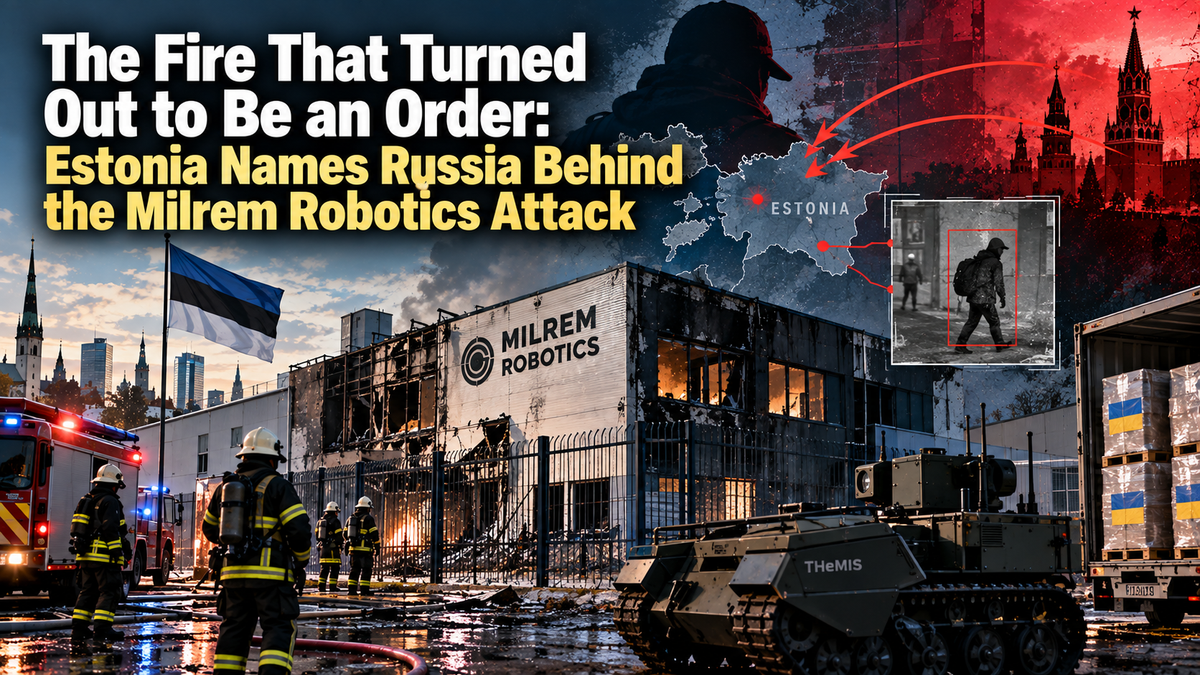
Six weeks ago, Estonia called it "one version under investigation." Today it says "complete confidence": the arson at Milrem Robotics on the night of 15 August is now officially a sabotage operation commissioned by Russian security services. This is no longer a hybrid-threat warning — it is a confirmed operation against Ukraine's supply chain, carried out on NATO territory.
Assessment
| Indicator | Value |
|---|---|
| BSM assessment | MATERIAL UPDATE |
| Category | Hybrid warfare / sabotage / defence industry / critical infrastructure |
| Materiality | High |
| Uncertainty flags | 🟡 1 · 🔴 0 |
| Delta type | Attributional: "suspected" → "possible sabotage" → official attribution to Russia |
The headline fact isn't the arson itself but the speed and clarity with which Estonia moved from hedged language to a direct state accusation. On 18 August, Prosecutor General Astrid Asi described sabotage as just one version under investigation, with motive unresolved. By 29 September, the foreign ministry and KAPO state plainly: the arson was an operation commissioned by Russian intelligence, not the work of freelance actors.
The attribution timeline
Night of 15 August: Fire breaks out at a building on Betooni Street in Tallinn used by Milrem Robotics, an Estonian maker of unmanned ground platforms including THeMIS. A local resident had flagged suspicious activity near the site beforehand.
17–18 August: Two Latvian nationals detained, a third the following day; all three extradited to Estonia. Prosecutor General Astrid Asi says the case is at an early stage and that motives, including a possible sabotage theory, are being examined. PM Kristen Michal says the state is investigating Russian involvement and warns that if the goal was to intimidate Estonia or end its support for Ukraine, it will not succeed.
29 September: Estonia's Internal Security Service (KAPO) states: "Today we can say with complete confidence that the arson at Milrem on the night of August 15 was an act of sabotage commissioned by Russian intelligence services." Foreign Minister Margus Tsahkna writes on X that the arson can be concluded with certainty to be "an act of sabotage ordered by the special services of the Russian Federation," that the perpetrators have been apprehended and "no longer pose a threat." Estonia formally summons Russia's chargé d'affaires in Tallinn.
Confirmed versus outstanding
| Claim | Status |
|---|---|
| Milrem building arson on 15 August | ✅ Confirmed since the investigation opened |
| Three suspects detained and extradited, all Latvian nationals | ✅ Confirmed |
| Arson was sabotage commissioned by Russian security services | ✅ Official KAPO / foreign ministry attribution |
| Method consistent with other Russia-linked sabotage in Europe | ✅ Internal Security Service statement |
| Specific handlers, recruitment chain, financing | 🟡 Not disclosed publicly |
BSM analysis: why Milrem
Milrem Robotics is not an incidental target. Majority-owned by the UAE's EDGE Group, it makes THeMIS, a tracked unmanned ground platform already at war in Ukraine: the manufacturer says over 150 additional units are being delivered under Dutch-coordinated funding, on top of 15 already in service. The platform handles casualty evacuation, route clearance and logistics — work that directly reduces Ukrainian troop losses.
Hitting a supplier of that equipment on NATO territory, rather than inside Ukraine, follows the logic of deniable, peripheral sabotage: damage the supply chain without triggering direct confrontation with the alliance. It sits alongside a growing list of comparable episodes across Europe — the IKEA warehouse arson in Vilnius (May 2024, tied to a Lithuanian supplier of military equipment for Ukraine), an attempted shopping-centre arson in Warsaw, and the Leipzig airport incident Germany attributed to Russia in August 2026. AP had counted 145 such incidents across Europe attributed to Russia or Belarus by late 2025.
BSM analysis: The execution model matches what Lithuanian and Polish investigators have documented since 2024: not career GRU officers but recruited nationals of third countries — here, Latvia. That is the essence of deniable sabotage: disposable, geographically dispersed executors shielding the actual commissioning party behind layers of intermediaries. The detention of Latvian nationals spreads responsibility rather than concentrating it — an attack on an Estonian company routed through a neighbouring Baltic state.
The wider context: attribution language is hardening
On 23 September, at the UN General Assembly, EU foreign policy chief Kaja Kallas warned of a "fast proliferation of sabotage attacks and airspace violations" and said Moscow was trying to scare Europe into winding down support for Ukraine. The same week, Poland, Romania and other eastern-flank states reported rising incident counts. Estonia's 29 September attribution is not an isolated statement but part of a broader trend: European governments increasingly moving from cautiously worded "likely involvement" language to direct, named accusations against Russia.
Lithuania's foreign minister responded with a blunt line: "Russia's fingerprints are all over" the case. Sweden and Germany expressed solidarity, calling the incident "extremely serious." The Kremlin rejected the accusation as "baseless."
What it means for the Baltic states and Ukraine
This is Estonia's first instance of naming a specific state-attributed sabotage operation against a defence contractor tied to Ukraine's supply chain at this level of official confidence. It gives Baltic governments and NATO a concrete case — not an abstract intelligence warning but a file with a target, suspects, detentions and state attribution — for ongoing EU/NATO discussions on coordinated responses below the Article 5 threshold.
For Ukraine, the signal is different: manufacturers of equipment headed to the front are now targets even outside the country at war. Protecting such companies is no longer only an industrial-security question but a counter-intelligence one, on allied soil.
Conclusion
Estonia moved from "checking all versions" to "complete confidence" in six weeks — fast by the standards of comparable investigations. What remains unknown — the recruitment chain, financing, the specific Russian handlers — could itself become the next material delta if it surfaces during prosecution.
Next checks: disclosure of the recruitment and financing chain during trial proceedings; whether the case triggers new collective EU/NATO attribution measures; Latvia's response to its nationals' role in an operation against a neighbouring state.
Sabotage can be denied for a year. Proving it takes one investigation.
Baltic Security Monitor (osint-baltic.com) — an analytical publication on security on NATO's northeastern flank. All OSINT assessments are produced by an automated monitoring system using open sources.