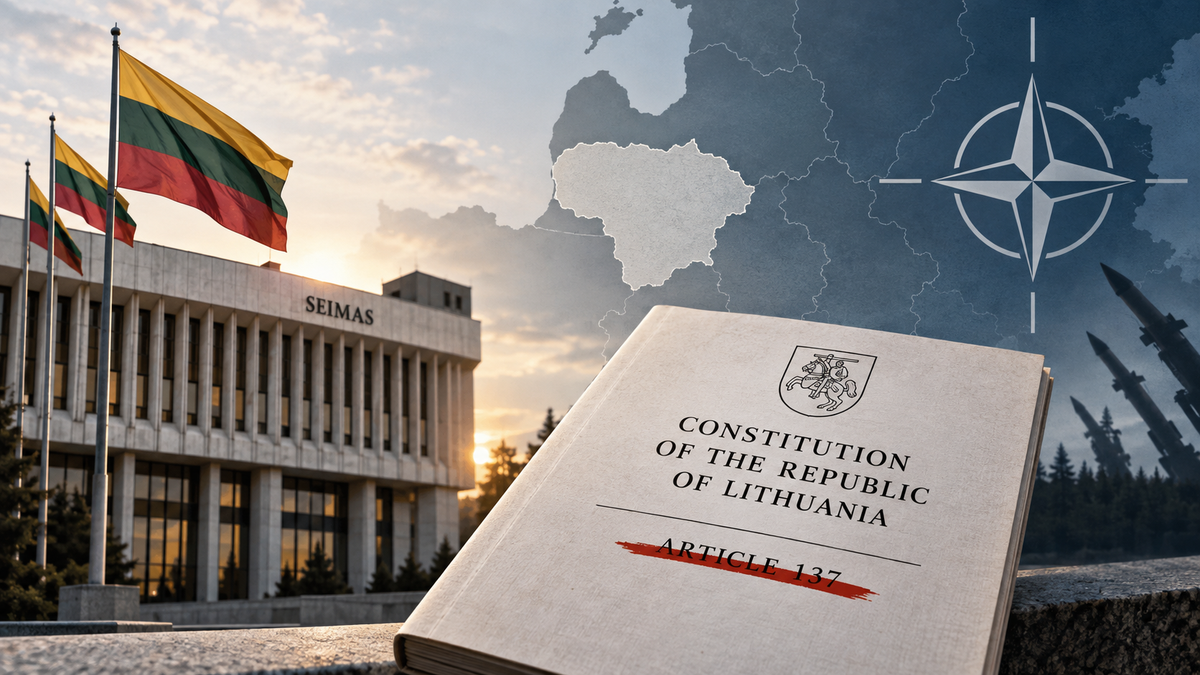
Lithuania Takes Another Step Toward Lifting Its Constitutional Ban on Nuclear Weapons: Seimas Committee Backs Repealing Article 137

Baltic Security Monitor | Analytical Briefing Event: 9 September 2026 · Published: 10 September 2026
A committee vote isn't a final decision, but its symbolic weight is hard to overstate: Lithuania is systematically dismantling one of the few constitutional barriers that directly limit its ability to participate in future NATO nuclear deterrence. Repealing Article 137 wouldn't deploy nuclear weapons in Lithuania — it would give Vilnius the legal option to negotiate that question when, and if, the need arises, rather than trying to amend the constitution mid-crisis.
What happened
The Seimas Committee on Legal Affairs voted 7–2 on 9 September to support deleting Article 137 of Lithuania's Constitution, which currently bars weapons of mass destruction and foreign military bases from Lithuanian territory. Draft XVP-1729, which proposes repealing the article in full, was formally referred to the committee the same day.
The process formally began in July. Fifty MPs registered the amendment on 3 July, and the Seimas accepted it for consideration on 7 July by 89 votes to 11, with six abstentions. Deputy Justice Minister Martinas Dobrovolskis, present at the committee session, said the Ministry of Justice fully supports the initiative.
BSM analysis: Committee approval is an intermediate, not a final, step. The Seimas speaker has previously warned publicly that keeping the current ban makes Lithuania look like a "black sheep" within the alliance. But the 89 votes from July — short of the 94 needed for final constitutional adoption out of 141 MPs — remain the key indicator: broad support exists, but it isn't yet guaranteed at the constitutional threshold.
What's still uncertain
🟡 Committee approval does not equal a constitutional amendment. Final repeal requires two plenary Seimas votes at least three months apart, each needing at least 94 of 141 votes.
Even a full repeal of Article 137 would not automatically authorize deploying nuclear weapons in Lithuania — that would require separate political agreements with allies and corresponding NATO decisions.
Regional context
Lithuania's case is not an isolated episode but part of a broader trend on NATO's northern flank. Finland has already removed statutory restrictions that prevented nuclear weapons from being imported, transited or stored for national defense purposes, and Lithuanian leadership explicitly cites that precedent. President Nausėda discussed nuclear-deterrence proposals with Latvia's president as early as March 2026 — meaning Vilnius already treats this as a regional question rather than a purely domestic legal one. Poland, for its part, has held consultations with France and other European partners on its own role in nuclear deterrence.
The regional logic is straightforward: Baltic defense is planned as a single theater. If one Baltic state is legally unable to participate in certain allied options, that unevenness undermines the political credibility of collective defense overall — particularly with Russia maintaining nuclear-capable forces in Kaliningrad and having deployed tactical nuclear weapons in Belarus.
For Ukraine, the relevance is indirect but telling: another frontline European state is stripping away self-imposed legal constraints on NATO deterrence, a direct consequence of Russia's war and nuclear signaling.
Bottom line
The committee vote changes nothing in the actual military balance by itself — no nuclear weapons arrive in Lithuania as a result. But it moves Vilnius closer to having the legal flexibility to negotiate allied options in advance, rather than under crisis pressure — and it aligns Lithuania with a broader recalibration of nuclear self-restrictions on NATO's northeastern flank already underway in Finland and under discussion in Poland.
Baltic Security Monitor (osint-baltic.com) — an analytical outlet covering security on NATO's northeastern flank. Compiled from open sources and BSM's automated OSINT monitoring system.