Lithuania Prepares on Two Tracks: Soldiers on the Kaliningrad Border and the First Switchblade Strike Drones

Baltic Security Monitor | Analytical Brief Snapshot: 8 October 2026, 14:00 (Europe/Tallinn) · Material OSINT Update
The incident happened on Latvia's border, but it is Lithuania that reacts, and not where the provocation took place. Vilnius is sending troops to its border with Kaliningrad, officially calling it a precaution and stressing that its own frontier is calm. At the same time it has quietly received its first batch of strike drones, closing a separate capability gap. Both stories say the same thing: a country preparing for hybrid pressure and possible deterioration without sounding an alarm.
Assessment
| Indicator | Value |
|---|---|
| BSM assessment | MATERIAL UPDATE (two stories, both Lithuanian) |
| Category | Military posture / border security / hybrid threats / procurement / NATO eastern flank |
| Materiality | High (border); medium-high (Switchblade) |
| Uncertainty flags | 🟡 5 · 🔴 0 |
| Delta type | Border: request → approved and activated deployment. Switchblade: contract → first physical delivery |
1. Lithuania brings the army to the Kaliningrad border
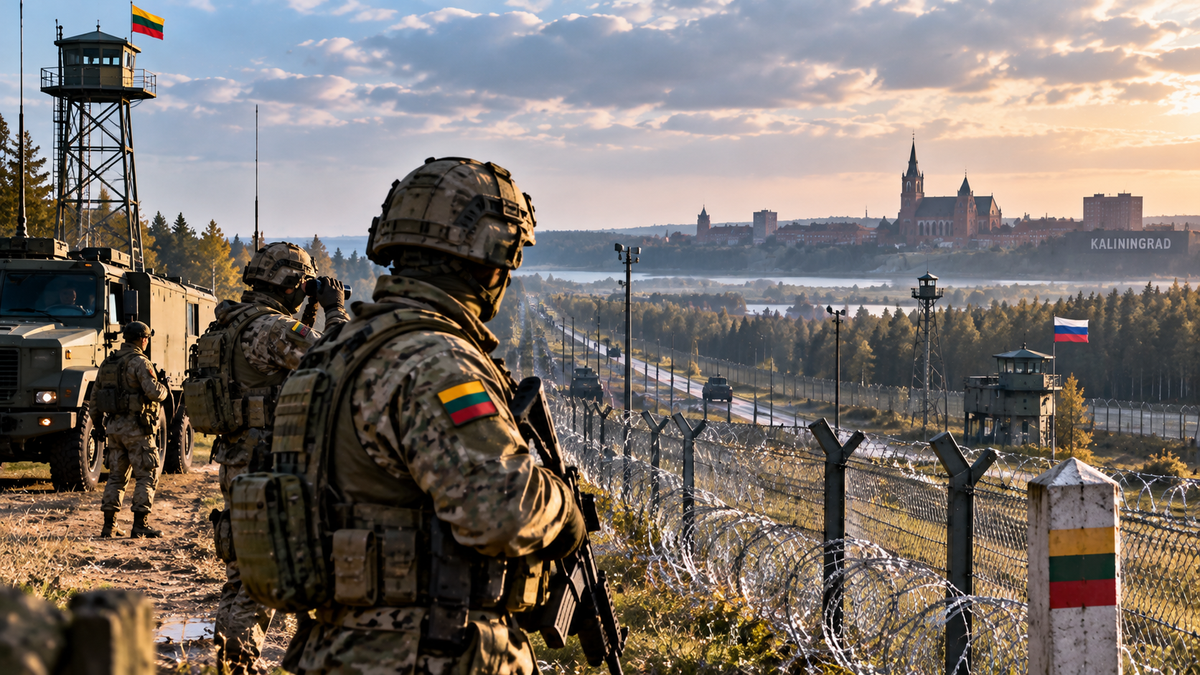
On 8 October the Lithuanian Armed Forces confirmed that a company-sized unit is starting to assist the State Border Guard Service (VSAT) on the frontier with Russia's Kaliningrad region, initially for about two weeks and extendable. Tasks: joint patrols with border guards in the border zone, and as needed mobile patrols, mobile observation posts and military-police crews.
Defence Minister Robertas Kaunas approved the deployment on 7 October at the request of Interior Minister Martynas Katelynas. According to LRT, citing the defence minister, about 100 soldiers are involved and the number can grow. The army itself calls the move preventive and part of routine inter-agency cooperation.
The interior minister justified the request by the incident on the Latvian border and the wider regional situation, and by "signals that Russia may announce mobilisation." He also said the situation on Lithuania's border is calm and there is no cause for alarm.
What happened in Latvia. On the night of 5–6 October at least 20 illegal migrants tried to cross from Belarus into Latvia escorted by armed, masked men who threatened Latvian soldiers and pushed the group forward. Soldiers stopped the attempt. A few hours later masked individuals entered Latvian territory, damaged an electrical cabinet and stole two border surveillance cameras, then returned to Belarus. The Latvian army called the provocation "particularly brazen and aggressive" and a hybrid threat.
BSM analysis: What stands out is the causal chain, not the scale. An incident on one border (Latvia–Belarus) triggers reinforcement of another (Lithuania–Kaliningrad) in a third country. That is regional operational spillover: hybrid pressure on one state shifts the military posture of its neighbour with no evidence of an imminent conventional attack. Vilnius also says "calm" and deploys a company in the same breath. It is precaution, but it carries signalling value.
2. Lithuania receives its first Switchblade 600
On 7 October the Ministry of National Defence confirmed that the first batch of Switchblade 600 loitering munitions has reached Lithuanian army warehouses. The supplier is the US firm AeroVironment, under an agreement signed back in 2022. Launch and control equipment, a training simulator and a maintenance package are part of the buy. Kaunas: "With Switchblade 600 the Lithuanian army gains a new strike capability," meaning the ability to destroy armoured vehicles quickly and precisely from a safe distance.
The ministry describes up to 40 minutes of loiter time, precision optics and an anti-armour warhead. It has not disclosed how many systems arrived, which units will receive them, or when they will be ready.
BSM analysis: This is the delivery of an old contract, not a new purchase. The delta is concrete: "ordered" became "in the warehouse." But a warehouse is not combat readiness. Quantity, training and assignment to units will show the real weight. The trend is clear, though: the Baltic region is locking in unmanned strike tools against armour, drawing on the war in Ukraine.
Confirmed versus outstanding
| Claim | Status |
|---|---|
| A company of the Lithuanian army is assisting VSAT on the Kaliningrad border from 8 October for about two weeks | ✅ Lithuanian Armed Forces |
| Defence minister approved on 7 October at the interior minister's request | ✅ Lithuanian Interior Ministry; LRT |
| About 100 soldiers, can be increased | 🟡 Defence minister's words as relayed by LRT; the army says only "company-sized" |
| Rationale: signals Russia may announce mobilisation | 🟡 Lithuanian officials' words only; no independently verified Russian mobilisation decision |
| Latvia, 5–6 October: armed masked men, threats to soldiers, two cameras stolen | ✅ Latvian army, LSM; Latvia's interior minister confirmed the theft |
| Who the intruders were | 🟡 Not established; Latvia's Border Guard chief says they may be organised criminals rather than Belarusian state services |
| First Switchblade 600 batch arrived in warehouses | ✅ Lithuanian Ministry of National Defence, 7 October |
| Number of systems, units, readiness dates, value (about €45 million) | 🟡 Not in the ministry release; the sum comes from a secondary source |
What it means for the Baltic states and Ukraine
For the Baltic states the point is that hybrid pressure works like a network. What happens near Latvia consumes Lithuanian resources. Latvian Border Guard chief Guntis Pujāts noted that sabotage against border IT infrastructure has become more frequent while fence damage is about half as common as a year ago. That suggests a change of tactics, not an easing of pressure.
For Ukraine the effect is indirect: the war and its hybrid environment force NATO's eastern members to commit people and money to border protection, resources that do not go elsewhere.
Outside this story are the political debates over a permanent US base in Lithuania and the constitutional amendment on nuclear weapons. That is a different track.
WATCH
🟡 Black Sea. Bulgaria continues to investigate the attacks on Alfa Watan and Able. The European Commission is helping with satellite imagery. No independently verified attribution to a specific state or operator.
🟡 Lithuania, permanent US base. Lithuania is willing to finance a permanent American presence, but Washington has announced neither a basing agreement nor a permanent force commitment.
Lithuania, constitutional amendment. The 6 October vote remains the latest verified institutional step. The next is expected on 12 January 2027. No nuclear deployment has been authorised.
NATO Theory of Victory. No new formal adoption. Next checkpoint: the 12 October presentation.
Denmark, defence-industry sabotage. No newly named facility, prosecution or independently verified incident that changes BSM's 7 October 20:00 assessment.
Other items checked
Latvia formally handed over its first Hunter/Mednieks infantry fighting vehicle on 7 October. But the vehicle arrived in June and was reportedly accepted in September, so the October ceremony is not enough of a new delta for a separate update.
Russia's 8 October attack on Kramatorsk caused heavy civilian casualties. It is a serious event, but the reporting shows no new weapon, no new geography and no change in regional posture, so BSM does not promote it on casualty numbers alone.
The EU's €1.24 billion transfer and the 1,646 proposed sanctions listings were covered in the 08:00 update.
Conclusion
Vilnius is saying two things at once: "it is calm here" and "we are strengthening." Both are true. A precautionary company on the border and the first strike drones in the warehouse do not shift the balance of forces, but they show how the Baltic states operate when a threat is diffuse: take the resources at hand and set them out early.
Next checks: who was behind the Latvian incident; the actual size and duration of the Lithuanian deployment (extended or enlarged); how many Switchblades were delivered and how ready they are; any sign of Russian mobilisation that would bear out the Lithuanian concern; forensic attribution of the Black Sea ship attacks.
Baltic Security Monitor (osint-baltic.com) — an analytical publication on security on NATO's northeastern flank. All OSINT assessments are produced by an automated monitoring system using open sources.