Listening to the Sky: Lithuania Pilots Ukraine's SkyFortress

Baltic Security Monitor | Analytical Brief Material OSINT Update · 2 October 2026, 20:00 (Europe/Tallinn)
The headline is a pilot, not a network. Lithuania has started testing a Ukrainian acoustic and radio-frequency detection system for low-flying targets, and says it is adapting something that already works in Ukraine rather than building from scratch. What BSM can confirm is the direction. What it cannot confirm is the scale: no public source gives the number of sensors, their location, the length of the trial or the price. Integration with existing systems is the real test.
What was announced
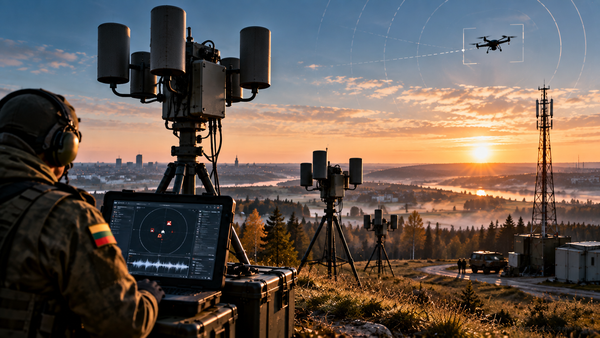
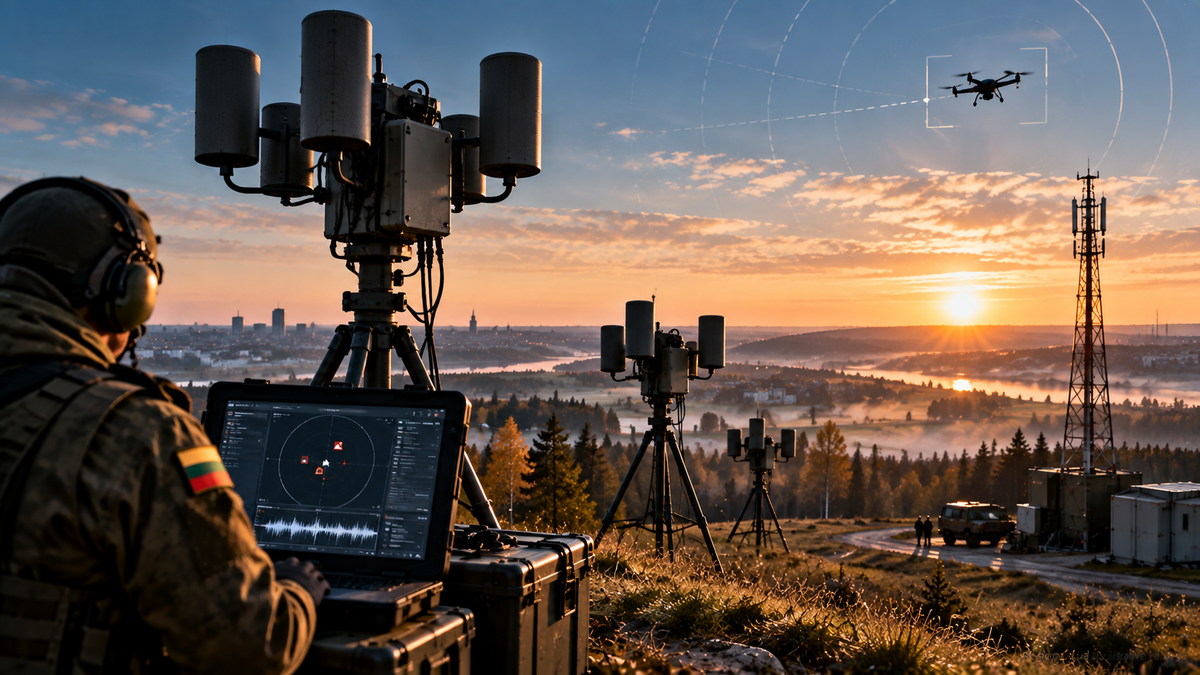
On 2 October Lithuania's Ministry of National Defence said a pilot version of SkyFortress is being deployed. Defence Minister Robertas Kaunas framed it as adapting systems already operating in Ukraine and as strengthening the whole chain from surveillance to interception and neutralisation. According to the ministry, the system uses artificial intelligence to detect and track low-flying drones or cruise missiles and classifies objects in real time from their acoustic or electromagnetic traces. LRT/BNS
The contract, signed in summer 2026, covers processing of sensor data, use of acoustic and radio-frequency signature libraries built on unclassified information, and training of personnel. Testing will assess how well the system detects and identifies low-flying unmanned aircraft under Lithuanian conditions. LRT/BNS
The backdrop is a September incident: Italian fighter jets based in Šiauliai shot down a drone that had flown in from Belarus. BNS describes it as the first drone downed over Lithuania; Latvia and Estonia had done so earlier. The ministry does not tie that incident to this programme. LRT
The project itself is not new. In summer 2025 the commander of the Lithuanian armed forces said the Ukrainian acoustic system would be deployed from 2026. He blamed the delay on bureaucratic procedures and said the system had to be adapted to Lithuania's American-made systems because of sensitive nuances. Militarnyi The only thing that has changed on 2 October is that the pilot has begun.
🟡 What public sources do not say
- Number and location of sensors, duration of the pilot, detection performance on Lithuanian terrain.
- Contract value and supplier: neither appears in the ministry's announcement.
- Degree of integration with Lithuanian and NATO command and control.
- Whether expansion is planned after the pilot. The incoming update speaks of importing a wartime "architecture"; for a pilot of unknown size BSM does not use that wording.
BSM analysis: detect first, choose the response later
Why acoustic and RF sensing. Cheap, low-flying targets are hard to track reliably with conventional radar. Distributed acoustic and radio-frequency sensors complement radar and NATO surveillance rather than replace them. The practical gain is that the choice of interceptor comes after detection, so a fighter jet is not the default answer: in September it was fighters that brought the drone down over Lithuania.
Ukraine as a supplier of solutions. Kaunas states the approach plainly: take what already works. NATO interest is not new; Militarnyi reports that in 2024 representatives of 11 NATO states watched a demonstration in which drone and cruise-missile simulators were easily detected and tracked. For scale, UNITED24 Media estimated in July 2025 that Ukraine's Sky Fortress network had around 14,000 acoustic sensors. Militarnyi, 2 October The Lithuanian pilot is probably far smaller, but no figure has been published.
Integration is the hard part. The Lithuanian commander's remark about adapting a Ukrainian system to American ones points to cybersecurity, data sovereignty and compatibility with existing command structures, not just placing sensors in a field. That is a BSM assessment; there is no public technical detail.
Regional context
- The September shoot-down was Lithuania's first; Latvia and Estonia had passed that point earlier. Air-threat alerts in Lithuania have been issued repeatedly in recent months.
- In 2025 the Lithuanian commander also spoke of additional air-defence assets moving closer to the Belarus border. Where the SkyFortress pilot sensors will stand is not known. Militarnyi
- If the pilot works, the model is potentially relevant to Estonia, Latvia, Poland and Finland, which face the same problem with inexpensive low-altitude targets. This is an assumption: today's material contains no public statement of such plans.
Outside the material threshold: HUR warning (WATCH)
The incoming update cites Ukraine's military intelligence saying Russian services have been tasked with preparing more hybrid operations in EU and NATO states, including against military facilities, critical infrastructure, communications and Starlink receiving stations. I found no independent confirmation of the specific targets, so this stays a WATCH item, not a second material update. Context: Polish authorities are investigating an arson attack on a Starlink ground station in central Poland as sabotage ordered by Russian intelligence; a formal investigation opened on 25 September 2026 and no charges have been filed. United24 Media
What to watch
- Length of the pilot and any published test results.
- Number and location of sensors, particularly near the Belarus border.
- A decision to expand or reorder.
- Integration with national and NATO command and control and with interceptors.
- Interest from neighbours: Estonia, Latvia, Poland, Finland.
Bottom line
Lithuania is adding an air-defence layer at the cheapest end of the problem, where the target costs less than the response. For the eastern flank the question is no longer only what to shoot with, but what to listen with. For now it is a pilot; the answer on a network depends on figures that have not been published.
Baltic Security Monitor (osint-baltic.com) — an analytical publication on security on NATO's northeastern flank. Prepared within BSM's automated open-source monitoring cycle; OSINT indices are not shown for this update.