One night, two directions: an object near Latvia's border and a third strike on Yaroslavl
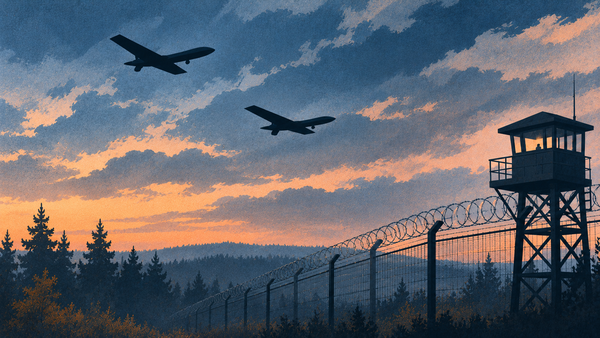
Late on 2 November, Latvia declared an airspace threat over its eastern regions for the second time in two days and called in NATO fighter jets. The same night, the governor of Russia's Yaroslavl region reported a 124-drone attack and damage to an oil refinery. Both events are officially…


Baltic Security Monitor | Material Update · 3 November 2026, 08:00 EET
Late on 2 November, Latvia declared an airspace threat over its eastern regions for the second time in two days and called in NATO fighter jets. The same night, the governor of Russia's Yaroslavl region reported a 124-drone attack and damage to an oil refinery. Both events are officially acknowledged. The questions that matter most — what came down in Latvia, and whether Yaroslavl lost any refining capacity — remain open.
Latvia: the second alert in two days
Latvia's National Armed Forces warned residents of two eastern regions of a threat in the country's airspace, told them to shelter indoors and said NATO Baltic Air Policing jets had been activated. The alert was later lifted, with the military saying the object was believed to be on the ground inside Latvia, near the Russian border. Reuters filed the report at 00:57 Tallinn time on 3 November.
Poland's Interia, as cited by UA.News, places the suspected crash site in Balvi Municipality in the north-east, where troops began searching for debris. 🟡 That location has not appeared in the official statements quoted by Reuters, and no recovery of wreckage has been reported.
This is a separate incident from the evening of 1 November, when the military responded to a threat over the Krāslava and Ludza districts. On that occasion the object left towards Russia and the BLAZE interceptor drone that had been launched was self-destructed near the border. (Full analysis: Material Update of 2 November.)
The same night, Poland's Operational Command scrambled air-defence assets in response to massive Russian strikes on Ukraine. Reuters points to the wider pattern: Ukrainian drones targeting Russia's Baltic oil export ports have repeatedly strayed into Finnish, Estonian, Latvian and Lithuanian airspace. Moscow accuses Kyiv of using NATO airspace as cover; Kyiv blames Russian electronic warfare for pushing drones off course. In Latvia, one such episode earlier this year ended with the government's collapse.
BSM analysis
Two public alerts in 48 hours along the same stretch of border are no longer a one-off glitch. They test the entire chain — detection, civil warning, interception and recovery. This time Latvia relied on NATO fighters rather than its own interceptor, and the object apparently came down on Latvian soil. That matters: physical debris can settle what radar cannot — airframe type, route, whether a warhead was carried. Until then, attribution stays open. Both a Russian drone and a Ukrainian one diverted by jamming have precedents in the region.
Yaroslavl: 124 drones, one refinery, again
Yaroslavl governor Mikhail Evrayev said a drone attack had damaged refinery infrastructure in the city and that crews were fighting a fire on site. Two employees suffered shrapnel wounds and were hospitalised. According to the governor, air defence and electronic warfare units repelled 124 drones overnight. Debris also damaged apartment blocks, private homes and cars, and the road out of the city towards Moscow was temporarily closed.
The 3 November statement does not name the facility. The city's largest plant, Slavneft-YANOS — jointly controlled by Rosneft and Gazprom Neft — processes about 15 million tonnes a year, roughly 300,000 barrels per day, and has been hit before this year. 🟡 Which units were affected this time — primary distillation, storage tanks or auxiliary infrastructure — has not been established.
This is the third officially acknowledged damage to a Yaroslavl refinery in three months:
- 6 August — 93 drones reported downed in what the governor called the region's largest attack; debris struck storage tanks, four people injured.
- 17 September — 65 drones, refinery damaged, no casualties; fire out by morning.
- 3 November — 124 drones, infrastructure damaged, two injured, fire still burning at the time of the statement.
BSM analysis
The attacks on a single site are getting bigger: 124 drones exceeds the August raid that Russian officials themselves described as a record. Repeated strikes on Yaroslavl, some 270 km north-east of Moscow, force Russia to keep point air defences deep in its rear. Yet a fire and two casualties are not the same as lost capacity. In August and September the fires were put out within hours. Without satellite imagery, operator statements or throughput data, claims of a production halt would be premature.
What is established and what is not
Officially confirmed - an airspace threat declared over two eastern Latvian regions, with NATO fighters activated; - a military statement that the object was believed to be on the ground near the Russian border; - damage to refinery infrastructure in Yaroslavl, a fire and two injured workers.
Not established - 🟡 the type, origin and exact crash site of the object in Latvia, and whether debris has been recovered; - 🟡 the name of the affected plant and the specific units hit; - 🟡 any effect on refining volumes.
Conclusion
The night of 3 November showed both ends of the same drone war. Deep inside Russia it hits refineries in ever larger waves; at its western edge, its stray fragments land on NATO territory. Unlike on 1 November, Latvia may this time get more than a radar track — it may get wreckage. What that wreckage shows will decide whether this episode becomes another line in the statistics or a reason to rethink how the eastern border responds.
The sky over the border belongs to neither side at war. Answering for it falls to those who live beneath it.
Baltic Security Monitor (osint-baltic.com) — an analytical publication on security across NATO's north-eastern flank.
Prepared from open-source monitoring; the verification status of each fact is marked in the text.