Kirishi Refinery Strike Halts All Primary Processing: Ukraine's Campaign Against Russian Oil Infrastructure Produces a System-Level Effect Again

Baltic Security Monitor | Analytical Brief As of 4 September 2026, 08:00 EEST
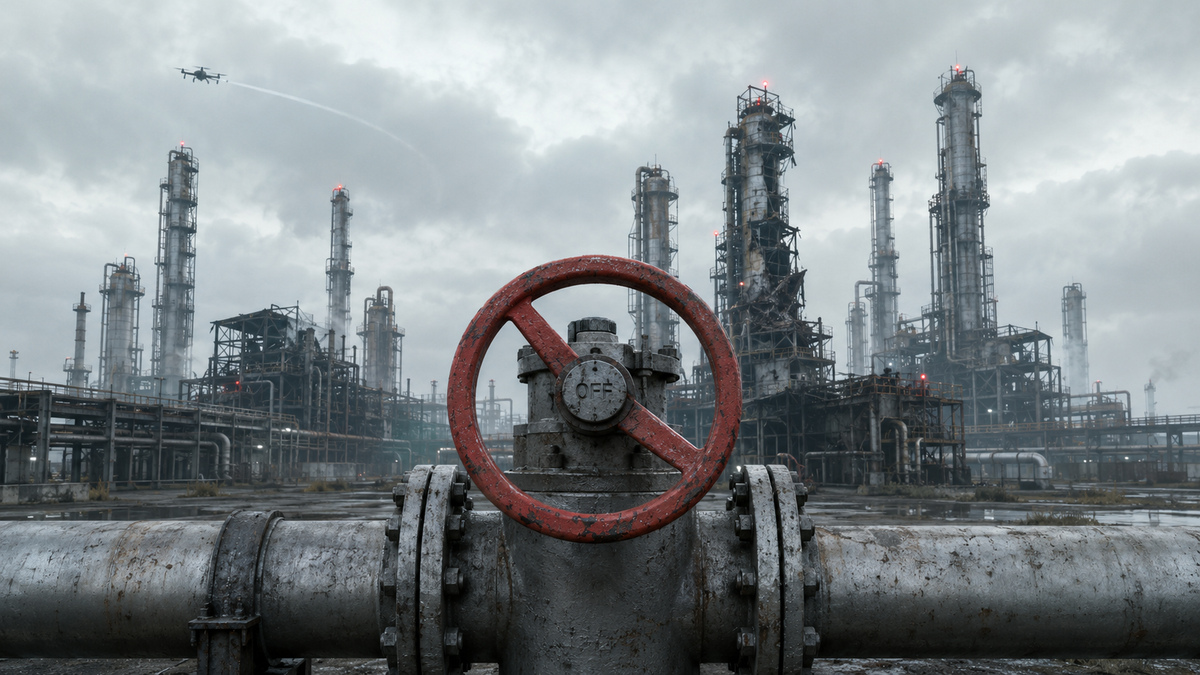
Reuters, citing two industry sources, reported that the Kirishinefteorgsintez (KINEF) refinery, owned by Surgutneftegaz and located in Russia's Leningrad region, has completely halted crude processing after a 30 August Ukrainian drone strike damaged two primary processing units. The AVT-6 unit, accounting for roughly 40% of the refinery's capacity (22,860 tonnes per day), and the smaller AT-1 unit (about 8%, 4,860 tonnes per day) were disabled in the attack. The plant's two other primary units — AT-6 and AVT-2, together accounting for roughly 52% of capacity — were already offline at the time of the strike, leaving KINEF with no active crude-processing capacity at all.
Ukraine's General Staff had already confirmed that Ukrainian forces struck KINEF on 30 August and that a fire broke out afterward. Leningrad Oblast Governor Alexander Drozdenko separately confirmed a fire in Kirishi's industrial zone, saying air defenses shot down 42 drones over the region overnight, but did not name the specific facility or describe the extent of the damage. Surgutneftegaz did not respond to Reuters' request for comment.
KINEF has a nameplate capacity of roughly 20 million tonnes a year and most recently processed around 18 million tonnes annually — about 7% of Russia's total refining throughput, making it Russia's second-largest refinery by capacity, behind only the Omsk refinery (22 million tonnes). It is the only major refinery in northwestern Russia and the principal supplier of diesel, gasoline, and fuel oil to St. Petersburg and the surrounding region.
The notable part isn't the strike or the fire themselves — those were known as of 30 August. What's new is that this moves the assessment from "physical damage with uncertain consequences" to a confirmed system-level shutdown at one of Russia's largest refineries — this time with zero active primary-processing capacity, not merely a partial outage.
BSM analysis: not the first strike on this refinery, but at least the fourth
Kirishi is not a one-off target — it has been hit systematically throughout the war. Ukrainian drones first struck it on 8 March 2025; this year alone, the refinery has already shut down twice for extended repairs following attacks, on 26 March and 5 May. Through August, before the latest strike, KINEF was operating at only about 50% capacity — meaning it has never been fully restored since March 2025. The current shutdown is at least the fourth serious episode, and each successive strike hits the plant while it is already partially degraded rather than at full capacity.
That's a fundamentally different picture than "a single successful hit": this looks like a sustained attrition campaign in which repair cycles never fully complete before the next strike lands. Kirishi sits within the same northwestern energy-logistics system as the Primorsk and Ust-Luga export corridors — the same system BSM has covered in the context of Russia's extended diesel export ban. A prolonged outage at one of the region's leading fuel suppliers adds further pressure to a system already operating near the edge of domestic shortage.
Why it matters for Ukraine and the Baltic region
Kirishi is the only major refinery in northwestern Russia and a critical fuel source for St. Petersburg and the surrounding region. Its shutdown adds pressure to a Russian refining system already strained by repeated Ukrainian long-range strikes across the country.
The Baltic dimension is significant: a shutdown at a refinery of this scale can affect product availability, rail movements, storage requirements, and export patterns through Baltic terminals. The outage also strengthens the case that Ukraine's energy campaign is producing sustained operational effects rather than isolated fires or brief disruptions — Russia has already extended restrictions on diesel, marine-fuel, and gasoil exports through 30 September amid broader stress on its refining sector.
Bottom line
No reliable repair timeline has been published yet, so how long the full shutdown will last remains unknown — and given the plant's history (two prior outages this year that lasted weeks if not longer, with full restoration never achieved), a quick return to full capacity seems unlikely. The next indicator for BSM to watch is whether Russia redirects crude and refined-product flows to other refineries and storage hubs while KINEF is offline, and whether volumes through Primorsk and Ust-Luga shift as Kirishi's output falls.
Baltic Security Monitor (osint-baltic.com) — an analytical publication covering security on NATO's north-eastern flank. All OSINT indices are calculated by an automated indexing system based on open sources.