IAEA Brokers a Local Ceasefire at Zaporizhzhia NPP: Repairs Begin on the Sole External Power Line After Two Weeks on Diesel

Baltic Security Monitor | Analytical Brief As of 6 September 2026, 14:00 EEST
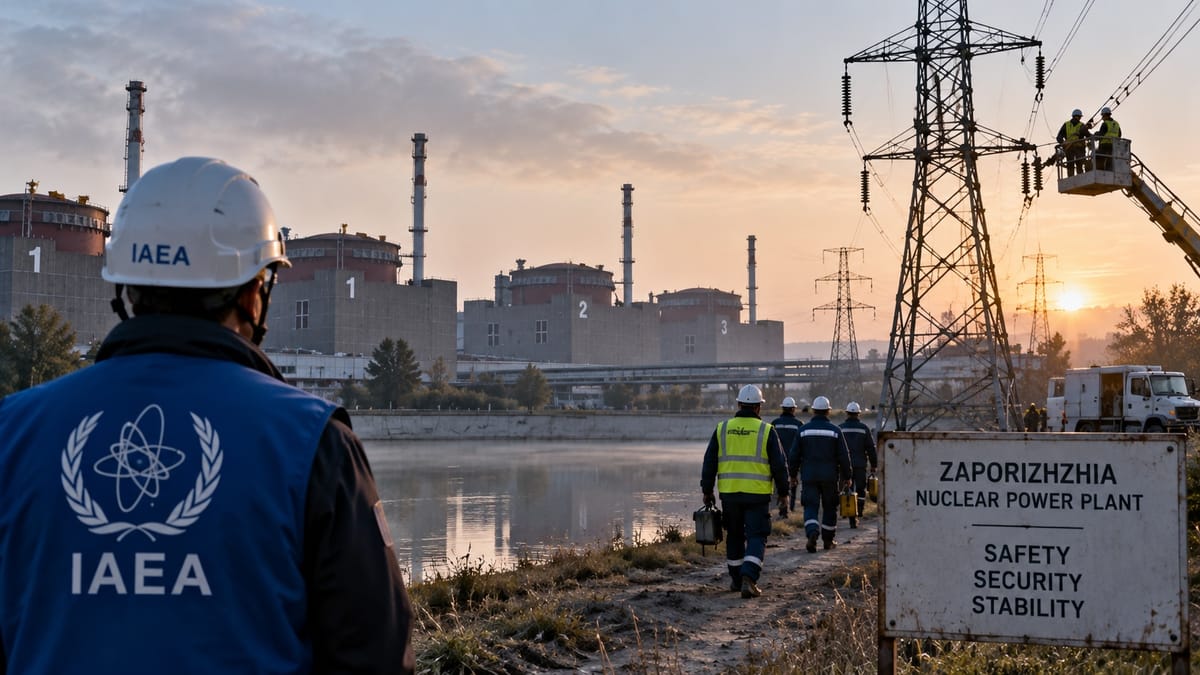
On 5 September, a localized ceasefire brokered by the International Atomic Energy Agency took effect around the damaged Ferosplavna-1 power line supplying the Russian-occupied Zaporizhzhia Nuclear Power Plant. The plant has been without off-site power since 20 August and has since relied entirely on emergency diesel generators to cool its six reactors and spent-fuel pools. IAEA Director General Rafael Grossi said the plant's diesel reserves are running low, and without restoration of external power or additional fuel deliveries, the site could face a complete loss of power within days. Under the terms of the temporary ceasefire, Ukrainian technicians were due to begin repairing the line that same day, following demining of the area; an IAEA team is monitoring the work, expected to take about a week.
This is the seventh localized ceasefire Grossi has negotiated during the conflict specifically to enable necessary repairs at the plant. "Both sides have engaged constructively with the IAEA to help make this localized ceasefire possible," Grossi said, calling the situation "deeply concerning": no nuclear plant should have to scale back essential cooling systems to conserve diesel fuel. Rosatom chief Alexei Likhachev said that repairing the line does not necessarily guarantee restored supply, claiming that another line had been repaired back on 23 July but was never reconnected due to what he called "inaction by the Ukrainian side." Ukraine has not publicly commented on either the ceasefire or Likhachev's claim.
The notable part isn't another ceasefire around the plant — the IAEA has already negotiated six previous ones. What's new is that this moves the situation from warnings and proposed repairs into an implemented mechanism meant to avert a complete loss of station power that looked like a real possibility just days ago.
BSM analysis: a narrow technical truce, unconnected to the capitals pause
It's important not to confuse this localized ceasefire with a separate arrangement from the same week — the pause on strikes against Kyiv and Moscow during the Witkoff-Kushner shuttle diplomacy, which BSM covered separately. These are two distinct mechanisms with different purposes, participants, and geography: one concerns a specific power line and an on-site repair crew, the other concerns broader restraint on long-range strikes against two capitals. The two shouldn't be conflated.
The structural context explains why the plant ended up this vulnerable in the first place: before the 2022 invasion, ZNPP had ten off-site power lines; only one — Ferosplavna-1 — remains. That leaves the plant's safety entirely dependent on repeated, fragile ceasefires and on diesel logistics inside an active war zone, rather than on any built-in grid redundancy. Likhachev's claim of Ukrainian "inaction" regarding a line supposedly already repaired on 23 July remains unverified and unanswered by Kyiv — worth tracking as a separate, still-unconfirmed thread.
Why it matters for Ukraine and the Baltic region
Zaporizhzhia is Europe's largest nuclear power plant. Although its reactors aren't generating electricity, continuous power remains necessary for cooling reactor cores and spent-fuel pools and for other essential safety systems. Restoring off-site electricity directly reduces the risk created by prolonged dependence on diesel generators.
For Ukraine and broader European security, the development also shows that narrow operational agreements around critical infrastructure can still be implemented despite ongoing combat elsewhere on the front. A serious radiological incident at Zaporizhzhia would stop being merely a battlefield issue and become a much wider European civil-protection, environmental, and security problem — one directly relevant to the Baltic states given their proximity and dependence on regional energy stability.
Bottom line
If the damaged line is successfully repaired and reconnected, the immediate risk of a total station blackout should drop substantially. But this ceasefire is strictly localized and temporary — it should not be read as an extension of the Kyiv-Moscow capitals pause or as evidence of a broader front-line truce. Repairs also don't necessarily guarantee immediate restoration of external power, and even after a successful reconnection, continued fighting around transmission infrastructure means the plant's power situation is likely to remain fragile. The next indicator for BSM to watch is whether the week-long repair estimate holds, and whether Ukraine publicly responds to Likhachev's claim about the supposedly unreconnected July line.
Baltic Security Monitor (osint-baltic.com) — an analytical publication covering security on NATO's north-eastern flank. All OSINT indices are calculated by an automated indexing system based on open sources.