Under Escort to St Petersburg: Security Watch, 14 November, 14:00
Three days ago Finland confirmed only that a Russian warship had been hit in the Gulf of Finland. Now the Estonian Defence Forces have filled in what happened next: several drone hits, dead and wounded among the crew, and a ship that could reach St Petersburg only with help from another vessel. It…

Baltic Security Monitor | Material Update
Snapshot: 14 November 2026, 14:00 EET · window 08:00–14:00 · lookback to 13 November, 14:00
Three days ago Finland confirmed only that a Russian warship had been hit in the Gulf of Finland. Now the Estonian Defence Forces have filled in what happened next: several drone hits, dead and wounded among the crew, and a ship that could reach St Petersburg only with help from another vessel. It is the first known case of a Baltic Fleet ship suffering serious damage at sea, close to NATO waters.
Cycle metrics
- Status: 2 MATERIAL UPDATES · 1 HIGH, 1 MODERATE
- WATCH: 16 lines under observation
- Uncertainty: 🟡 7 · 🔴 0 (down from 🟡 10 this morning)
- Both developments date from 13 November and were picked up within the 24-hour lookback.
The 14:00 cycle closes some of the questions left open this morning. The Gulf of Finland strike is no longer a fact without details: Estonian officers have described its consequences, and they are serious. At the same time, the core question has sharpened. A Baltic Fleet ship took combat damage a few dozen kilometres off the Finnish and Estonian coasts, while drones heading for Ust-Luga again crossed into Estonian airspace. The Gulf of Finland has become a frontline waterway that NATO members share with a belligerent.
🔴 HIGH · Estonia: ship lost propulsion, crew killed and wounded
Colonel Aron Kalmus, deputy commander of a division of the Estonian Defence Forces, told a briefing that during the mass drone attack on the port of Ust-Luga on 11 November, a Baltic Fleet warship was hit by more than three drones, ERR reported. According to Kalmus, crew members were killed and wounded; he gave no figures.
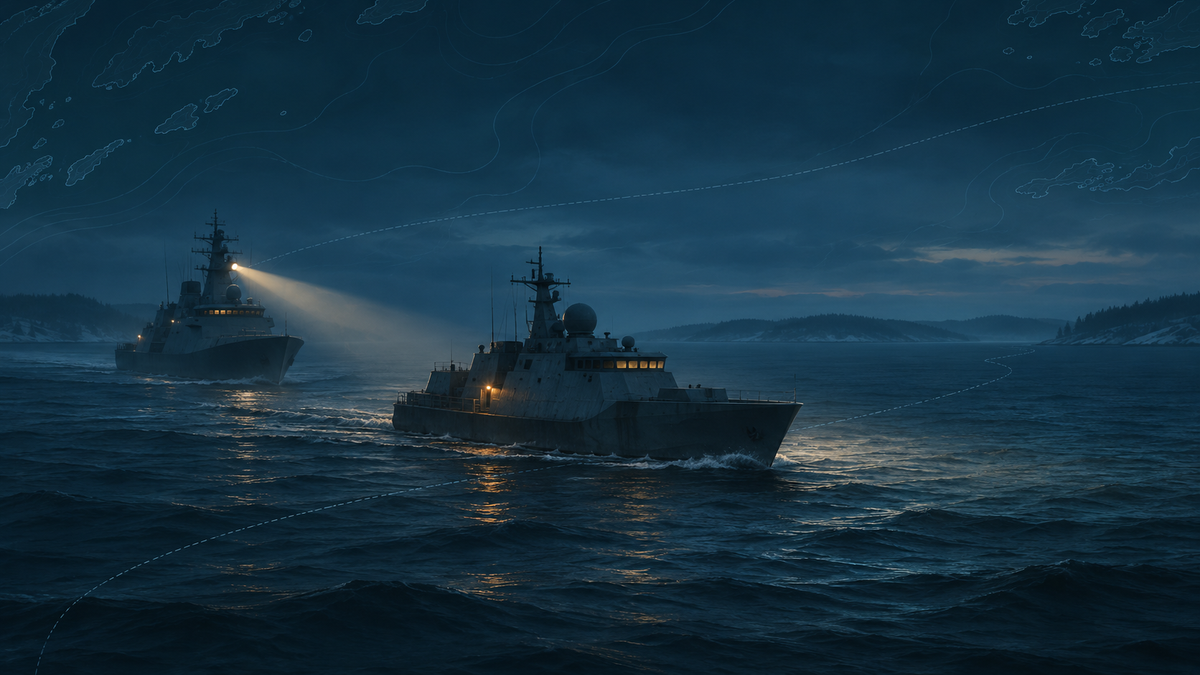
The strike took place near Gogland (Suursaari) island in the Gulf of Finland. The ship initially headed for St Petersburg under its own power, then stopped, and the Russian navy had to call in an additional escort vessel to get it the rest of the way.
The ship's identity remains open. According to Yle and UNN, Kalmus described it as a Sviyazhsk-class corvette, the Project 21631 Buyan-M type. UNITED24 names a specific ship, the Naro-Fominsk. There is no independent confirmation of the name, no imagery of the damage and no casualty count.
Kalmus also assessed the impact on Ust-Luga. In his estimate, oil transshipment at the port fell from about 700,000 to 300,000 tonnes a day. The SBU had earlier reported hits on storage tanks, pumping stations and pipelines. During the raid, Ukrainian drones briefly entered Estonian airspace over the Gulf of Finland and in the country's southeast.
What changed. On 12 November Finland confirmed only that a strike had happened, with no damage assessment. The new delta is about consequences: multiple hits, crew losses and loss of independent propulsion. These are signs of substantial combat damage, not a rerun of the original report.
BSM analysis. Until now, strikes on the Baltic Fleet hit ships in dock or on inland waterways: the Boikiy at Kronstadt in June, the Grad on Lake Onega in October. Off Gogland, a ship was hit for the first time in the open waters of the Gulf of Finland, a few dozen kilometres from the Finnish and Estonian coasts. For Russia, the message is that its Kalibr-armed missile ships are exposed even in home waters; the likely response is stronger shipboard air defence and changed routes. For Finland and Estonia, it means ever denser traffic of attack drones, warships and merchant shipping in a narrow gulf where any navigation failure can end as an incident on NATO territory. Next step: an official identification, satellite imagery and a repair timeline.
🟡 MODERATE · Europe's negotiating team, without the Baltic states
On 13 November in Dublin, EU leaders agreed that Europe will be represented in the Ukraine talks by the EU institutions and the E5: Britain, France, Germany, Italy and Poland. Under the announced model, the EU institutions cover Ukraine's European future and reconstruction, while security guarantees are handled by the Coalition of the Willing in coordination with NATO. Estonia, Latvia, Lithuania, Finland, Sweden and Denmark have no seats of their own. Moscow does not recognise any European role in the talks.
(Full analysis: Security Watch, 14 November, 08:00, "A Team Without the Baltics".)
BSM analysis. The two updates in this cycle belong together. The week's sharpest military incident happened in the waters between Finland and Estonia, and these are exactly the countries without a voice of their own on Europe's negotiating team. Their influence over security guarantees now runs through consultations with the E5 and through whoever personally represents the EU institutions.
WATCH queue
- 🟡 Russian warship. Official identification, independent imagery, casualty figures, repair timeline.
- 🟡 Ust-Luga. Kalmus's estimate of throughput falling to 300,000 tonnes a day needs confirmation from tanker movements and operator statements.
- 🟡 Drones over the Baltic states. Attribution, flight paths, forensic results.
- 🟡 Starshield. Reasons for the restrictions, US and SpaceX position, restoration.
- 🟡 Volgograd. Refinery damage unconfirmed.
- 🟡 Prisoner exchange. Final terms and actual execution.
- Zaporizhzhia NPP. New IAEA reporting.
- Kirishi refinery. Actual downtime and repairs.
- 🟡 Black Sea. Attribution of attacks on merchant ships.
- 🟡 Rassvet. Technical confirmation of use.
- Poland / ABW. Investigative findings.
- Klaipėda. Controls on Russian and Belarusian grain from 16 November.
- EU Black Sea Maritime Security Hub. Funding and operational timeline.
- Rzeszów–Jasionka. Actual deployment.
Conclusion
In a single day the cycle moved from facts without details to two confirmed shifts. Europe decided who speaks for it, and the Gulf of Finland showed how close the war has come to the Estonian and Finnish coasts. A warship limping to St Petersburg under escort is the week's most telling image: the Baltic Fleet no longer feels safe even at home.
Klaipėda's grain controls start in 2 days. The European Council on Ukraine's financing meets on 26–27 November, 12 days away.
Baltic Security Monitor (osint-baltic.com) — an analytical publication on security across NATO's northeastern flank.
Event statuses are assigned by an automated open-source monitoring system and independently verified.