Germany Test-Fires a Ballistic Missile From a Frigate for the First Time: Berlin Trials a New Long-Range Naval Deterrent Against Russia

Baltic Security Monitor | Analytical Brief As of 3 September 2026, 08:00 EEST
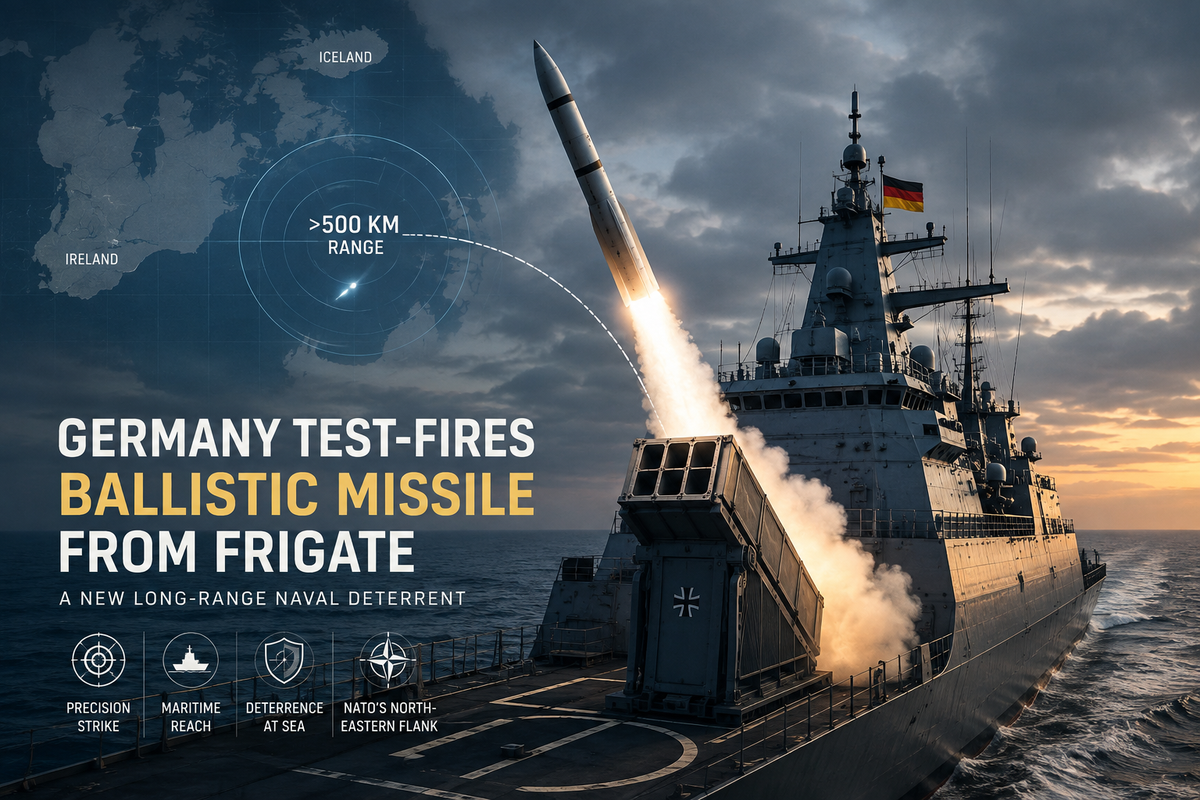
Overnight from 1 to 2 September, the German Navy successfully test-fired the Israeli-made LORA (Long Range Artillery / Long-Range Attack) quasi-ballistic missile, produced by Israel Aerospace Industries, from the Baden-Württemberg-class frigate Sachsen-Anhalt in the North Atlantic, in waters between Ireland and Iceland. According to German sources, at least two missiles were launched from a canister launch module on the frigate's flight deck, and both struck their designated sea targets. Preparations were largely kept secret, though shipping and air traffic in the area had been warned 45 days in advance; a second German frigate escorted the trial. The test was conducted under the Bundeswehr's Operational Experimentation (OPEX) framework, designed to evaluate emerging technologies under realistic conditions before decisions are made on wider adoption.
German Navy chief Vice Admiral Jan Christian Kaack called the trial a success: "Our units can successfully deploy the system, and its potential range exceeds anything we have known before." He added that "for the protection of Germany and our allies, this test marks a new chapter in deterrence and defense readiness at sea." LORA's range exceeds 500 kilometers; under arms-control classification, it falls into the short-range ballistic missile category. Germany currently fields no ballistic missile of its own, which makes this test a qualitatively new capability demonstration rather than another step in an existing program. According to Reuters, citing a Navy spokesman, Berlin now plans to advance preparations to procure the missiles — meaning, contrary to initial reporting that framed this purely as an experiment, there is now a stated intent to move toward acquisition, even though no formal contract, unit quantity, or in-service date has been announced.
The notable part isn't the test itself — Germany has long been developing its own long-range strike programs, including Taurus NEO. What's new is that, for the first time, a German warship has actually demonstrated the ability to fire ballistic weapons, and naval leadership is explicitly tying that to a new phase of deterrence against Russia — and, per the latest reporting, this is no longer just an experiment but a step toward an actual purchase.
BSM analysis: a containerized missile that doesn't require new ships
Technically, the appeal of this approach lies in how easily it can be fielded: each naval-configuration LORA missile is roughly 5.2 meters long, 62.3 centimeters in diameter, and weighs about 1.5 tonnes — compact enough to fit in containerized launchers that require no vertical launch cell and no permanent modification to a ship's hull. According to the manufacturer, the missile uses GPS/GNSS-based navigation with a circular error probable (CEP) of around 10 meters and can strike heavily defended land targets even in adverse weather; the system can reportedly be prepared and deployed from unprepared positions within minutes. The Baden-Württemberg-class (F125) frigates, designed primarily for long-duration deployments, maritime security, and stabilization missions, have historically been criticized for their limited organic firepower — a containerized LORA fit substantially expands their combat capability without redesigning the ship.
The test also fits into a broader pattern of German-Israeli defense cooperation: Germany has already fielded Israel's Arrow 3 missile-defense system, while Israel is receiving German-built submarines — this same week, the sixth Dolphin 2-class submarine departed Germany for Haifa. The LORA acquisition fits directly into a series of defense programs Germany launched after Russia's full-scale invasion of Ukraine, aimed at deterring Moscow and closing a capability gap in long-range precision strike.
Why it matters for Ukraine and the Baltic region
A ship-launched precision weapon with roughly 500 km of reach substantially expands the set of targets German naval forces could strike from Baltic and North Atlantic waters — including airbases, logistics nodes, missile infrastructure, and other operational-depth military targets. That is directly relevant to NATO's north-eastern flank: Germany is already the framework nation for the permanent brigade in Lithuania and a major contributor to Baltic reinforcement. A maritime deep-strike capability would give NATO another distributed launch option that doesn't depend solely on combat aircraft.
The test also reflects a broader European push to narrow Russia's advantage in long-range conventional fires: Germany is simultaneously developing Taurus NEO and participating in multinational programs to expand European stand-off strike capacity. The timing is notable in its own right: the test took place literally the day before Berlin officially attributed the attempted drone attack at Leipzig/Halle Airport to Russia — a demonstration of new deterrent capability landing amid growing allied concern over Russian hybrid activity.
Bottom line
For now, this is a capability demonstration, not fielded capacity: no procurement contract, unit quantity, or in-service date has been announced. But the fact that Reuters now reports Berlin's intent to move toward procurement is itself a qualitative shift from the purely experimental status the program held just a week ago. The next indicator for BSM to watch is precisely that: whether Germany makes a concrete decision to buy LORA or a comparable ship-launched ballistic system, and whether future German surface combatants begin to be designed with an organic land-attack capability built in, rather than relying on temporary deck-mounted launch canisters.
Baltic Security Monitor (osint-baltic.com) — an analytical publication covering security on NATO's north-eastern flank. All OSINT indices are calculated by an automated indexing system based on open sources.