From Separate Components to One System: How Ukrainian JATEC Instructors Took NATO's Counter-Drone Work to Latvia

Baltic Security Monitor | Analytical Briefing Snapshot: 2026-08-29T08:09:12.356Z
OSINT indices for the day
| Indicator | Value | 24h dynamics |
|---|---|---|
| Composite threat index | 0.19 | flat over 6h and 24h |
| Force Posture | 0.53 | no movement in the digest — WARNING-level reading against a calm composite |
| Logistics | 0.00 | zero |
| Info/Cyber | 0.00 | zero |
| Border/Air/Maritime | 0.00 | zero |
Events logged in 24h: 1 · High confidence: 0 Quarantine: 0 · Source failures: 0
The same pattern BSM criticised on 22 August repeats almost exactly: Force Posture spikes off zero to WARNING level while three other sub-indices stay silent, and the day's only logged event is a training story, not a force-posture one, scored a mere 0.19. That event is worth attention in its own right, though: Ukrainian JATEC instructors just helped NATO move from testing individual counter-drone solutions to integrating them into one command system — this time in Latvia, not Romania, where the series began.
Top event of the day
🔵 1. Ukrainian JATEC experts advise NATO on countering drones
OSINT score: 0.19 — WATCH
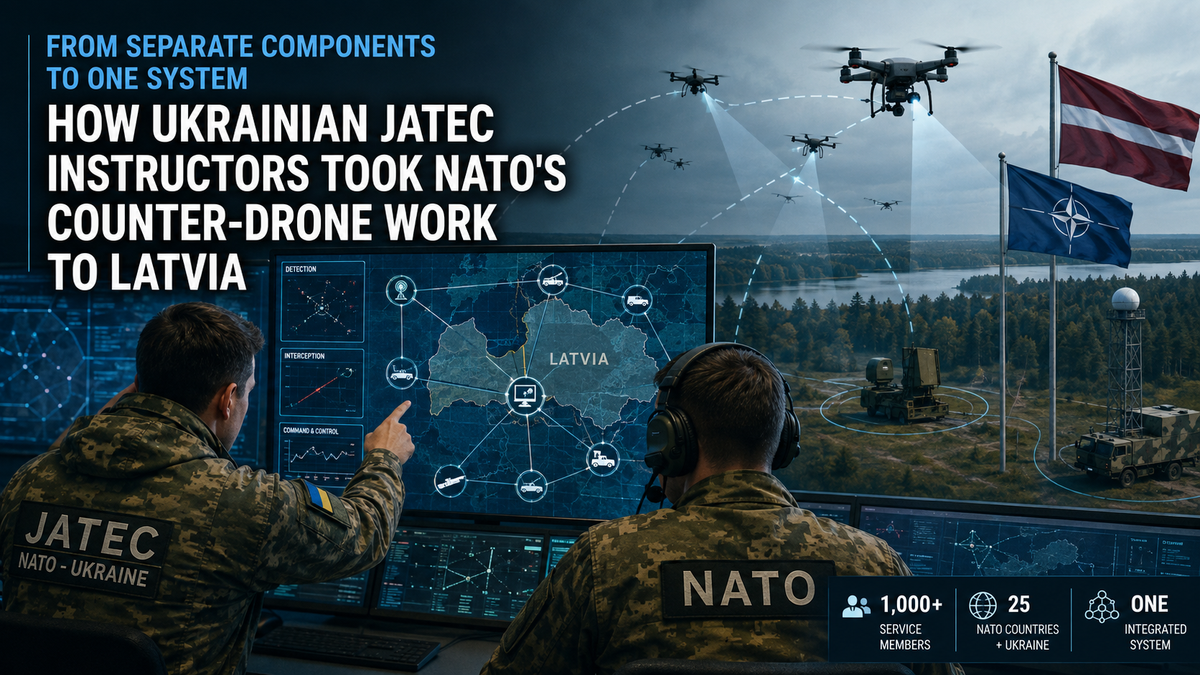
Ukrainian specialists from the NATO-Ukraine Joint Analysis, Training and Education Centre (JATEC) advised Alliance forces during LCI-X Crucible 3-26 in Latvia — the third phase of an experimentation series held under the broader Baltic Trust exercise. More than 1,000 service members from 25 NATO countries and Ukraine took part. According to Ukraine's Defence Ministry, the third LCI-X phase moved beyond testing individual counter-drone elements: this round tested how several separate counter-UAS "cells" work together at the tactical level and integrate into NATO's command-and-control systems.
Before the exercise, Ukrainian specialists helped revise the scenario to reflect real frontline conditions, including adjustments to UAV flight parameters. During the active phase, JATEC experts monitored and coordinated the simulated opposing-force crews, ensuring precise adherence to routes, flight plans and threat profiles.
BSM analysis: Worth noting the chronological progression of this exercise series, which BSM has partly tracked already. The first Layered Counter-UAS Initiative (LCI-X) phase took place at the Capu Midia range in Romania: roughly 500 participants from 21 countries tested individual detection and interception solutions. The third phase, just concluded in Latvia, involved more than 1,000 participants from 25 countries, and the goal shifted from "does each individual component work" to "do all the components work together as one system." This is the same Baltic Trust exercise series BSM fact-checked on 25 August — that piece covered the main exercise window of 3–14 August; the LCI-X Crucible 3-26 phase involving JATEC is a continuation of the same training cycle later in August, not a separate event.
Among the specific technologies that have already gone through the NATO Innovation Challenge process with Ukrainian involvement: an AI-based solution for guiding UAVs against aerial targets from Alta Ares (the company has confirmed successful combat engagements against Shahed, Gerbera and SuperCam drones), an interceptor from Tytan, and an autonomous "drone wall" concept from Atreyd — the same underlying logic BSM described on 22 August in connection with Alexa Spatium and the Baltic Drone Wall.
A note on data quality: Force Posture at 0.53 with no corresponding event
This is now the second time in a week BSM has seen the same pattern flagged on 22 August: Force Posture reads 0.53 — WARNING level — while Logistics, Info/Cyber and Border/Air/Maritime sit simultaneously at zero, and the only event in the top list is an advisory training mission scored a mere 0.19 that doesn't explain a reading that high.
BSM analysis: Unlike 25 August, when the Border/Air/Maritime elevation could be explained by a documented structural trend (a series of drone incursions and shootdowns over the Baltics), BSM finds no equivalent justification for Force Posture here — neither in today's event nor in an obvious structural trend that would explain this specific level right now. This looks like a repeat of the same potential pipeline issue BSM flagged a week ago: a sub-index that isn't refreshing day to day, partly stuck at an elevated value. The recurrence of this pattern is itself a reason to check the Force Posture calculation mechanism directly, rather than simply re-flagging it as an anomaly each time it appears.
Bottom line
Today's single event is worth attention on its own merits — it's a marker of how Ukraine-NATO cooperation is maturing from testing individual technological solutions to integrating them into one command architecture. But the digest itself is, once again, a reminder: a sub-index figure with no event to anchor it is a signal to check the pipeline, not to raise the alarm.
Baltic Security Monitor (osint-baltic.com) — an analytical outlet covering security on NATO's northeastern flank. All OSINT coefficients are calculated by an automated indexing system based on open sources.