Five Drones Crossed Moldovan Airspace in One Night: Russia's Mass Strikes Are Increasingly Spilling Beyond Ukraine

Baltic Security Monitor | Material Update
Published: 27 August 2026, 14:00
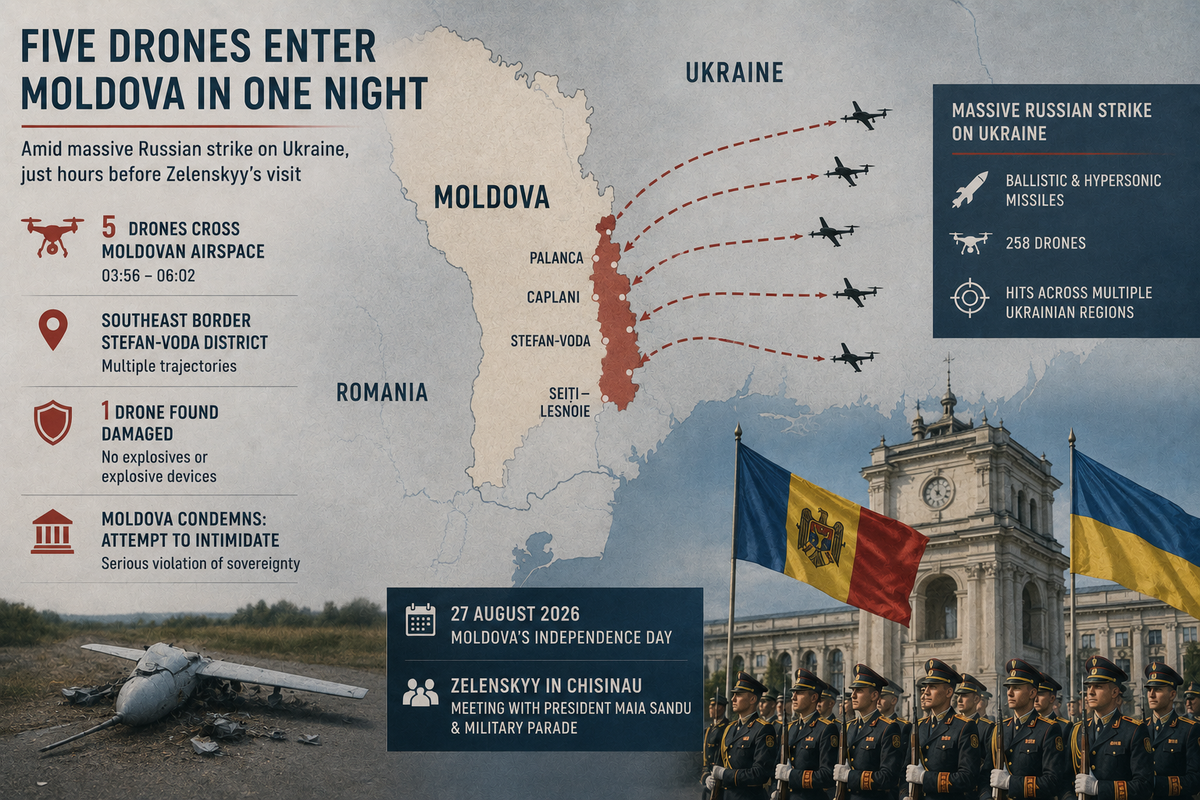
Five drones crossed Moldovan airspace overnight on 27 August — hours before President Zelensky arrived in Chișinău to mark Moldova's 35th Independence Day and hold a bilateral meeting with President Maia Sandu. The scale and simultaneity — five separate tracks during a single strike window, not a solitary incursion — moves the episode out of "another round of border spillover" and into what Moldova's Foreign Ministry directly called an attempt at intimidation.
What happened
Moldovan authorities confirmed that five drones entered the country's airspace between 03:56 and 06:02 on 27 August, while Russia was conducting a large-scale missile and drone attack against Ukraine. The National Army's Air Operations Service said the tracks were established jointly with partners; the first drone entered from the direction of Bilyaivka toward Palanca at 03:56 and exited along the same axis a minute later. All five crossings occurred along the southeastern frontier in the Ștefan Vodă district — the stretch of border that absorbs most of the traffic reaching Moldova from the Odesa region — over Palanca, Căplani, Ștefan Vodă and the Săiți–Lesnoe border area. Some of the UAVs returned to Ukraine; two disappeared from tracking systems while still over Moldovan territory, one near Pervomaisc in the Transnistrian region.
A damaged UAV was subsequently found near the Chișinău–Basarabeasca road. Moldovan police identified it as a "Parodia"-type drone and reported after examination that it contained no explosive device or explosive substance. President Maia Sandu publicly described the overnight incursions as repeated violations by Russian drones and condemned them as an attempt at intimidation. Moldova's Foreign Ministry separately called the five unauthorised overflights a serious violation of sovereignty and a direct security risk.
The incursions coincided with a major Russian attack across Ukraine — Ukrainian figures reported by Reuters put it at ballistic and hypersonic missiles plus 258 drones. Kyiv, port infrastructure, energy facilities, industrial sites and logistics targets across several regions were struck. Reuters and AP independently reported the Moldovan airspace violations in the context of that same attack.
BSM analysis: The source digest omits a detail that gives this episode extra weight: the incursion happened just hours before Moldova marked its 35th Independence Day that same afternoon with a military parade in Chișinău — featuring colour-guard detachments from Romania, Ukraine, Lithuania, Italy, Poland, France, the Czech Republic and the US — attended by Ukrainian President Volodymyr Zelensky, who held a bilateral meeting with Sandu. The timing — five drones overnight, a national holiday and a meeting between two presidents by afternoon — doesn't prove intent, but it's exactly the coincidence that explains why Chișinău and Reuters framed this immediately as intimidation rather than accident.
What changed
Moldova has already experienced drone and debris incidents generated by the war, including an unidentified aerial object that entered Moldovan territory and exploded near Talmaza on 17 August, and repeated Russian attacks immediately adjacent to Moldovan border crossings (BSM covered the strike on the Tabaki crossing on 22 August).
The material delta here is scale and simultaneity: Moldova officially tracked five unauthorised drone incursions during a single Russian strike window, along several separate routes across the country's southeast. At least one damaged UAV was then physically recovered on Moldovan territory.
This moves the incident beyond another isolated border spillover. Moldova's president has explicitly attributed the incursions to Russian drones. The detailed forensic provenance and control history of each of the five individual aircraft have not yet been publicly established. 🟡
Regional context
This episode isn't unique to Moldova — it's part of a broader regional trend. Neighbouring Romania logged 25 drone incursions during 2026, against just nine for all of 2025; allied fighters on air-policing duty over Romania have shot down four drones since July 2026, and at least one of those approached through Moldovan airspace — meaning this isn't the first time Moldovan skies have served as a transit corridor toward Romania, a NATO member state.
BSM analysis: The incident demonstrates how Russia's increasingly large long-range strike packages can generate multiple simultaneous sovereignty violations outside Ukraine, raising the operational burden on neighbouring states for low-altitude detection, identification and interception. That lesson applies directly to NATO's eastern and north-eastern flank. Estonia, Latvia, Lithuania, Poland, Romania and Finland have all confronted drone incursions or spillover tied to the Ukraine war and are strengthening counter-UAS and air-defence capabilities. Five crossings during a single attack illustrate why national air pictures alone are insufficient when drones can move rapidly across several jurisdictions.
Moldova's reconstruction of the flight paths also relied on coordination with Ukrainian monitoring services — reinforcing the operational case for faster cross-border sharing of low-altitude tracks between Ukraine and neighbouring European air-surveillance networks, the same kind of infrastructure the Baltic states are already building into their own drone wall.
Likely implications
Moldova is likely to accelerate deployment and procurement of short-range surveillance and counter-UAS capabilities, particularly along its southeastern border. 🟡
Eastern-flank states may treat this episode as further evidence for integrated low-altitude track sharing and clearer peacetime procedures for unidentified drones crossing national borders. 🟡
The public evidence does not yet establish whether all five incursions resulted from navigation error, electronic-warfare effects, deliberate Russian routing, or some combination of these factors. 🟡
Bottom line
Five separate tracks in one strike window is a statistic, not an anecdote, and Chișinău has grounds to read it as pressure rather than coincidence. But the most telling fact of this cycle isn't the drone count — it's that none of them carried explosives: Moldovan authorities didn't suffer physical damage, they received a demonstration of the capacity to inflict it, timed precisely to a day the country was celebrating independence in the presence of Ukraine's president.
Baltic Security Monitor (osint-baltic.com) — an analytical outlet covering security on NATO's northeastern flank.
This report draws on an automated monitoring digest cross-checked against independent open sources.