Finland and Sweden Fly Their First Joint QRA Identification Mission Over the Gulf of Finland

Baltic Security Monitor | Material Update Event: 24 September 2026 · 25 September 2026
What happened
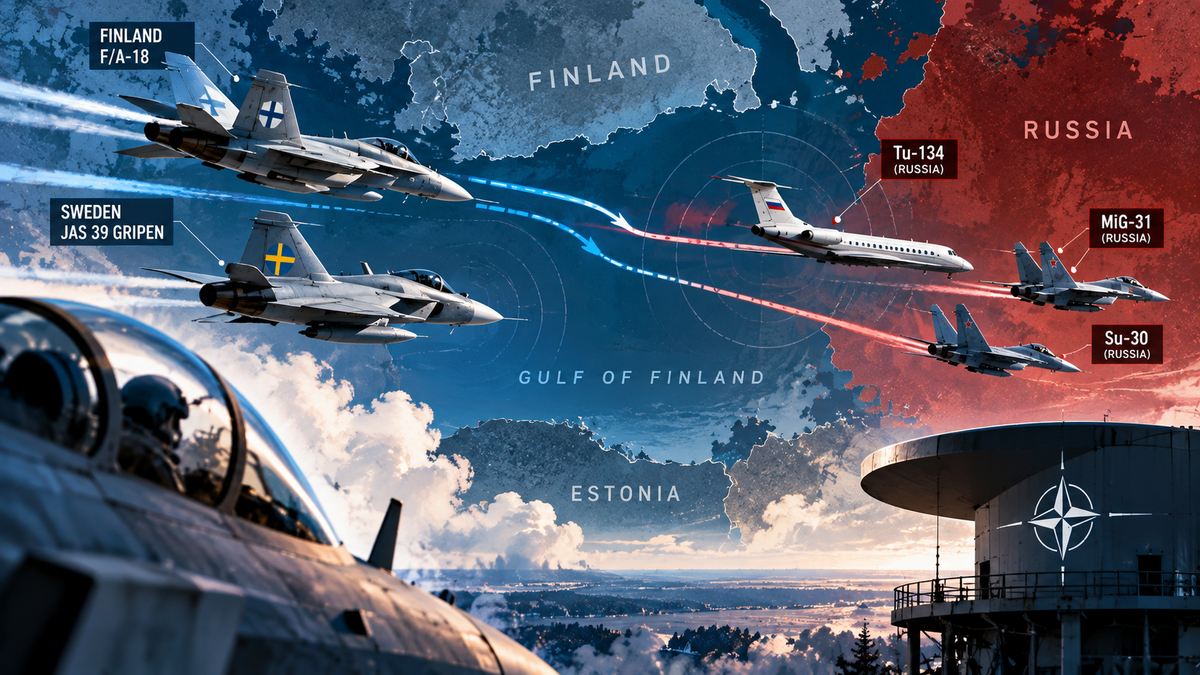
On 24 September, Finnish and Swedish Quick Reaction Alert (QRA) fighters carried out their first joint operational identification mission. The operation was led by the Finnish Air Force's Air Operations Centre. Finnish F/A-18 Hornets and Swedish JAS 39 Gripens intercepted and identified a Russian formation in international airspace over the Gulf of Finland — a Tu-134 transport aircraft and MiG-31 and Su-30 fighters.
Neither country reported an airspace violation. According to Zona Militar, the wider coordinated NATO response that day included Turkish F-16s based at Ämari, Estonia, and Italian Eurofighters based at Šiauliai, Lithuania — meaning this was not an isolated mission but one episode within NATO's broader Baltic air-policing structure.
Why this is a material change, not just another incident
Finnish and Swedish jets have flown Cross Border Training sorties almost weekly for years. What made 24 September different is that it was the first time the two countries' alert fighters performed an actual operational identification task together, rather than a training exercise.
Colonel Vesa Mäntylä, Deputy Chief of Staff at Air Force Command Finland, explained that the deeper cooperation launched this autumn enables joint identification missions and lets QRA jets operate from the other country's air bases when needed. That is a concrete operational implementation, not another statement of intent.
BSM analysis: The distinction between training and an operational mission matters. Training demonstrates the capacity to cooperate; an operational mission demonstrates that capacity being exercised in real time against a real target. That is the material development here.
Regional context
The deeper cooperation arrangement was announced in late August with the stated goal of protecting Finnish territorial integrity. It fits within the broader Nordic Air Power framework, which brings Finland, Sweden, Norway and Denmark together to improve interoperability within NATO's collective defence. Both countries also coordinate regional activity with NATO Baltic Air Policing detachments.
Context worth noting: on 21 August, Finland's Border Guard said a Russian Il-20 reconnaissance aircraft had flown roughly 9 km into Finnish airspace south of Utö. That incident is not directly linked to the 24 September mission, but it helps explain the current push toward tighter interception coordination.
Relevance for Ukraine
There is no direct link to the war in Ukraine — the aircraft stayed in international airspace, and no violation was reported. But a more integrated Nordic air-response architecture around the Gulf of Finland and NATO's north-eastern flank indirectly eases the burden on the Alliance of monitoring Russian military aviation activity while the war against Ukraine continues.
Bottom line
The Russian formation itself should not be read as escalation — the aircraft operated in international airspace, and neither side reported a violation. The material fact is not what Russia did, but that Finland and Sweden put their joint identification mechanism into practice for the first time. Joint QRA missions and cross-border use of each other's air bases are likely to become a routine part of Nordic air-defence integration going forward.
Baltic Security Monitor (osint-baltic.com) — an analytical publication covering security on NATO's northeastern flank. Sources: Forsvarsmakten, Ilmavoimat/Puolustusvoimat, Bloomberg, AeroTime, Zona Militar.