EU Moves the Leipzig/Halle Case to the Level of a Collective Response: Russia's Representative Summoned, New Sanctions in Preparation After German Attribution

Baltic Security Monitor | Analytical Brief As of 2 September 2026, 20:00 EEST
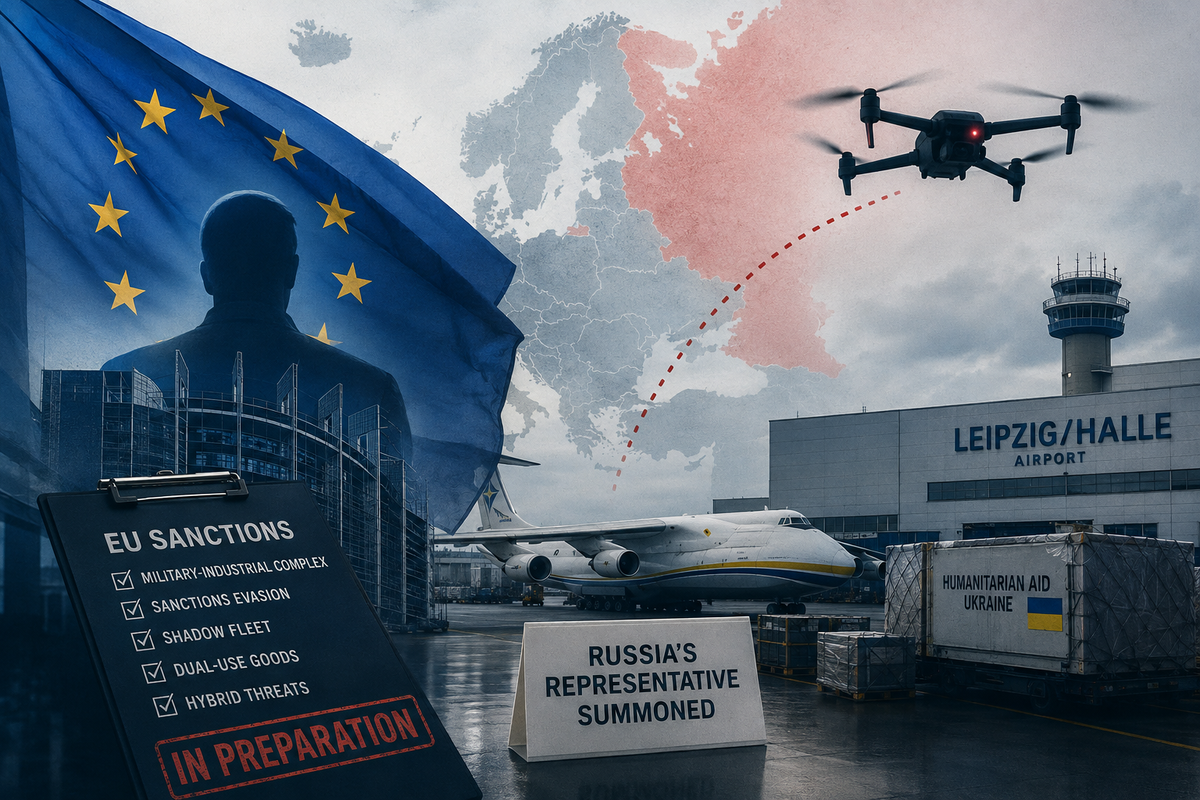
On 2 September, the European Union took its first concrete institutional steps following Germany's attribution, the day before, of the attempted explosive-drone attack at Leipzig/Halle Airport to Russia. EU foreign policy chief Kaja Kallas confirmed that Russia's representative to the EU had been summoned, while several member states separately summoned Russian officials in their own capitals. Kallas said the Leipzig operation bore "all the hallmarks of state-sponsored terrorism" and that the EU was moving forward with additional sanctions. Speaking alongside NATO Secretary General Mark Rutte, European Commission President Ursula von der Leyen called Leipzig/Halle a new escalation on EU territory and said Europe and NATO would increase pressure on Russia, tying the response to stronger protection of European infrastructure, tighter sanctions, continued reinforcement of Ukrainian air defence, and faster European defence investment.
The sanctions component has not yet been formally adopted. Kallas said a package of up to 1,600 listings targeting Russia's military-industrial complex is being prepared for the October Foreign Affairs Council, with at least one member state submitting additional proposals after the Leipzig attribution; "maybe there are more to be added," she noted. The 2 September Gymnich meeting was informal and could not itself adopt sanctions — as Kallas put it directly: "This is not something that we are deciding today, as it is an informal meeting. But we will definitely discuss this." Lithuanian Foreign Minister Kęstutis Budrys said on the sidelines: "It is obvious Russia does not see the political cost of its hybrid activities against us. So for them, this is the cheap way to make tensions in our society." Finnish Foreign Minister Elina Valtonen added that the bloc needs to "explore all the options on the table in terms of tightening the sanctions."
Separately, German authorities are investigating two new incidents affecting high-voltage infrastructure in North Rhine-Westphalia and Brandenburg, one of which temporarily forced lignite power units totaling roughly 4.2 GW off the grid. German officials say foreign-state involvement is among the possibilities under review, but there is currently no established connection to Russia or to the Leipzig operation.
The notable part isn't the condemnation itself — that was expected once Germany made its attribution. What's new is that the response has shifted from a bilateral Berlin-Moscow confrontation to the EU institutional level: a joint summons of Russia's representative, public commitments from the Commission and the European External Action Service to further steps, and — for the first time — sanctions preparation explicitly tied to the Leipzig incident itself.
BSM analysis: from a German precedent to a collective agenda
The difference between 1 and 2 September is the difference between a single state's response and the formation of a common European position. Germany closed a consulate and rescinded a cultural-center agreement on its own; the EU is now bringing in tools that go beyond what any one state can do alone — a 1,600-item sanctions list, discussion of tourist visas as an access channel for saboteurs (raised separately by several ministers at the meeting), and formal acknowledgment from the bloc's top foreign-policy official that the incident bears the marks of "state-sponsored terrorism." This is the level of response that had previously been missing to turn scattered sabotage cases — from Tallinn to Skarżysko-Kamienna — into a single picture formally recognized at the EU level.
At the same time, it's worth not getting ahead of the facts: no sanctions package has been adopted yet, there is no set date for a vote on the 1,600 listings, and the two new German power-grid incidents remain unconfirmed as connected to Russia or to Leipzig. Attribution at this stage would be premature.
Why it matters for Ukraine and the Baltic region
Leipzig/Halle is not simply a civilian airport — it is a major NATO freight and logistics hub, home to Ukrainian An-124 cargo aircraft. The EU's decision to treat the incident as a Europe-wide security problem raises the potential political and economic cost of attacks on infrastructure supporting Ukraine.
For Estonia, Latvia, Lithuania, Poland, and the Nordic states, the precedent is directly relevant to ports, airfields, defence factories, rail hubs, energy infrastructure, and other dual-use facilities exposed to Russian intelligence and sabotage activity. Budrys's comment at the meeting isn't abstract solidarity — it's a direct acknowledgment that the Baltic states are the ones experiencing firsthand just how "cheap" Russia's hybrid operations have become. The emerging response also links physical-infrastructure protection with sanctions enforcement, military-industrial restrictions, and visa policy — exactly the areas where eastern-flank governments have consistently pushed for tougher collective action.
Bottom line
The next material step is likely to be adoption of a concrete sanctions package, potentially expanding military-industrial listings and measures against sanctions circumvention and Russia's shadow fleet. Leipzig/Halle may also accelerate tighter EU visa restrictions: several ministers already raised concerns directly that tourist visas can give operatives access to EU territory. No new NATO operation or Article 4 consultation has been announced. For BSM, the key indicator to watch is whether a concrete sanctions package is actually adopted at the October Foreign Affairs Council, and whether it is explicitly tied to the Leipzig precedent.
Baltic Security Monitor (osint-baltic.com) — an analytical publication covering security on NATO's north-eastern flank. All OSINT indices are calculated by an automated indexing system based on open sources.