EU Approves €6.1 Billion for Ukraine's Air Defence, Missiles and Ammunition: Funding Becomes Concrete Procurement

Baltic Security Monitor | Material Update Published: 24 August 2026, 20:00
On Ukraine's Independence Day, the European Commission moved from words of support to a concrete payment authorisation: €6.1 billion for air-defence systems, missiles, ammunition and radars. This is already the third major Western defence-industrial signal of the same day — following Britain's declassification of SCALP components in the morning — and this time it isn't about technology, but about money that can now be turned into contracts.
What happened
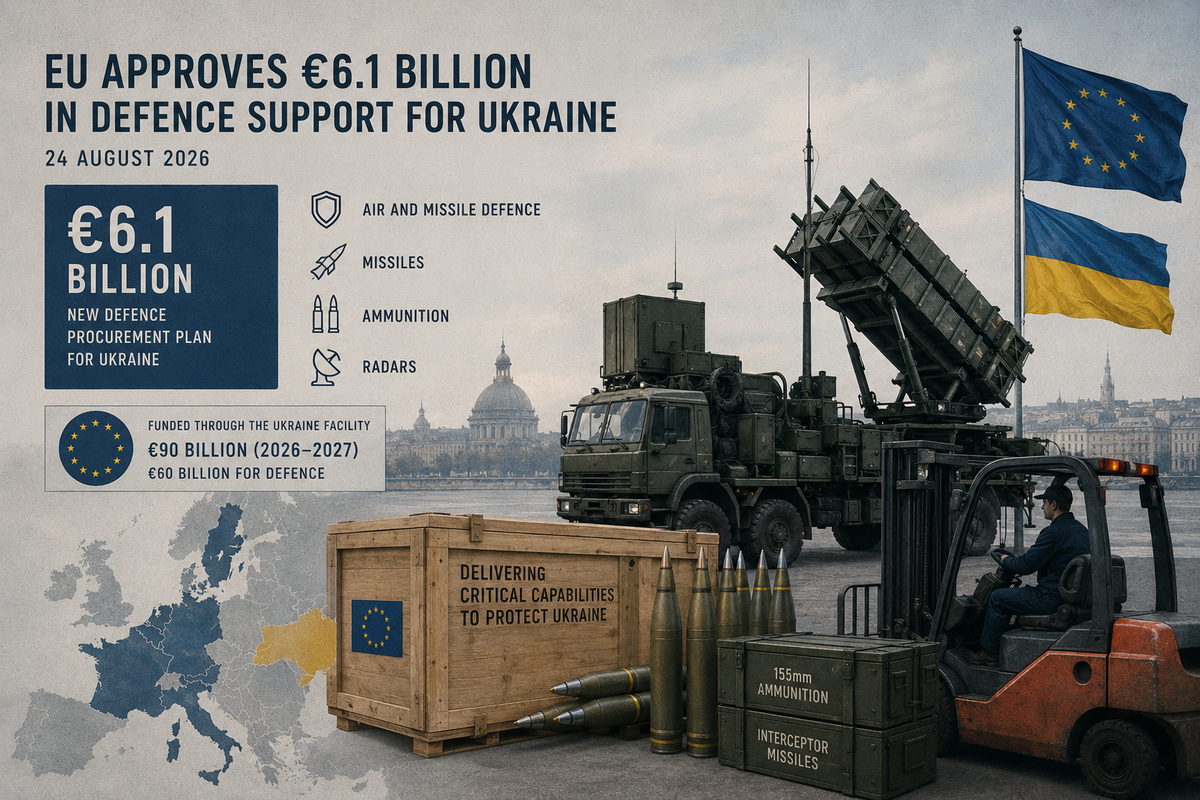
The European Commission approved €6.1 billion in new defence procurement plans for Ukraine on 24 August, covering air- and missile-defence systems, missiles, ammunition and radars. The decision is financed through the €90 billion Ukraine Support Loan for 2026–2027, of which €60 billion is earmarked for defence; €28.3 billion of that is planned specifically for 2026 to strengthen Ukraine's defence-industrial base.
Commission President Ursula von der Leyen said: "On Ukraine's Independence Day, Europe shows our support is unfaltering and concrete. Today, we have approved €6.1 billion for the air and missile defence systems, missiles, ammunition and radars that Ukraine urgently needs." Commissioner for Defence and Space Andrius Kubilius added that the Ukraine Support Loan enables Ukraine to procure the missiles and air-defence systems it needs to protect its sovereignty. The Commission explicitly linked the decision to the fact that Ukraine faced 376 missile strikes in July alone, and called on member states and industry to draw down existing stocks, reprioritise orders and ramp up production.
The new decision adds to €16 billion in defence procurement plans already approved under the same mechanism, of which €8.35 billion has already been disbursed — bringing total approved defence procurement under the loan to more than €22 billion. Most procurement will come from European defence companies. Payments won't happen all at once: Ukraine must conclude eligible contracts, which the Commission then reviews for compliance before releasing funds. By previous reporting, the EU expects to pay Ukraine roughly €20 billion by the end of 2026, with new tranches potentially arriving in the coming weeks.
BSM analysis: Worth flagging the publication timing — the decision was announced earlier on 24 August, so this is better understood as a previously missed item from the prior 24-hour look-back rather than something new since 14:00. The material distinction from earlier pledges is specificity: this isn't a political statement of intent but formal approval of procurement for a defined amount under an already-funded instrument. That said, individual deliveries still depend on signed contracts, available European production capacity and subsequent disbursement.
One day, three signals
It's worth noting this is already the third major Western defence-industrial signal on 24 August. That morning, Britain declassified SCALP components to enable local missile assembly in Ukraine — a story BSM covered at 14:00 today. The same day, European Council President António Costa attended a wreath-laying in Hatne outside Kyiv, and UK Prime Minister Andy Burnham reportedly brought blueprints for Ukraine's own long-range missile production. The Commission's €6.1 billion is the third element of the same package: technology (SCALP), symbolic leadership presence, and now concrete funding for air-defence systems and ammunition procurement. Three signals in one day is not coincidence — it's a coordinated demonstration timed to Independence Day.
BSM analysis: Ukraine's air-defence problem increasingly comes down to a combination of financing, available interceptor stocks and manufacturing capacity. Today's EU decision hits all three at once: it finances procurement while explicitly pushing member states to draw down stocks, reprioritise orders and expand European production.
Why it matters for the Baltic region
The industrial dimension matters for the Baltics too. Most of the €6.1 billion is intended for EU defence companies — the same European production base that supplies Poland, the Baltic states and Nordic NATO members. Rising Ukrainian demand can accelerate production capacity useful to both Ukraine and NATO's north-eastern flank — the same mechanism BSM described earlier today in the Baltic Rheinmetall shell plants alongside the British SCALP decision.
The decision also adds predictability: rather than relying solely on ad-hoc bilateral donations, Ukraine is progressively gaining multi-year, EU-backed purchasing capacity for missiles, ammunition and air-defence systems.
Likely implications
A significant portion of the new envelope is likely to go toward urgently available air-defence interceptors and ammunition rather than entirely new systems, given the Commission's explicit emphasis on drawing down existing stocks and reprioritising orders. 🟡
European manufacturers may receive larger or accelerated orders for missiles, radars and ammunition, improving production visibility but potentially increasing competition between Ukrainian requirements and NATO national replenishment unless capacity expands accordingly. 🟡
The practical military effect will depend less on the headline €6.1 billion figure and more on how quickly Ukraine signs contracts and whether European producers have deliverable inventory or near-term production slots. 🟡
Bottom line
The €6.1 billion approval isn't a standalone story — it's the third part of a coordinated support package timed to Ukraine's Independence Day: technology in the morning, political presence during the day, money in the evening. For the Baltics, the practical takeaway is the same as with today's SCALP story: rising Ukrainian demand strengthens the very European production base the Baltic states' own defence industry depends on.
Baltic Security Monitor (osint-baltic.com) — an analytical outlet covering security on NATO's northeastern flank. This report draws on an automated monitoring digest cross-checked against independent open sources.