The Estonian Track Closes: New U.S. Unit Confirmed for November

Baltic Security Monitor | Material Update 23 September 2026, 20:00 (Europe/Tallinn)
This morning BSM logged only a political assurance — that the U.S. presence in Estonia would continue. By evening, actual numbers arrived: a new unit will land in November, matching the formation that departed in spring. The Lithuanian and Estonian tracks are now closed almost simultaneously.
What's confirmed
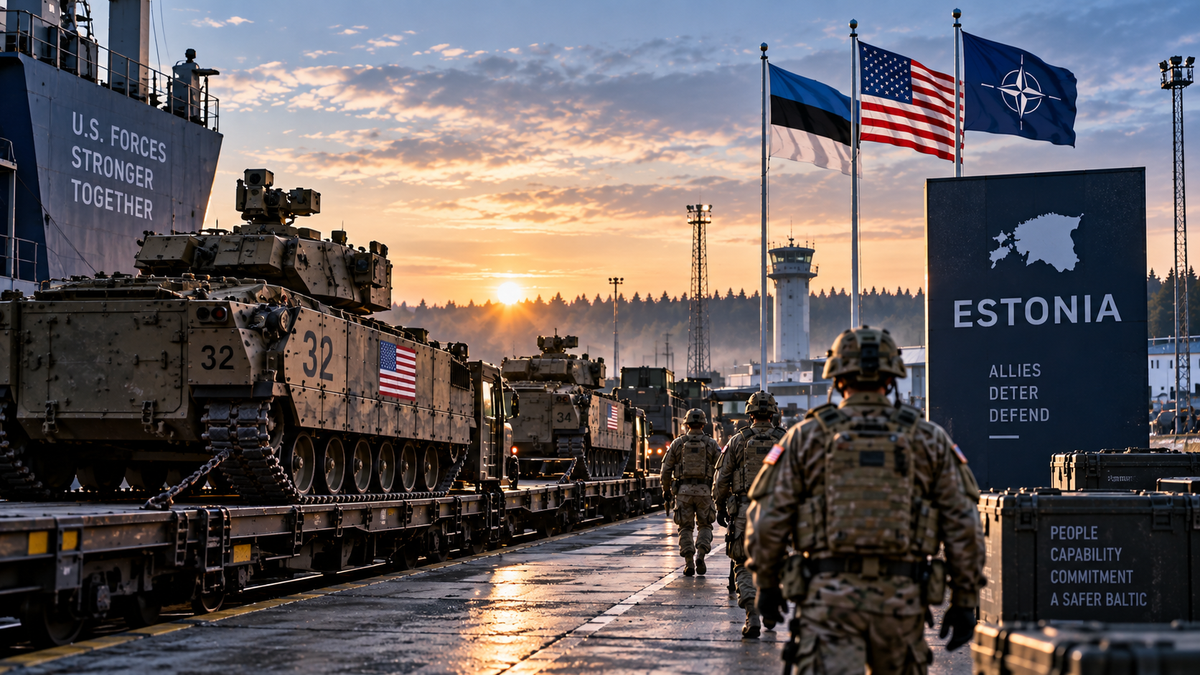
Estonia's Ministry of Defence said on 23 September that U.S. representatives had informed Tallinn that the rotational American presence would resume shortly, with a new unit arriving during November. Defence Minister Martin Herem — in office since 16 September 2026 — said Estonia highly values the U.S. presence as a cornerstone of NATO's deterrence and defence posture, confirming allied readiness and unity to defend alliance territory.
The incoming unit will match, in size and capability, the formation that completed its rotation in spring — the 6th Squadron, 9th Cavalry Regiment (6-9 CAV), an armoured formation equipped with Bradley infantry fighting vehicles and Abrams tanks. After it departed, only a reduced U.S. contingent remained at Camp Reedo in southern Estonia. U.S. representatives specifically noted that the November deployment decision is separate from the ongoing U.S. force-posture review — it's no longer waiting on the broader review to conclude.
BSM analysis: The key shift from this morning's BSM snapshot is the move from political assurance to concrete parameters: a named month and a stated equivalence in force size. That resolves two of the three uncertainties BSM flagged at 08:00 (timing and scale), leaving only the unit's specific identity, personnel strength, and equipment package still open.
Estonia and Lithuania: closing almost in sync
Estonia's decision landed barely a day after Lithuania's: on 22 September, President Nausėda announced a new rotation was already moving toward Lithuania, while Estonia received its first political assurance from Foreign Minister Tsahkna the same day. Now, on 23 September, both tracks have specifics — Lithuania says "already en route," Estonia says "arriving in November."
Tsahkna added context of his own: Tallinn has pledged to cover the costs of retaining allied troops where necessary, and pointed to Estonia investing over 5% of GDP in defence this year. He also stressed that U.S. troops in Estonia, Latvia, Lithuania, and Poland send Russia a clear message not to entertain any thoughts of aggression.
BSM analysis: Notably, both decisions land on a day that also saw a different kind of incident — a Russian military helicopter entered neighbouring Poland's airspace. These aren't directly connected events, but they form one news day: confirmation of allied presence landing alongside another NATO airspace violation, and that contrast is exactly what best explains why allies treat these rotations as a concrete deterrence tool rather than a formality.
The wider picture in Estonia
Estonia currently hosts a U.S. armoured infantry battalion alongside a tank company; the UK leads NATO's Forward Land Forces presence there, with France contributing on a rotational basis. Turkey provides air policing with F-16s flying from Ämari. The UK has separately decided to deploy roughly 1,200 troops to Estonia next year, keeping an entire brigade at high readiness to reinforce the country if needed.
BSM analysis: The November rotation isn't an isolated American decision — it's one piece of a broader multinational deterrence architecture that already includes British, French, and Turkish presence. That reduces how much Estonian security depends on any single ally's decisions, even as the American component remains the most combat-capable in armour.
What to watch
The next material deltas: official identification of the incoming unit, confirmed arrival at Camp Reedo, disclosure of personnel strength and equipment, and any signal about longer-term U.S. force levels in Europe and the Baltics once the broader posture review concludes.
Baltic Security Monitor (osint-baltic.com) — an analytical publication on security along NATO's northeastern flank. Compiled from the official statement of Estonia's Ministry of Defence and independently verified through open sources.
Sources
- Estonia's Ministry of Defence (kaitseministeerium.ee) — official confirmation of the November deployment, 23 September 2026
- ERR — US to send new troop contingent to Estonia, ministry confirms
- LIGA.net — New US troop rotation in Estonia: what is known about the contingent
- Reuters — new U.S. rotation on its way to Lithuania, and Estonia commitment, 22 September 2026
- Bytes Europe / Defence24 — wider context of allied presence in Estonia