Close, Not Contact: A Russian Satellite Shadows ICEYE
Russia's Cosmos 2612 spent 16–18 October manoeuvring within a few hundred metres of ICEYE-X36, a commercial radar-imaging satellite from a Finnish company that supplies intelligence to Western militaries. Independent trackers see deliberate manoeuvres, no collision and no sign of disturbance. The…

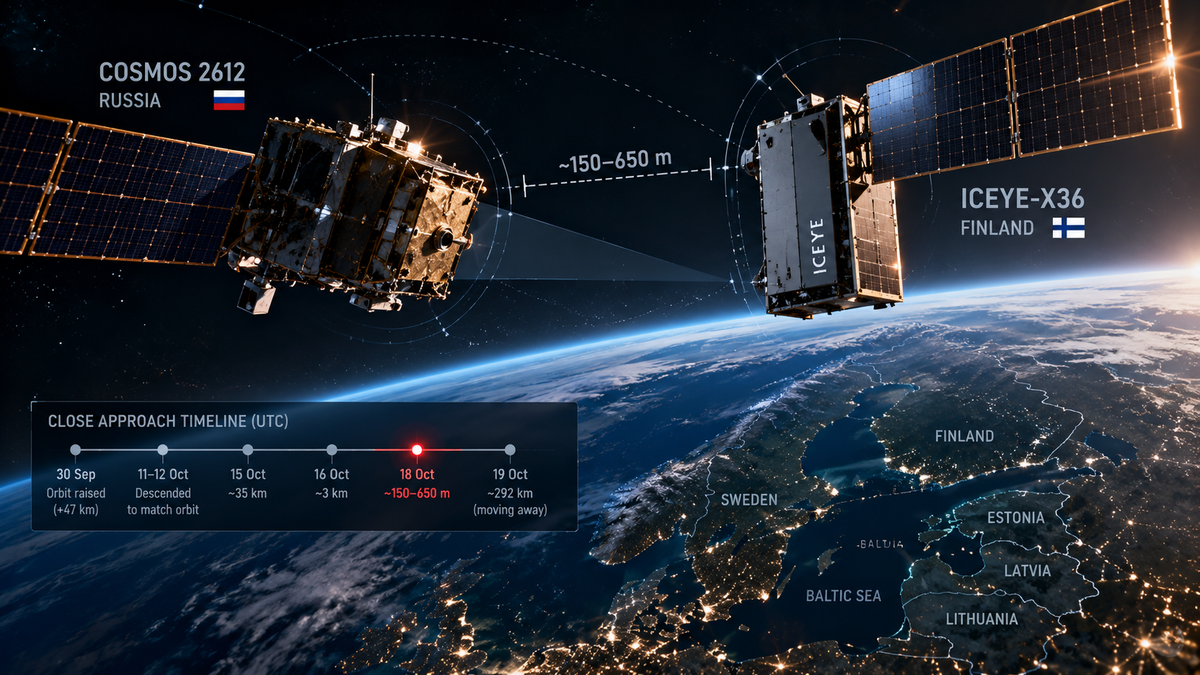
Russia's Cosmos 2612 spent 16–18 October manoeuvring within a few hundred metres of ICEYE-X36, a commercial radar-imaging satellite from a Finnish company that supplies intelligence to Western militaries. Independent trackers see deliberate manoeuvres, no collision and no sign of disturbance. The much-quoted "26 metres" is a prediction, not a measurement.
1. What is confirmed
The approach
- Per the KeepTrack reconstruction from public orbital element sets, Cosmos 2612 raised its orbit by 47 km on 30 September, then descended on 11–12 October to a matched orbit about 480 km behind ICEYE-X36. A burn on 15 October closed the gap to about 35 km, and on 16 October it settled about 3 km behind (KeepTrack, 19 Oct).
- LeoLabs observed Cosmos 2612 roughly three miles (about 4.8 km) from the ICEYE satellite on the afternoon of Friday 16 October, against more than 200 miles the day before, and described the movement as appearing to be "a deliberate approach"; it added that intent remains uncertain (Axios, 17 Oct).
- The closest approach fell in a gap in the public data, between element sets of 17 October 17:18 UTC and 18 October 07:38 UTC. KeepTrack puts it at roughly 150–650 m in the early hours of 18 October. Analyst Marco Langbroek estimates a few hundred metres, possibly closer, at about 01:35 UTC (AeroTime, 19 Oct).
- A departure burn followed on 18 October. By 07:32 UTC on 19 October, Cosmos 2612 was about 292 km behind ICEYE-X36 and drifting away (KeepTrack).
- Langbroek found no orbital evidence that ICEYE-X36 was struck or disturbed (AeroTime).
The "26 metres" figure
- KeepTrack states that the 25–26 m claims are not measurements. One analysis gave about 25 m at 10:00 UTC on 18 October, when the element sets place Cosmos 2612 several kilometres away. An automated forecast of 26 m referred to 19 October, after the satellite had left. Public element sets, KeepTrack says, cannot support a miss distance of that size; its own in-track uncertainty for Cosmos 2612 is about 1.9 km.
- AeroTime's article does not contain a 26 m figure.
Earlier pattern
- Cosmos 2609–2614 launched from Plesetsk on 16 April. In May, according to the US Space Force, Russia manoeuvred four of them near an ICEYE satellite, which ICEYE confirmed was its own. Germany's Space Command chief, Maj. Gen. Michael Traut, said the Russian craft were "chasing" it, and that similar tactics against a mega-constellation such as Starlink "concerns me quite a lot" (Reuters, 9 Oct, via Internazionale).
- ICEYE's chief executive, Rafal Modrzewski, told Reuters that ICEYE later moved its satellite, which prompted further Russian manoeuvres, and that satellites can be moved close "either to observe or potentially do harm". The same report notes that Moscow has warned that Western commercial satellites helping Ukraine could be legitimate targets, and that Germany's armed forces have contracted ICEYE and a German company to build dozens of satellites, mainly to support NATO's eastern flank.
Official silence
- The US Defense Department and ICEYE declined to comment to Axios. As of 19 October, ICEYE had made no public statement about the approach or the satellite's status (AeroTime). A Ukrainian official told Axios that the military works with ICEYE, but it was unclear whether this particular satellite supports Ukraine.
2. Confirmed versus outstanding
| Claim | Status | |
|---|---|---|
| ✅ | Cosmos 2612 made deliberate orbital changes from 30 Sep and reached about 3 km from ICEYE-X36 by 16 Oct | KeepTrack reconstruction; LeoLabs via Axios |
| ✅ | Closest approach on 18 Oct was likely in the range of 150–650 m | KeepTrack; Langbroek estimates a few hundred metres |
| ✅ | Cosmos 2612 departed on 18 Oct and was about 292 km away on 19 Oct | KeepTrack |
| ✅ | No orbital sign that ICEYE-X36 was struck or disturbed | Langbroek via AeroTime |
| 🟡 | The exact minimum separation | Public orbital data too coarse; closest pass falls in a data gap |
| 🟡 | The 26 m figure | Prediction and misdated forecast, not an observation |
| 🟡 | Russia's purpose (surveillance, inspection, signalling or interference) | No Russian statement; orbital data cannot show intent |
| 🟡 | Whether ICEYE-X36 is fully operational | Only ICEYE and its customers can say; no statement |
| 🟡 | Whether ICEYE-X36 supports Ukraine | ICEYE has not disclosed; Ukrainian official unsure |
| 🟡 | Any electronic interference with ICEYE-X36 | Not established |
3. BSM analysis
Close is not contact. Three claims are often blended: the satellites came within a few hundred metres (reconstructed, with wide uncertainty), they passed within tens of metres (not supported by the public data), and Russia attacked or disturbed the ICEYE satellite (no evidence). Only the first stands, and even it rests on element sets with a gap at the key moment.
A pattern, not a one-off. The Russian craft launched in April, passed ICEYE-X36 at 2.4–4.2 km in May (KeepTrack, CSIS), and in October one of them matched its orbit and closed to a few hundred metres. ICEYE moved its satellite in June, and the CEO links that to Russian manoeuvres. Whether the 18 October burn is a full departure or the start of another phasing sequence is not yet clear; the next element sets should show it.
Why the Baltic region is affected. ICEYE is a Finnish company, and its radar satellites image day and night through cloud. Germany has contracted it for dozens of satellites for NATO's eastern flank. A Russian inspector that can sit within hundreds of metres of such a satellite, while the operator and the US Defense Department decline to comment, is a reminder that this kind of intelligence capacity depends on commercial assets with no formal protection.
4. In scope, from the WATCH list
Starshield and Starlink speed limits. In a Telegram post on 19 October, Zelensky said that, following a report from the commander-in-chief, Starlink and Starshield equipment stops working at speeds of 130–161 km/h in various frontline sectors, hampering logistics, mid-range drones and interceptors used against jet-powered Shahed drones (Interfax-Ukraine). The range is wider than the single 161 km/h figure of 17–18 October. On 17 October Rubio said his understanding was that service had been restored. No provider statement or independent measurement was found; Zelensky said the matter would be raised again with partners.
Patriot deliveries. In an interview with Bloomberg on 18 October, Zelensky said the US is supplying about 12 Patriot interceptors a month, roughly a quarter of the Biden-era figure, and approved delivery of only some of the interceptors bought through NATO's PURL scheme, "and this is not a technical issue". He also said he offered to stop strikes on Russian diesel infrastructure in exchange for more Patriot missiles (Kyiv Independent, 19 Oct). The US government has not publicly confirmed the figures or explained any delay; no Pentagon or NATO response was given.
| Claim | Status | |
|---|---|---|
| ✅ | Zelensky said on 19 Oct that Starlink/Starshield equipment fails at 130–161 km/h in various sectors | Telegram post, Interfax-Ukraine |
| 🟡 | Whether the restriction persists as stated | No provider statement or independent measurement; Rubio said restored |
| ✅ | Zelensky said on 18 Oct that the US supplies about 12 Patriot interceptors a month and has not authorised some PURL deliveries | Bloomberg interview, via Kyiv Independent |
| 🟡 | The 12-a-month figure and the authorisation delay | Single source; no US confirmation |
| 🟡 | The planned State Defence Council review of Lithuania's air-alert procedures next week | Digest only; not located in other sources |
Per the digest, not re-verified
| Topic | What the digest says |
|---|---|
| Kaliningrad radar | Reports on 19 Oct of an over-the-horizon radar near Gvardeysk, citing ICEYE imagery; the digest treats it as known construction. LRT reported the project on 8 Sep 2025; the October 2026 reports themselves were not located |
| Lithuania drone and arson | Route still disputed; no arrests (covered in the 14:00 note) |
| Black Sea | North Atlantic Council to discuss Bulgaria's request on 20 Oct |
| ZNPP | No confirmation of completed repairs |
| Ukraine's energy system | At least 550,000 households without power (Ukrainian figures); outside scope |
| Saint Petersburg | No verified figures on export disruption |
| Sailors | Seven Wine Trader sailors missing |
| Moldova | Drone fragments near Scăieni; origin unconfirmed |
| Lower-priority queue | Borisoglebsk, Poland and Bulgaria Starlink arson cases, Latvia's border counter-drone network, grain transit, Millerovo and Oryol, Estonia's PURL contribution |
Conclusion
A Russian military satellite came within a few hundred metres of a Finnish commercial radar satellite, left again, and has so far done nothing that public data can show to be an attack. The risk is the pattern: repeated approaches to a commercial asset that serves NATO's eastern flank, with the operator and the Pentagon declining to comment.
Next checks: the next element sets for Cosmos 2612 and ICEYE-X36 (departure or new phasing); a statement from ICEYE on the satellite's status; any US, German or Finnish government response; independent measurements of the Starlink/Starshield speed limits; confirmation from the US side on Patriot supply and PURL authorisations; NATO's North Atlantic Council session on 20 October.
Baltic Security Monitor (osint-baltic.com) — an analytical outlet on security on NATO's north-eastern flank.
All OSINT assessments are prepared by an automated open-source monitoring system.