Cleared to Engage: OSINT Digest, July 10

Baltic Security Monitor | Analytical Briefing Snapshot: 2026-07-10T15:39:19Z
Today's OSINT indices
| Indicator | Value | Movement |
|---|---|---|
| Composite threat index | 0.11 | Δ6h 0.00 · Δ24h 0.00 — flat again, though slightly higher than recent days |
| Force Posture | 0.11 | back up from zero |
| Logistics | 0.07 | reappeared after dropping to zero |
| Info/Cyber | 0.00 | flat zero for a third straight snapshot |
| Border/Air/Maritime | 0.24 | highest reading across three consecutive snapshots (0.21 → 0.22 → 0.24) |
Events logged in 24h: 10 · High-confidence: 0 Quarantined: 0 · Source failures: 0
Border/Air/Maritime has now climbed for a third straight snapshot — no longer noise, but a trend. Yet nothing in today's top five explains it: all five entries are, once again, about the Mediterranean and administrative NATO ISR initiatives. The actual driver behind the sub-index rise almost certainly happened off the digest's radar — at the Ankara summit, NATO just changed the rules of engagement for the skies over the Baltic states.
Top five digest entries
🔵 1. Italy hands over NATO maritime task group command to Greece
OSINT score: 0.44 — WATCH
This entry has now appeared in the top five for a third consecutive snapshot (July 6, 7, and 10), with an identical 0.44 score each time — the longest-running "stuck" entry BSM has observed so far.
BSM analysis: A Mediterranean administrative event holding the top spot this persistently says something about how the system works: once an official NATO publication goes live, it keeps dominating the index until the source publishes something newer and heavier-scored. The northeastern flank, meanwhile, remains structurally underrepresented in the top five even as its own Border/Air/Maritime sub-index keeps climbing.
🟣 2. NATO Education and Training Opportunities Catalogue (ETOC)
OSINT score: 0.35 — WATCH
A second straight snapshot with the same administrative entry.
🟠 3. NATO Maven Smart System reaches full technical operational capability
OSINT score: 0.28 — WATCH
A third consecutive snapshot carrying the same June 22 milestone — the event grows more stale relative to the snapshot date each time it recurs, but keeps its slot for lack of fresher source content.
🔵 4. NATO and Italy launch Task Force X-Central Mediterranean
OSINT score: 0.28 — WATCH
A new entry: the alliance's first multi-domain Task Force X initiative, focused on the Central Mediterranean. Another southern-flank record in today's top five.
🟠 5. NISRF concludes Exercise ACE, delivering persistent ISR support
OSINT score: 0.28 — WATCH
Another new but again infrastructure/administrative entry — the conclusion of a NATO intelligence-surveillance-reconnaissance cycle tied to a major alliance exercise.
BSM analysis (entries 4–5): Both of today's new entries are about the southern flank and alliance-wide ISR capability, not BSM's coverage area. Five out of five top-five slots today have no direct bearing on the northeastern flank — further confirmation that indexing skews toward whatever official NATO sources just published, not toward geographic relevance.
The signal the digest missed
While the top five holds onto the Mediterranean, Ankara produced a change on July 8–9 with direct bearing on the skies over the Baltic states.
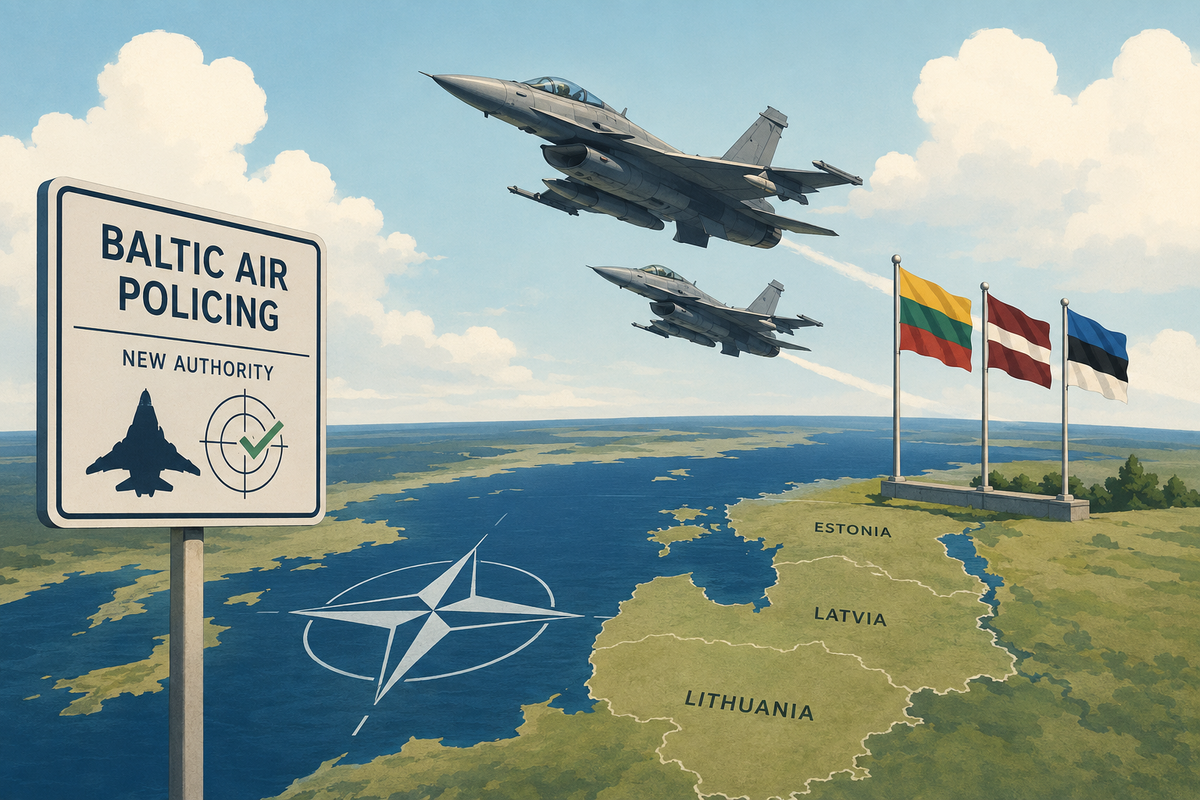
Following the summit, NATO upgraded its Baltic Air Policing mission over Lithuania, Latvia and Estonia — a posture in place since 2004 — giving pilots broader authority to shoot down objects assessed as threats, rather than simply escorting and identifying them. Lithuanian President Gitanas Nausėda explained the logic: the previous format was built for peacetime, when fighters respond to incidents purely by escort — but, in his words, what's happening today is "not a totally peaceful environment." Estonian Foreign Minister Margus Tsahkna described the upgraded mission as offering "greater flexibility and faster response to air threats."
The decision rests on this year's track record: mission fighters opened fire in defence of the alliance for the first time ever, downing suspected stray Ukrainian drones over Estonia (May 19, a Romanian F-16 over Lake Võrtsjärv) and over Latvia (June 8, a French Rafale over Berzgale). Both incidents are attributed by Baltic governments and Kyiv to Russian electronic warfare knocking Ukrainian strike drones bound for Russian targets off course into NATO airspace.
BSM analysis: This is the week's most consequential development for BSM's coverage area — an actual change in the rules of engagement over the skies of three Baltic states, decided at the alliance's highest political level. Its absence from today's OSINT top five is a clean illustration of why the Border/Air/Maritime sub-index has climbed for three straight days without any visible explanation in the digest: the causal event happened at the summit itself, not in the daily stream of source publications the system indexes.
Regional context: after Ankara
The summit closed on July 8 with a package of decisions carrying a direct regional dimension. The alliance announced €27 billion in investment to modernise fuel storage and distribution infrastructure, including new pipeline capacity extending to the eastern part of the alliance. This is the first plausible link to today's Logistics sub-index uptick (0.07): while no single event on the topic made the top five, the reading tracks with a broader infrastructure decision made just days earlier.
On the bilateral track, Ukrainian President Volodymyr Zelensky announced new drone agreements with Estonia, the Netherlands and Denmark, with further deals expected with Germany, Norway, Finland and Canada. The alliance also confirmed a €70 billion support package for Ukraine in 2026, with a commitment to sustain at least the same level in 2027 — at least €140 billion combined over the two years.
Conclusion
For a third straight day, the digest's top five stays structurally tilted toward the Mediterranean and administrative NATO ISR initiatives, while the sub-index most relevant to BSM's coverage area keeps climbing. The cause isn't in the digest at all — it's in a decision made at the Ankara summit: the skies over the Baltic states now operate under new rules of engagement. The index sees administration. The sky over three countries has actually changed.
Baltic Security Monitor (osint-baltic.com) — an analytical publication covering security on NATO's northeastern flank. All OSINT coefficients are calculated by an automated indexing system based on open sources.