Canada Formally Applies to Join the UK-Led Joint Expeditionary Force: A Northern European Military Format Gets a Direct Transatlantic Dimension

Baltic Security Monitor | Analytical Briefing Event: 16 September 2026 · Published: 17 September 2026
Tellingly, this decision reverses a position more than a decade old: back in 2014, when the JEF concept was first discussed at NATO's Wales summit, the government of then-Prime Minister Stephen Harper declined to join — Canada's military was undergoing budget cuts at the time, and the armed forces leadership worried that membership without a specific mission would mean committing to respond to future crises in a way Ottawa itself might not get to choose. Twelve years later, Canada is applying on its own initiative — and not with empty hands: Canadian forces already lead a NATO multinational brigade in Latvia.
What happened
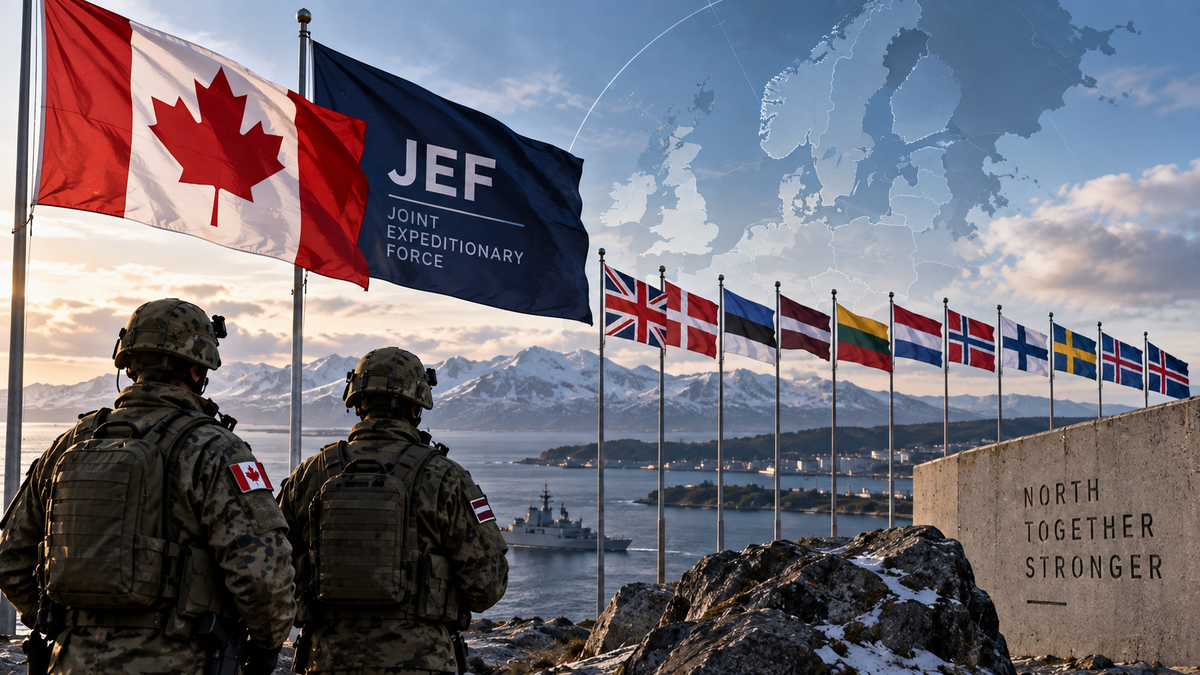
On 16 September, Canadian Prime Minister Mark Carney, meeting with UK Prime Minister Andy Burnham in Liverpool, announced that Canada has formally applied to join the UK-led Joint Expeditionary Force (JEF) — a rapid-response military partnership whose ten current members are the UK, Denmark, Estonia, Iceland, Latvia, Lithuania, the Netherlands, Norway, Finland and Sweden. According to Carney's office, London supports Canadian participation. The Canadian PM's office reiterated the decision on 17 September.
Canada had already participated as a special invitee at a JEF leaders' meeting in March, alongside Baltic and Nordic members. That meeting was hosted by Finnish President Alexander Stubb, with discussion focused on the Arctic — giving Carney a chance to highlight Canada's own Arctic-security agenda and its substantial increase in defence spending: in March, Canada hit NATO's 2% of GDP threshold for the first time.
BSM analysis: The formal application marks a shift from guest participation and cooperation with JEF members to a formal accession process. The Canadian PM's office says explicitly that the goal is to reinforce military interoperability and collective security. That distinction matters because JEF isn't a generic diplomatic grouping — it's a military framework built around rapid-deployment forces and cooperation in Northern Europe and the North Atlantic, with membership heavily concentrated in the Nordic-Baltic region. A formal application doesn't yet mean membership: existing participants still need to complete the accession process, and no membership date has been announced.
What's still uncertain
🟡 If admitted, Canada could theoretically become an important transatlantic bridge between JEF operations in the Nordic-Baltic theater and North American Arctic defense — but its precise operational role hasn't been publicly defined. Carney's statement didn't specify how Canadian participation would work in practice.
Tellingly, similar reservations were raised back in 2014 by then-commander of Canada's joint operations command, Lieutenant-General Jonathan Vance (later Chief of the Defence Staff): membership without a specific mission means a commitment the country might not always be able to honor on the terms the format would require.
Regional context
For the Baltic states, the key feature is the overlap between Canada's existing military footprint and JEF's geography. Ottawa isn't entering Northern European security from the outside: Canadian forces already constitute a major part of NATO's forward defense posture in Latvia. JEF membership would give Canada another mechanism for planning, exercising and potentially responding alongside the UK, Nordic and Baltic states — and would add a significant North American Arctic actor to a framework increasingly focused on the interconnected security of the Baltic Sea, the High North and the North Atlantic.
The decision also fits a broader Canadian shift toward European defense structures. Ottawa has already joined the EU's SAFE defence-financing framework and is an observer in the UK-Italy-Japan Global Combat Air Programme (GCAP), which it joined in July. During the same meeting, Carney and Burnham also discussed further GCAP industrial cooperation, as well as modernizing the British Army Training Unit Suffield (BATUS) in Alberta under the BATUS Future Project.
For Ukraine, the direct effect is indirect: JEF members are among Kyiv's most active military supporters, and the format provides a flexible mechanism that can operate alongside NATO structures. Deeper Canadian integration therefore deepens the Northern European security architecture supporting NATO's eastern flank.
Bottom line
The most immediate next step is likely to be consultations among existing JEF members over Canadian accession and the practical arrangements governing its participation. The next significant marker to watch will be formal acceptance of Canada's application, a defined accession timetable, or the assignment of Canadian forces and capabilities to JEF planning.
Baltic Security Monitor (osint-baltic.com) — an analytical outlet covering security on NATO's northeastern flank. Compiled from open sources and BSM's automated OSINT monitoring system.