Britain Opens SCALP's Classified Data to Ukraine: Local Long-Range Missile Production Moves From License to Engineering

Baltic Security Monitor | Material Update Published: 24 August 2026, 14:00
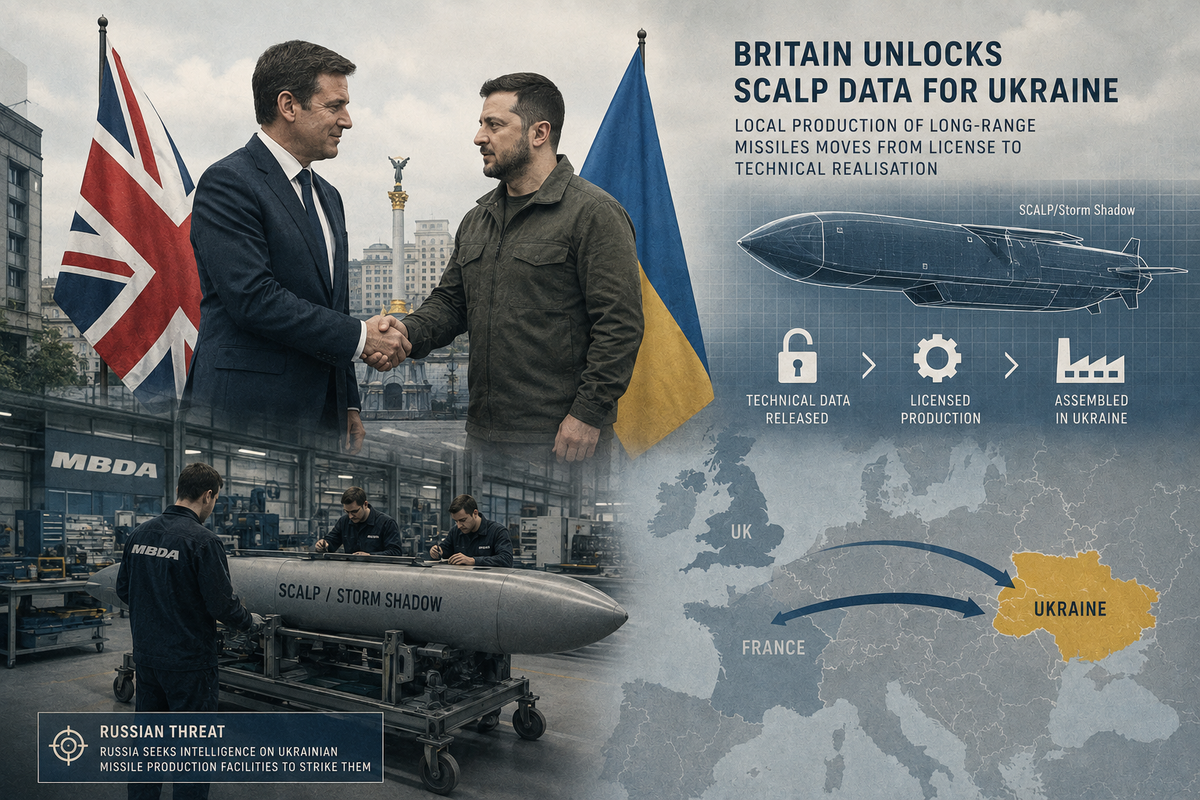
Britain has done what the French license alone could not: declassified the UK-origin component data without which assembly in Ukraine was legally impossible. This is not another gesture of solidarity timed to Independence Day — it's a concrete export-control decision that removes a technical barrier and moves the programme from political agreement to industrial implementation. The Kremlin answered with a direct threat: Russia is seeking intelligence on Ukrainian missile-production sites in order to strike them.
What happened
On 24 August, during a visit to Kyiv by UK Prime Minister Andy Burnham — his first overseas trip in office, timed to Ukraine's 35th Independence Day — the British government announced it had authorised MBDA to release classified information on British-made components used in the long-range SCALP cruise missile. The decision is specifically what allows France and Ukraine to move forward with practical arrangements for establishing assembly lines inside Ukraine itself.
This builds directly on the 14 July France–Ukraine agreement, under which Paris authorised licensed SCALP production in Ukraine before the end of 2026. That earlier agreement established the political and industrial framework; the British decision now removes the technical barrier tied to UK-origin components in a missile Britain and France developed jointly. SCALP is the French version of the British Storm Shadow; both systems share British and French technology. Notably, MBDA had already reactivated assembly lines that had sat idle for 15 years back in 2025 — this decision builds on an existing production ramp-up rather than starting one from zero.
"Ukraine's security is our security," Burnham said, adding that Britain would stand by Ukraine "for as long as it takes." CNN's assessment is that even with this decision, scaling up production could still take several years.
The Kremlin reacted publicly the same day, saying the British move would "add fuel to the fire" and stating that Russia is seeking intelligence on Ukrainian missile-production sites specifically in order to strike them. The threat to production infrastructure is explicit, though no new Russian strike tied specifically to today's decision has yet been identified. Worth noting the context: a week earlier, Moscow had already warned London of "consequences" over drone supplies to Kyiv, following reports that British-made drones had been used for long-range strikes against Russia for the first time — so today's statement fits an escalating pattern of British-Russian friction rather than standing alone.
BSM analysis: The key distinction from July's French agreement is the shift from "authorised to produce" to "technically able to produce." Ukraine already had French approval for licensed SCALP production, but the missile contains British-origin components and know-how that couldn't simply be transferred under the French agreement alone. Today's decision isn't another declaration of intent — it's a concrete technology-transfer and classified-information decision that enables previously announced licensed production to actually happen.
Why it matters for Ukraine and the Baltic region
For Ukraine, local SCALP production would reduce dependence on finite French and British inventories of Storm Shadow/SCALP-class weapons and give Kyiv a more sustainable source of precision long-range strike capability.
The decision also marks a deeper form of European defence-industrial integration. Britain and France are no longer only transferring finished cruise missiles — they are progressively transferring the licenses, technical information and manufacturing capability Ukraine needs to produce Western-designed long-range weapons domestically.
For the Baltic region, the broader significance is industrial rather than geographic — and it already has a concrete, on-the-ground counterpart. The same strategy of moving production closer to the eastern flank and integrating battlefield experience with European defence manufacturing is already shaping the Baltic states' own artillery, drone and missile programmes. Lithuania and Latvia have gone the route of directly courting Rheinmetall: a 155mm shell plant under construction in Baisogala, Lithuania since November 2025 is targeting up to 100,000 shells a year, while Latvia's €275 million agreement for a mirror-image plant is slated for 2027 production. Estonia has instead chosen an open tender rather than a direct Rheinmetall deal, while separately arranging a local Lockheed Martin service centre for its HIMARS systems. Together, the three Baltic states are preparing to spend roughly €12.2 billion from the EU's SAFE programme, explicitly insisting on technology transfer over off-the-shelf purchases.
BSM analysis: Britain's SCALP decision and the Baltic "ammunition belt" being built by Rheinmetall are the same strategic move under different names — moving Western defence production closer to the line of contact with Russia, transferring not just finished weapons but the manufacturing technology itself. Ukraine gets this through combat experience and urgency; the Baltics get it through geographic proximity to the threat. Both trends are collapsing what, a few years ago, were treated as purely national production chains.
Likely implications
Ukraine and MBDA can now move into more detailed engineering, certification and supply-chain work required for SCALP assembly before the end of 2026. 🟡
Local production is unlikely to make Ukraine immediately independent of European supply chains, since key components, explosives, propulsion systems and guidance electronics will still depend on controlled inputs and production capacity outside Ukraine. 🟡
Russia is likely to place greater intelligence and strike priority on facilities associated with SCALP, Aster and other licensed Western weapons production in Ukraine. 🟡
The British step may also encourage further selective release of controlled European defence technology where existing licensing agreements are currently limited by the multinational ownership of individual components. 🟡
Bottom line
This decision matters not as a symbolic gesture timed to Independence Day, but as the concrete technical step that clears the last legal barrier to Ukrainian SCALP production. The same underlying logic — move production closer to the threat rather than rely solely on outside supply — is already materialising in the Baltic states' own Rheinmetall shell plants. The only difference is who is building the production line under their own sky.
Baltic Security Monitor (osint-baltic.com) — an analytical outlet covering security on NATO's northeastern flank. This report draws on an automated monitoring digest cross-checked against independent open sources.