Britain Gains Access to Avengers Battlefield Data: UK and Ukraine Turn Frontline AI Into a Shared Military Platform

Baltic Security Monitor | Material Update Published: 25 August 2026, 08:00
Britain and Ukraine have signed a defence AI partnership giving British researchers access to Avengers AI Labs — five million annotated battlefield images collected by thousands of daylight and infrared sensors on the front line. This is already the third major UK-Ukraine defence-industrial signal in a week, following the SCALP declassification and the EU's €6.1 billion approval. But the phrase "first foreign access" deserves a closer read: Germany signed a comparable battlefield-data agreement back in April.
What happened
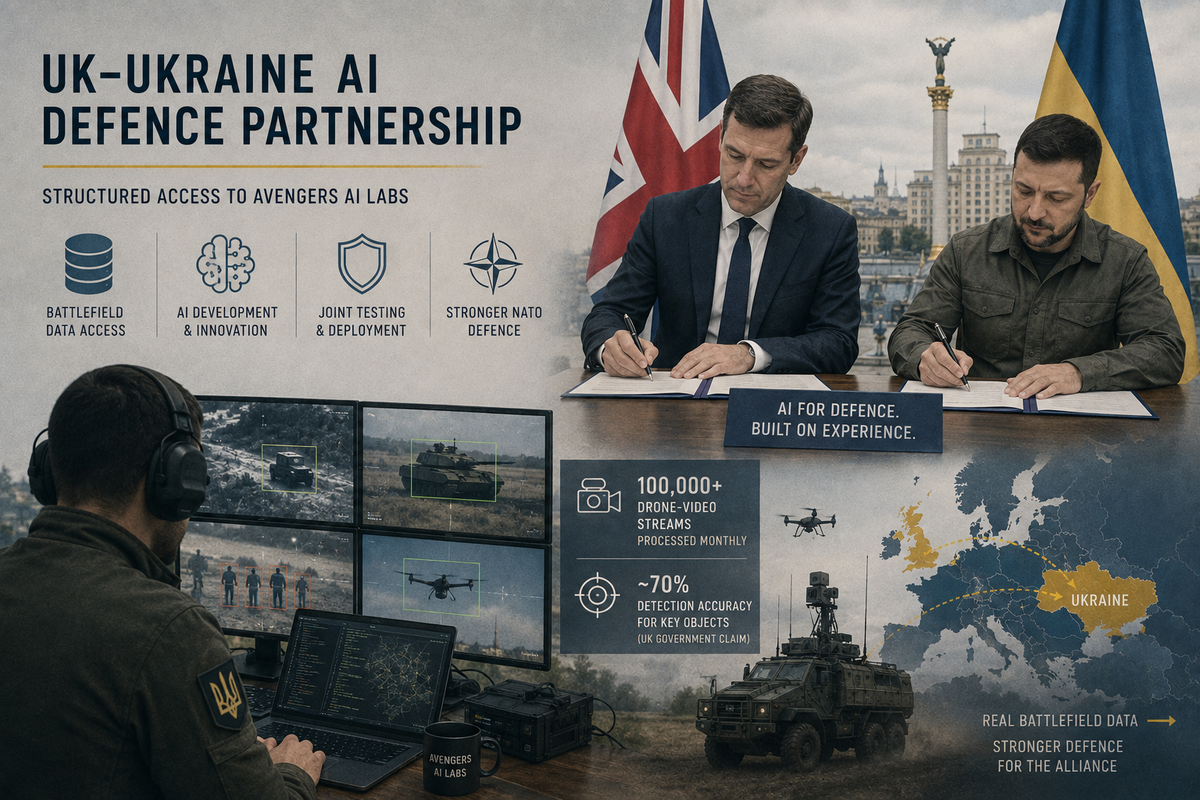
On 24 August in Kyiv, UK Prime Minister Andy Burnham and Ukrainian President Volodymyr Zelensky signed a new defence artificial-intelligence partnership. According to the official UK announcement, Britain becomes the first international partner to gain access to Avengers AI Labs — a platform built on real combat data collected by thousands of daylight cameras and infrared sensors across the battlefield. The UK government says the underlying corpus includes roughly 5 million annotated battlefield images; Reuters independently confirmed the agreement and its military-development purpose. The dataset is largely drawn from DELTA, Ukraine's domestically developed battlefield-management and situational-awareness system.
The partnership goes beyond simple data-sharing. Its formal declaration establishes government-to-government cooperation on AI models, secure data and computing pathways, industry programmes to develop, test and deploy AI-enabled capabilities, and academic cooperation on autonomy, cybersecurity, AI assurance and synthetic data. The agreement explicitly adopts a pilot-first implementation model, with further arrangements expected within months.
Implementation is already under way: one British-Ukrainian pilot uses fibre-optic cables as distributed AI sensors for detecting activity around military facilities, while another explores low-power AI chips for drones, robotics and autonomous platforms — with three British startups involved. Ukraine's Defence Ministry says AI models trained on this data are already powering an automated target-detection system that analyses more than 100,000 drone video feeds monthly and identifies roughly 70% of enemy targets in real time — though public materials do not disclose how that figure was validated.
BSM analysis: The "first foreign partner with access" framing needs a qualifier. In April 2026, Germany already signed a first-of-its-kind memorandum with Ukraine on exchanging battlefield data, which then-Defence Minister Mykhailo Fedorov called "the biggest project of this scale in the world" for defence AI development — Berlin got access to DELTA and related systems at that point. The British agreement is most plausibly the first covering the specifically named Avengers AI Labs platform — evidently a distinct, more advanced layer sitting on top of the raw DELTA data — rather than the first instance of any foreign partner accessing Ukrainian battlefield data at all. That doesn't diminish the materiality of the UK deal, but it's the nuance worth preserving: "first access to Avengers" is a narrower and more accurate claim than "first foreign access to Ukraine's battlefield data."
Why it matters for Ukraine and the Baltic region
Ukraine possesses an unusually large real-world dataset on drones, Shahed interception, artillery, armour, air defence, reconnaissance and target classification under electronic-warfare conditions. Turning that data into a shared development resource can shorten the cycle from battlefield observation to model training, hardware integration and operational deployment.
The implications extend directly to NATO's north-eastern flank. Estonia, Latvia, Lithuania, Poland and the Nordic states are investing heavily in counter-UAS systems, autonomous platforms and critical-infrastructure protection while facing many of the same problems visible in Ukraine: inexpensive mass drones, difficult target classification, electronic interference, and the need for low-cost sensors and effectors.
The partnership is another step toward institutionalising the transfer of Ukrainian wartime innovation into NATO defence capability, rather than waiting for lessons to be absorbed after the war ends. The declaration explicitly allows jointly developed outputs to be extended to trusted allies and partners by mutual agreement — creating a pathway from Ukrainian combat data into wider allied capability development, potentially including the Baltic states.
BSM analysis: Some critical distance on the performance figures is warranted. Human Rights Watch and evidence given to the UK Parliament flag unresolved risks — dataset quality, automation bias, opaque model behaviour. The claimed 70% real-time target-identification accuracy is a Ukrainian Defence Ministry figure without a disclosed validation methodology, not an independently verified metric. For BSM, that means the partnership is worth attention as an industrial and geopolitical signal, while conclusions about the actual combat performance of these models remain premature.
Likely implications
The first practical effect is likely to be faster development and testing of AI-enabled reconnaissance, target-recognition, perimeter-security and autonomous-system technologies using real Ukrainian combat datasets. 🟡
If the initial projects succeed, jointly trained models or derived technologies could be offered to other trusted NATO partners under the declaration's interoperability provisions, turning Ukrainian battlefield data into an input for wider European force modernisation. 🟡
British and Ukrainian companies may increasingly design systems simultaneously for Ukrainian wartime requirements and future NATO procurement, narrowing the gap between Ukraine's rapid battlefield-development cycle and conventional European defence acquisition. 🟡
Access will nevertheless remain controlled: the declaration specifically preserves national ownership of data and intellectual property and subjects cooperation to security, export-control and legal restrictions. It is a declaration of political intent rather than a legally binding treaty. 🟡
Bottom line
This is already the third major UK-Ukraine defence-industrial signal in under a week — after SCALP and the EU's €6.1 billion. But the "first" in the headline deserves a caveat: Germany already secured comparable access to Ukraine's battlefield data back in April. The real story isn't that Ukraine shared data with a foreign partner for the first time — it's that battlefield-data exchange is becoming a standard, repeatable form of allied cooperation, and Britain has just secured its own, most advanced version of that access.
Baltic Security Monitor (osint-baltic.com) — an analytical outlet covering security on NATO's northeastern flank. This report draws on an automated monitoring digest cross-checked against independent open sources.